In a landmark judgment that brings to a close one of the most politically sensitive terror cases in the country, a special NIA court in Mumbai on Thursday acquitted all seven accused in the 2008 Malegaon blast case, including BJP MP Pragya Singh Thakur and Lt Col Prasad Purohit. The court said the prosecution failed to establish the case beyond reasonable doubt.
The 2008 blast in Maharashtra’s Malegaon town had killed six people and left over 100 injured. It was one of the earliest cases where the term “saffron terror” was controversially invoked, triggering a decade-and-a-half of legal wrangling, political rhetoric, and communal debate.
“My Life Is Ruined”: Sadhvi Pragya Breaks Down in Court
Moments after the acquittal, Sadhvi Pragya Singh Thakur broke into tears inside the courtroom, addressing Judge A P Lahoti directly. “I was living a sage’s life. I was dragged, humiliated, tortured. They ruined my whole life,” she said, her voice trembling with emotion. “They defamed Bhagwa through a conspiracy. But today, Bhagwa has won, Hindutva has won.”
Thakur also added that her survival through these years was only because of her spiritual discipline as a Sanyasi. “No one stood by us. No one wanted to believe we were innocent. But truth has a strange way of finding its day.”
Political Reactions: A Divided Verdict Beyond the Courtroom
The judgment triggered sharp and polarised responses across the political spectrum. Shiv Sena MP Naresh Mhaske welcomed the verdict with sharp criticism of the Congress, calling the previous investigation “fabricated.”
“The truth has won. The Congress used this case to plant the idea of Hindu terror in people’s minds. That lie stands exposed today,” he told ANI.
Congress veteran Sushil Kumar Shinde, who once used the term “saffron terror” during his tenure as Union Home Minister, declined to comment. But fellow Congress leader Kamal Nath struck a more reconciliatory tone:
“It’s a court verdict. It must be accepted. Why are we discussing this further?”
“A Shoddy Investigation”: Owaisi Slams Acquittal
Not everyone accepted the verdict as the end of the road. AIMIM chief Asaduddin Owaisi expressed deep disappointment, claiming the acquittals were the result of a compromised investigation.
“Six namazis were killed, and nearly 100 injured. They were targeted because of their religion. The investigation was shoddy. Justice has been denied,” he posted on X (formerly Twitter).
The Case: From Motorcycle Bomb to Years of Legal Fog
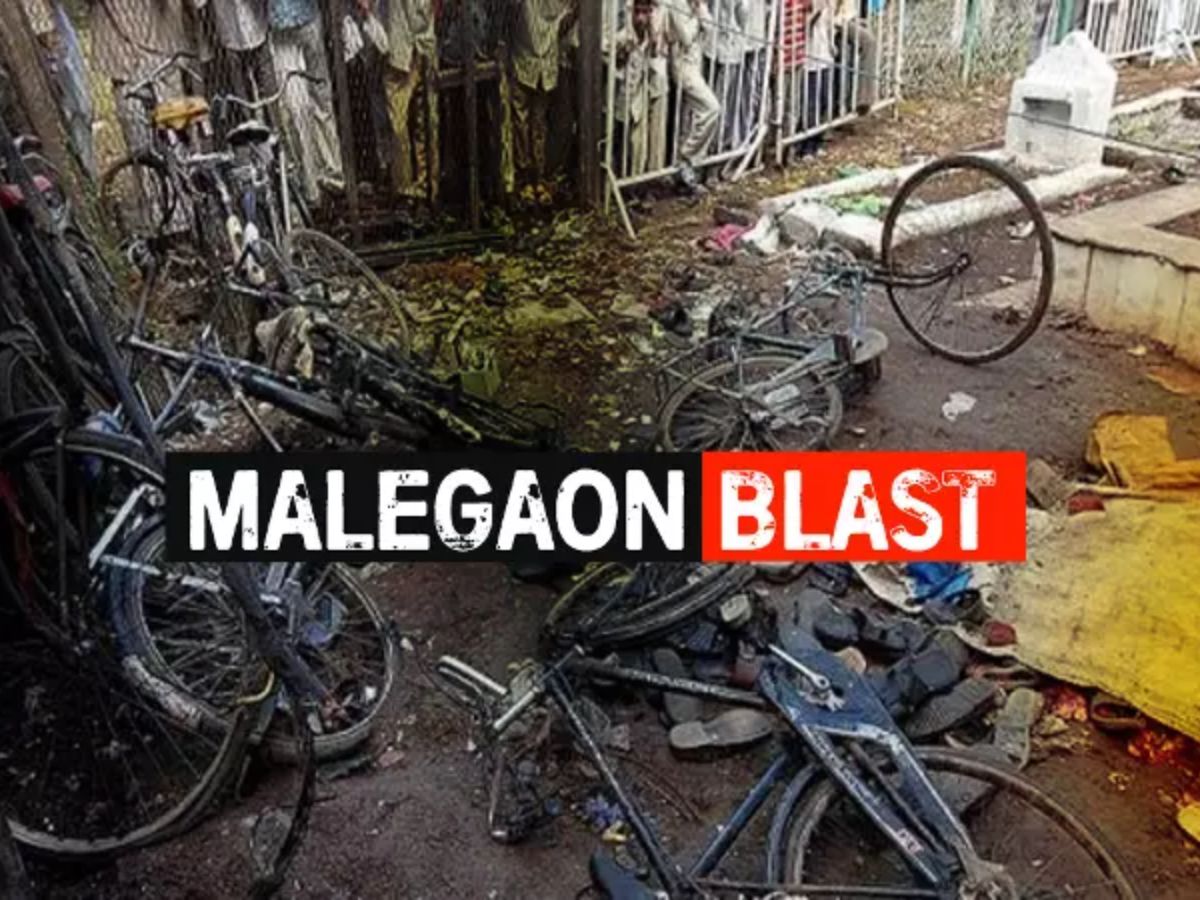
On September 29, 2008, a bomb attached to a motorcycle exploded near Bhikku Chowk in Malegaon, a town with a sizable Muslim population. The blast killed six and injured 95 (the number was revised from 101 after discrepancies were found in medical certificates).
Originally, 11 people were named as accused, but charges were ultimately framed against seven, Pragya Singh Thakur, Lt Col Prasad Purohit, Ramesh Upadhyay, Sudhakar Chaturvedi, Ajay Rahirkar, Sudhakar Dwivedi (aka Shankaracharya), and Sameer Kulkarni.
The case was first investigated by the Maharashtra Anti-Terrorism Squad (ATS), which claimed the accused had ties to radical Hindu outfits. In 2011, the probe was handed over to the National Investigation Agency (NIA).
NIA’s Final Stand vs. Court’s Doubt
The NIA claimed it had presented a cogent, admissible chain of evidence linking the accused to the bomb plot. It said the act was designed to instil fear among Muslims and destabilise communal harmony. However, Judge A P Lahoti ruled that the agency failed to prove this beyond reasonable doubt. In a scathing observation, the court noted that:
“Prosecution proved that a blast occurred, but failed to prove that the bomb was placed in the said motorcycle.” It also flagged manipulation in some medical certificates presented as evidence, bringing the number of recognised injured down from 101 to 95.
What the Acquittal Means: Justice or Injustice?
While the courtroom battle may be over, the Malegaon blast case has opened deeper societal fault lines, questions about investigative integrity, political narratives, and communal biases remain unresolved.
For some, this is a long-overdue vindication. For others, it’s an unsettling reminder of justice delayed, and possibly, justice denied.