
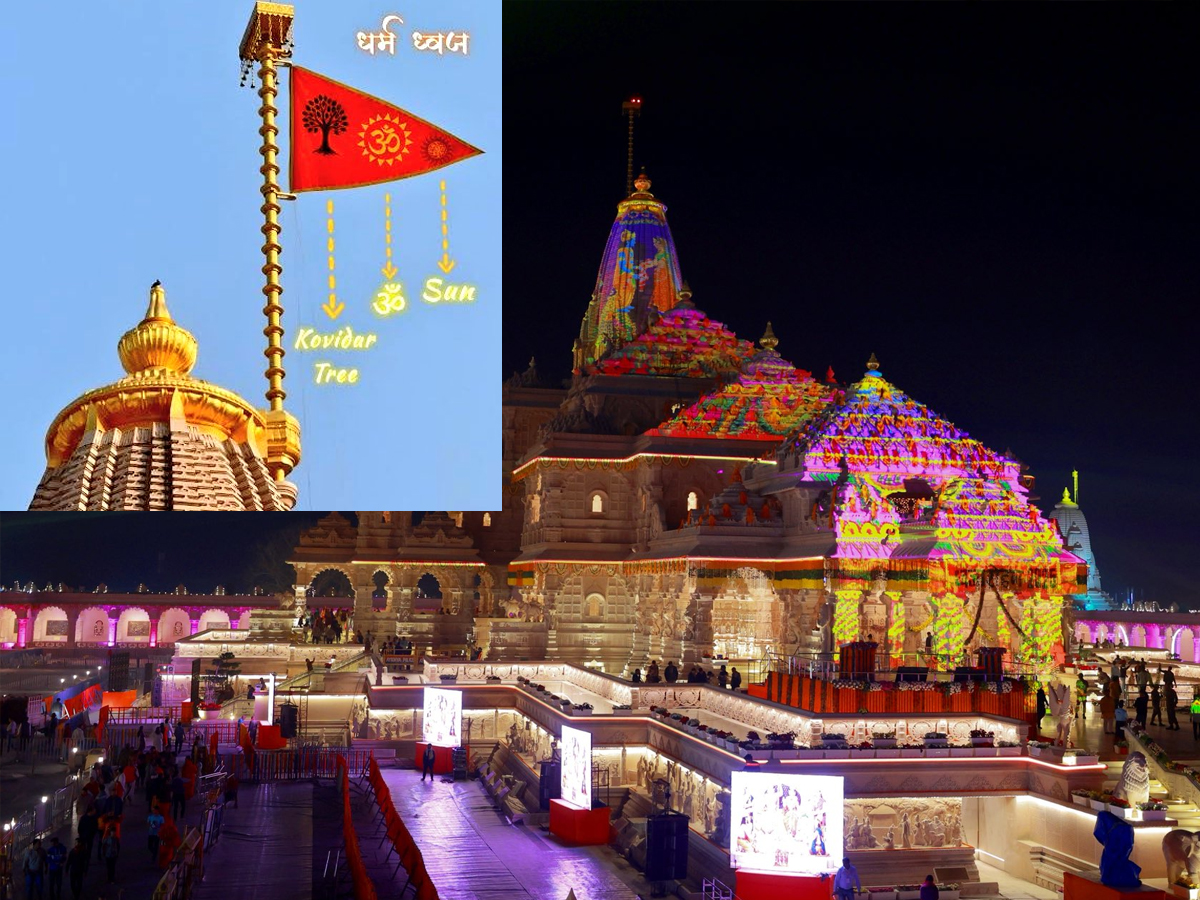
Ayodhya is preparing for a historic moment as a forgotten symbol of its ancient heritage returns to the city after thousands of years. An old flag, which was once believed to represent Ayodhya during the era of Lord Ram, will be raised at the Ram Mandir during the ceremony marking the completion of its main construction. What makes this flag extraordinary is not just its age, but the fact that it had vanished from memory, scriptures, and tradition for centuries. Its rediscovery has opened a fresh chapter in India’s cultural narrative.
Indologist Lalit Mishra is credited with bringing the flag back to public consciousness. His accidental discovery has now turned into a moment of national attention, as Ayodhya prepares to welcome a symbol that faded from history long ago.
Ram Mandir Flag Hositing: A Forgotten Symbol Finds Its Way Back
Indologist Lalit Mishra says he identified the flag while studying a painting from the pictorial Ramayana of Mewar. He later traced its mention in the Ayodhya Kand of the Valmiki Ramayana, confirming that Ayodhya once used a flag adorned with three ancient symbols, which were the Sun and the Kovidara tree.
The flag will be hoisted on November 25 at the Shri Ram Janmabhoomi Temple in the presence of Prime Minister Narendra Modi and RSS Sarsanghchalak Mohan Bhagwat.
The ceremony marks a powerful moment as the return of a symbol that went missing after the Mahabharata era. Mishra says the rediscovery restores a link that was broken for thousands of years.
Ram Mandir Flag Symbols: Three Ancient Symbols Explained
The three symbols on the restored flag carry layers of cultural and spiritual meaning.
- Om represents the eternal spiritual sound and the foundation of Hindu philosophy.
- The Sun symbolizes Lord Ram’s Suryavansh lineage.
- The Kovidara tree is the most intriguing element, a hybrid of the Mandar and Parijat trees, believed to have been created by Rishi Kashyap.
According to Mishra, this hybrid tree reflects early experiments in plant breeding in ancient India. The rare botanical identity of the Kovidara even was confused among experts until botanists from Banaras Hindu University helped confirm it.
Why the Flag Disappeared for Centuries
Mishra says the historical rupture began after the Mahabharata war. Ayodhya’s king, Brihadbal, died in the battle, leading to a long period of decline and abandonment.
Mishra explains, “What happened in the Mahabharata war, Ayodhya’s king Brihadbal participated. And from the Mahabharata, we know that he was killed. So after he was killed, Ayodhya was ruined and forsaken. And I think by that time, because it was ruined, the tradition had lost the memory of the flag and the tree also.”
The break in tradition meant later versions of the Ramayana, almost 299 of them, did not preserve any mention of this symbol.
Mishra adds that even poet Kalidasa admired the beauty of the Kovidara flower, but did not link it to Ayodhya’s flag because the cultural memory had already disappeared.
Rediscovery of Ram Mandir Flag Rooted in Scholarship and Chance
Mishra describes his discovery as unexpected, “This flag was discovered unintentionally… I saw Ayodhya’s flag in one of the paintings of the pictorial Ramayana of Mewar… I found the reference to this flag in Valmiki Ramayana’s Ayodhya Kand…”
However, recognising the tree was not easy. “I had difficulty identifying the Kovidar and Kachnar trees, as both had the same botanical name,” he said.
Support from BHU botanists Prof Gyaneshwar Chaube and Prof Abhishek Dwivedi helped settle the debate. Their study confirmed that Kovidara and Kachnar were not the same.
Mishra says this rediscovery could reshape how ancient Indian scientific knowledge is viewed.
“We propose that the government get a genetic study done,” he said, arguing that the findings may highlight India’s early understanding of plant science.
A Symbol Returns to Its Home
For Mishra, the emotional significance is profound, “So this is how the flag has returned to Ayodhya, where it originated. In a long tradition of many thousands of years, we lost it… So now I am very happy that it has been discovered and it has found its place.”
As Ayodhya prepares to raise the flag atop the Ram Mandir, it is not just a ceremonial act. It represents the restoration of a lost cultural memory, the revival of a symbol rooted in mythology and history, and the reclaiming of a heritage that once defined an ancient city.
Some basic questions about the Ram Mandir Flag Hoisting on 25th November 2025
Dimensions of the Ram Temple Flag
The saffron flag created for the Ram Temple measures 22 feet in length and 11 feet in width. Its large size ensures visibility from far across the temple complex. The dimensions also follow traditional proportions seen in ancient depictions of Ayodhya’s royal standards.
Who Made This Flag?
The flag has been crafted by an Ahmedabad-based parachute-fabric company known for producing durable, weather-resistant textiles. The team used specialised fabric normally used in high-altitude and defence-grade applications. The makers designed the flag keeping in mind longevity and its sacred cultural symbolism.
How Much Will the Flag Cost?
The exact price of the flag has not been publicly disclosed by temple authorities. Given its specialised fabric, hand-crafted symbols, and custom design, it is expected to be a high-value ceremonial object. The focus, however, remains on its cultural significance rather than its monetary cost.
The Flagpole Is Made of Which Material?
The flag will be hoisted on a pole made of solid brass, a metal traditionally associated with purity, longevity, and ceremonial use. Brass also withstands harsh weather, making it suitable for long-term installation. The pole’s craftsmanship reflects temple architecture standards.
What Is the Height of the Flag and Flagpole?
The brass flagpole rises 42 feet high, giving it a commanding presence within the temple premises. It stands atop the 161-foot shikhar, allowing the flag to be seen from a significant distance. Together, the elevation ensures the flag becomes a new visual symbol of Ayodhya’s skyline.