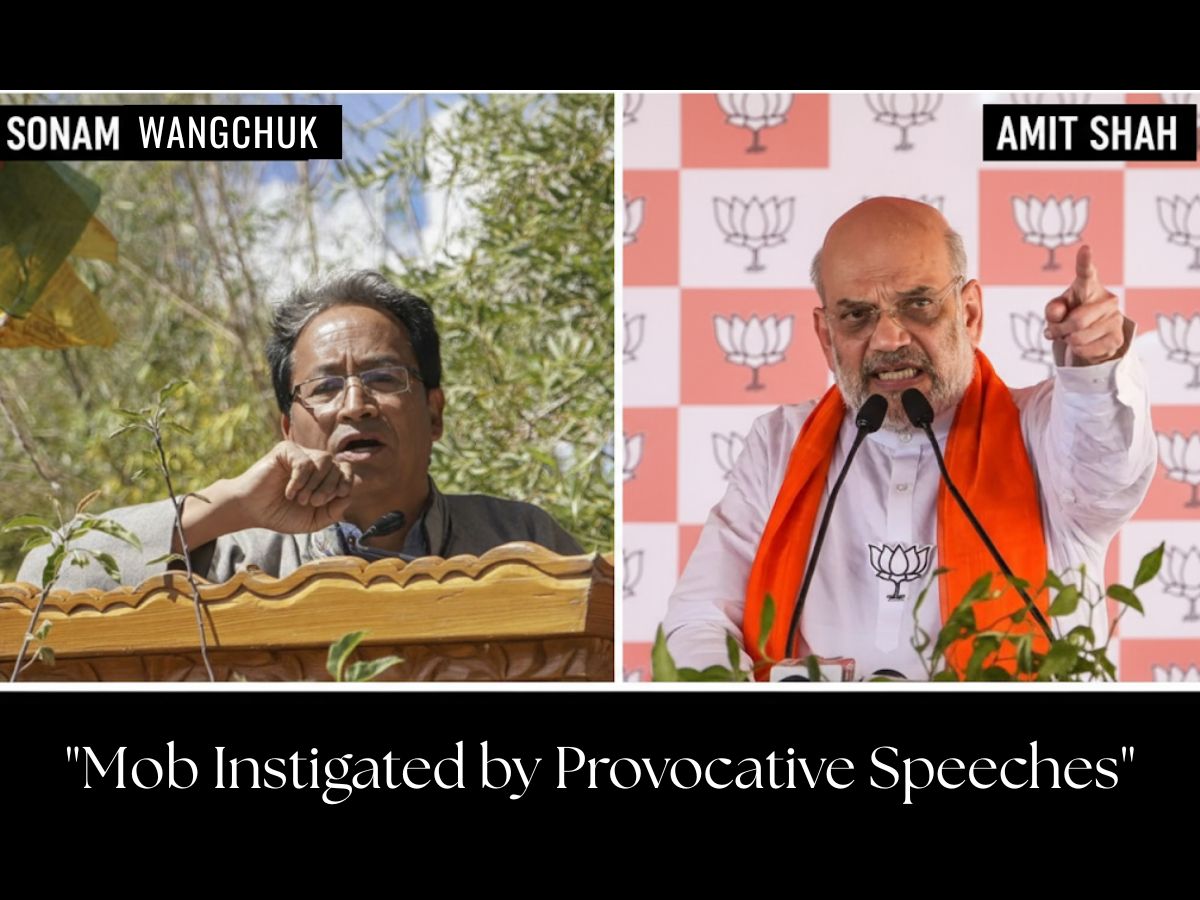
What began as unrest in Ladakh has now worsened. The Home Ministry has pointed the finger at Sonam Wangchuk, the Magsaysay Award-winning activist, blaming him for violent Leh protests that claimed several lives. The government’s late-night statement accused Wangchuk of “misleading the people” with provocative references, as the peaceful movement for statehood and constitutional safeguards descended into fatal clashes between protestors and security forces.
What is the Government’s Core Accusation Against Wangchuk?
The central government’s statement, released after 10 PM on Wednesday, places the blame for the violence squarely on Sonam Wangchuk. The MHA alleged that a mob was “instigated by [his] provocative speeches.” It specifically cited his “provocative mention of Arab Spring-style protest and references to Gen Z protests in Nepal” as actions that misled people. The government claims that after his speech around 11:30 AM on September 24, a mob left the hunger strike venue and attacked a political party office, understood to be the BJP, and government buildings, setting them on fire.
How Did the Protests Turn Violent and What Was the Toll?
According to the MHA’s account, the situation rapidly deteriorated from a planned demonstration. More than 30 police and CRPF officers were reportedly hurt as the mob attacked security guards and set a police car on fire. The statement said that in “self-defence, police had to resort to firing in which unfortunately some casualties are reported.” While the official statement did not confirm a number, news agencies reported four to five fatalities. The MHA stated that the situation was brought under control by 4 PM on the same day.
Also Read: What Triggered Gen Z Protests in Ladakh? Key Factors Behind the Unrest
Was the Government in Talks with Ladakhi Leaders Before the Violence?
Yes, the MHA emphasized that dialogue was actively ongoing. It stated that the government has been “actively engaged” with the Apex Body Leh and Kargil Democratic Alliance regarding the demands for statehood and inclusion under the Sixth Schedule. It highlighted that a series of formal and informal meetings had yielded “phenomenal” results, including increasing job reservations for Ladakhi Scheduled Tribes from 45% to 84%, providing one-third reservation for women in hill councils, and declaring Bhoti and Purgi as official languages. The next meeting of the High-Powered Committee was scheduled for October 6.
Why Were Protest Leaders Unhappy Despite the Talks?
Despite the government’s portrayal of progress, Ladakhi leaders expressed significant dissatisfaction. The youth wing of the Leh Apex Body had called for the demonstration on September 25, partly due to discontent with the MHA unilaterally setting October 6 as the next meeting date. Sonam Wangchuk himself had stated that the date was too far away, especially while people were already on hunger strike. The leaders felt the pace of negotiations was too slow on their core constitutional demands, leading to growing public frustration that appears to have boiled over.
Also Read: Government Retains Top Military Advisor, Extends General Anil Chauhan’s Term as CDS till 2026
What is Wangchuk’s Position in This Crisis?
Sonam Wangchuk, who began a hunger strike on September 10, is the most visible face of the movement. The MHA statement took a pointed dig at his actions during the violence, noting that “amidst these violent developments, he broke his fast and left for his village in an ambulance without making serious efforts to control the situation.” Wangchuk had earlier in the afternoon condemned the violence and announced an end to his hunger strike “in disgust,” but had not yet responded to the MHA’s specific allegations against him as of the statement’s release.
Disclaimer: This information is based on inputs from news agency reports. TDG does not independently confirm the information provided by the relevant sources.