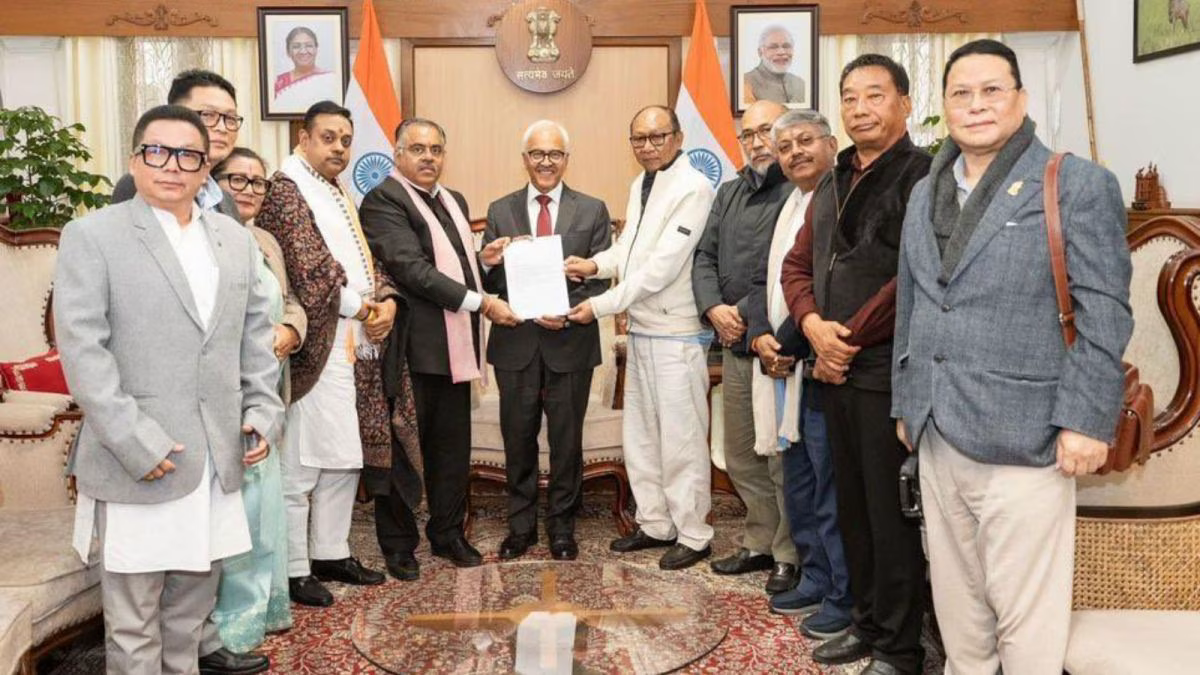
Manipur: After nearly a year under President’s Rule, Manipur on February 4 returned to elected governance with the formation of a new BJP-led NDA government. President’s Rule, which was imposed on February 13, 2025 following the resignation of then chief minister N. Biren Singh amid rising ethnic violence was officially revoked earlier in the day.
Senior BJP leader Yumnam Khemchand Singh was elected leader of the BJP legislature party on February 3 and took oath as the new chief minister at the Raj Bhavan in Imphal. Singh, 62, is a two-time MLA from Singjamei constituency in Imphal West and is seen within the party as a leader capable of engaging across communities at a difficult time for the state.
The new government has been structured to give representation to Manipur’s major ethnic groups. Two deputy chief ministers have been appointed: Nemcha Kipgen, representing the Kuki-Zo community and Losii Dikho, representing the Naga community. Senior BJP leader Govindas Konthoujam, a seven-time MLA from Bishnupur has been given charge of the crucial Home Department, placing him in charge of law and order at a sensitive time.
The inclusive political arrangement comes as Manipur continues to recover from ethnic violence that erupted in May 2023, primarily between Meitei and Kuki-Zo communities. The conflict has claimed more than 260 lives and displaced over 60,000 people. Large parts of the state remain divided, with security forces manning buffer zones separating Meitei-dominated valley areas from Kuki-Zo hill districts. Economic activity and daily life have been severely affected, and peace remains fragile.
Recent incidents, including attacks on government assessment teams and tensions involving Kuki and Naga groups in certain areas have highlighted the challenges before the new administration. The government’s tenure will run until 2027 giving it a limited window to restore normalcy, rebuild trust and prepare the ground for the next Assembly elections.
Khemchand Singh brings long political experience to the top post. He served as Speaker of the Manipur Legislative Assembly from 2017 to 2022 and earlier held key portfolios such as rural development, education and municipal administration. He entered electoral politics in 2012, when he lost on a Trinamool Congress ticket, before joining the BJP. He is also known for his close association with the RSS and for his deep interest in sports. A martial arts enthusiast, Singh holds a fourth-dan black belt in taekwondo and is the first Indian to receive a fifth-dan certification in traditional South Korean taekwondo.
During the unrest, Singh has repeatedly spoken in favour of dialogue. In June 2024, when protesters gathered outside his residence demanding a hardline stand, he urged calm and stressed the importance of talks, reminding them that even major global conflicts ended through dialogue. In December 2025, he visited relief camps housing Kuki families in Ukhrul and Kamjong districts, a rare move by a Meitei leader since the violence began earning cautious appreciation from different quarters.
Nemcha Kipgen, 52, makes history as Manipur’s first woman deputy chief minister and the first from the Kuki-Zo community to hold the post. An MLA from Kangpokpi, she previously served as a cabinet minister handling textiles, commerce and cooperation. Her appointment is seen as a signal to the Kuki-Zo community, which has been among the worst affected by the violence.
Losii Dikho, the other deputy chief minister, is a senior NPF leader from Mao and a known advocate of tribal unity and development. His inclusion is aimed at ensuring Naga representation and preventing further ethnic spillover.
The NDA enjoys a comfortable majority in the 60-member Assembly, with 32 BJP MLAs, supported by the NPP, NPF, JD(U), KPA and three independents. However, the road ahead remains challenging. The government must address the resettlement of displaced families, curb the spread of illegal arms, tackle poppy cultivation under the “War on Drugs”, and move ahead on sensitive issues like the NRC with 1951 as the base year.
As the new chief minister took charge, expectations are high but cautious. “Manipur is home to 36 communities. We need to remove the trust deficit,” Singh has said earlier. Whether his government can translate that vision into lasting peace will be watched in the months ahead.