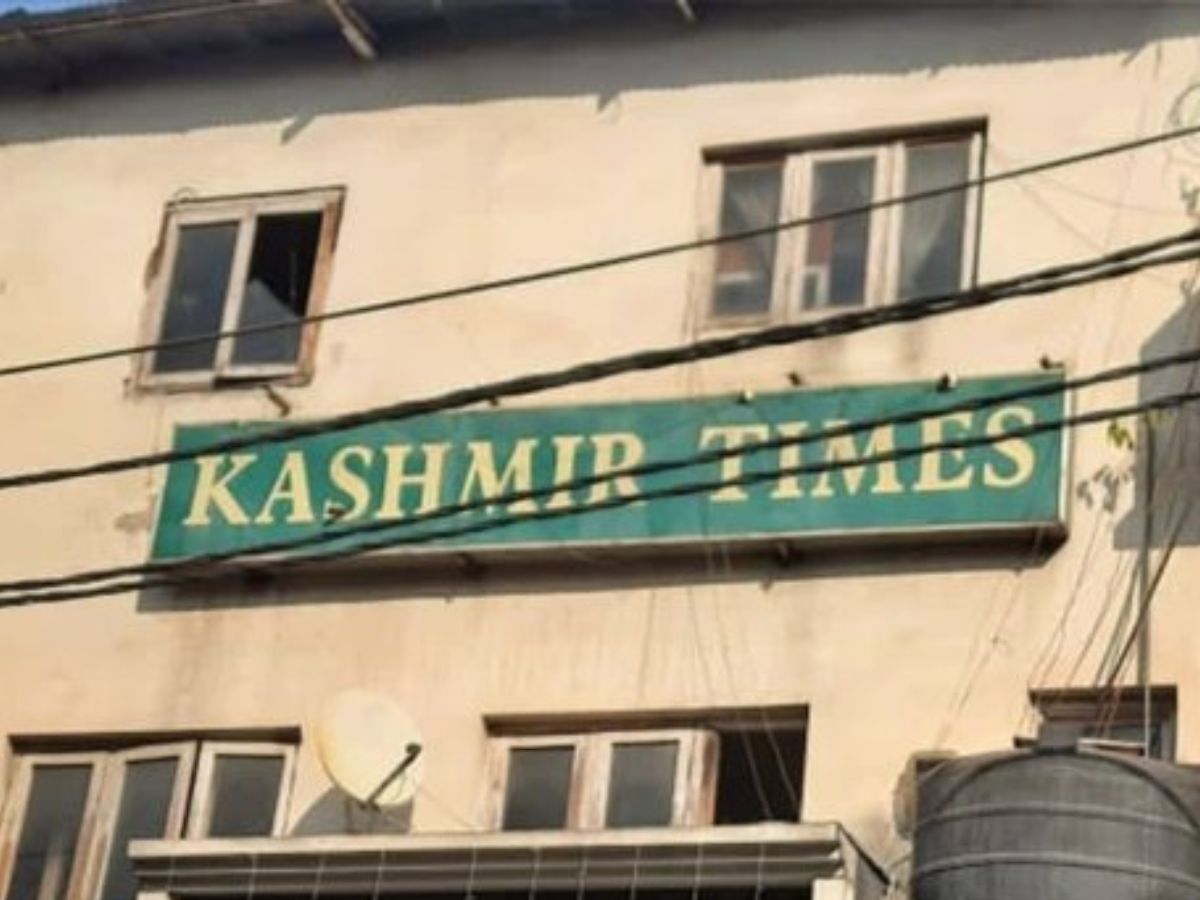
Jammu and Kashmir Police’s State Investigation Agency (SIA) has raided the Kashmir Times office in Jammu on Thursday. The raid, according to officials, recovered AK-47 cartridges, pistol rounds, and three grenade levers during a lengthy search.
The police filed a First Information Report (FIR) against the Kashmir Times, accusing it of “spreading disaffection, glorifying secessionism and threatening sovereignty and territorial integrity of India.”
Kashmir Times Raid: What All is Recovered?
From the raid at Kashmir Times in Srinagar, Jammu, according to Kathua police, 3 magazines containing 30 rounds, 1 magazine having 24 rounds, 75 rounds in separate polythene, 3 live grenades, Rs 1 lakh currency (200 notes of Rs 500 denomination), eatables (Pakistan-made chocolates, dry chana and stale chapatis), Pakistan made medicines and injections (pain killers), 1 syringe, 2 packs of A4 batteries, 1 handset wrapped in tape having antenna and 2 wires hanging from this handset, 1 M4 carbine and 1 Ak 47 recovered in the operation.
FIR names Executive Editor Anuradha Bhasin
This is not just another police action — it raises deep questions about press freedom, state power, and democratic balance in a sensitive region. Critics warn that such raids could become a way to silence dissent.
Supporters of the paper argue that a free press is essential for holding power accountable, especially in Jammu & Kashmir, a place with a complex political history.
Kashmir Times Responds — ‘We Will Not Be Silenced”
The Kashmir Times has pushed back strongly. In a statement, the newspaper said this is “yet another attempt to silence us.” The editors argued that “criticising the government is not the same as being inimical to the state.”
They insisted that their journalism — probing, independent, and focused on accountability — strengthens democracy, rather than weakening it. They also pointed out that their print edition was suspended in 2021–22 after continuous targeting. Despite that, they continue digitally, with all their reporting available on kashmirtimes.com.
Political Voices & Reactions
Not everyone believes the raid is justified. Deputy Chief Minister Surinder Singh Choudhary questioned the move, saying, “Action should follow only in cases where wrongdoing is established and not for the sake of pressure.” His remarks highlight a concern: that raids like this might be used more for intimidation than justice.
On the other hand, authorities have stuck to their line. According to reports, they are treating the incident as part of a larger probe into activities “detrimental to the sovereignty” of India.
What does the Investigation Involves?
SIA officers not only searched the physical office — they also checked digital devices and documents. This suggests the investigation is not limited to weapons or materials on the premises, but could also involve content, communications, and potentially financial links.
The FIR, registered under a serious section (Section 13 of the Unlawful Activities Act), indicates that authorities view this as more than a standard criminal case.
Why the Raid Is Significant?
The Kashmir Times is among the oldest English-language papers in Jammu & Kashmir. It started in 1954, originally as a weekly, and became a daily in 1964. Given its legacy, a raid on its office carries symbolic weight: this is not a fringe outlet, but a respected institution with deep roots in the region.
The SIA’s allegations are serious: they claim that the newspaper’s content could undermine Indian sovereignty. The recovery of weapons-related items — AK-47 cartridges and grenade levers — intensifies the gravity of the accusation.
Larger Implications: Press Freedom & Democracy
This raid is being closely watched by journalists, civil rights advocates, and political commentators across India. For many, it signals a worrying trend in which strong media voices may face state pressure under the guise of national security. Others argue that if any media outlet crosses the line, it must be held accountable.
The Kashmir Times, with its long history, represents more than just a newspaper. For many in the region, it is a symbol of independent journalism and a critical space for public debate. A forceful state action against it risks eroding that space.
At the same time, the government argues that national security is not negotiable. If its claims are correct, the raid may be a justified part of preserving sovereignty and countering potential threats. But the resulting tension — and how the case unfolds — will likely affect how people view both the press and the state in Jammu & Kashmir.