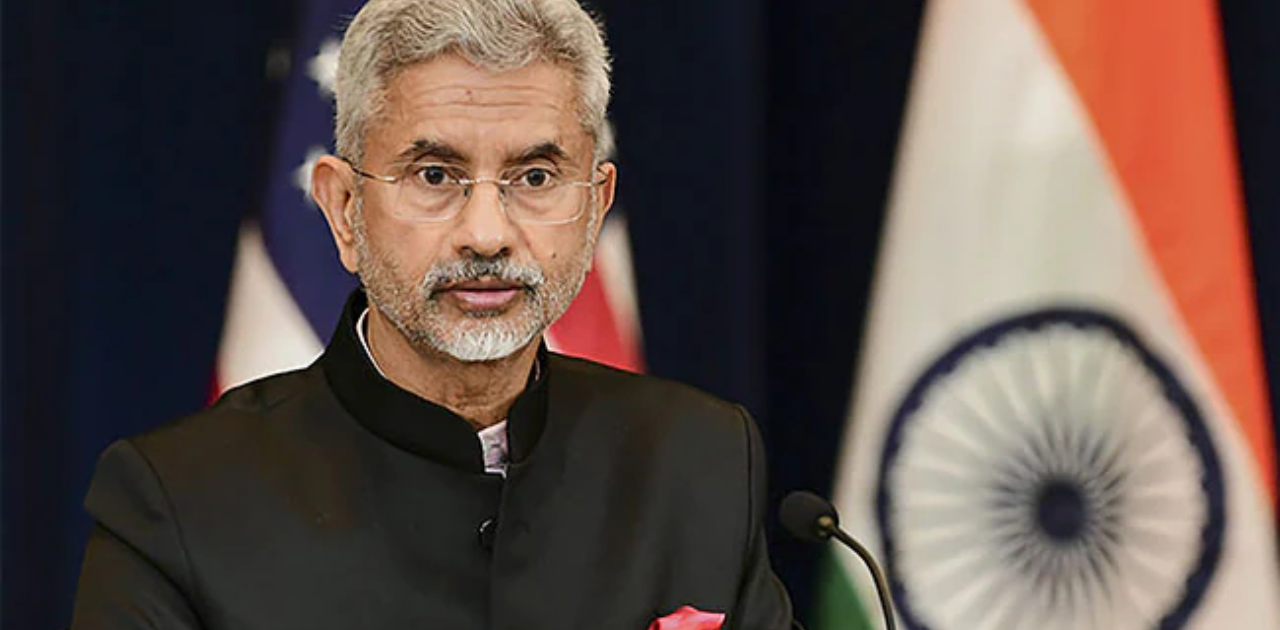
The new geopolitical controversy erupted after India’s External Affairs Minister S. Jaishankar briefed Parliament on a provocative map depicting “Greater Bangladesh” that included Indian territories like Assam, West Bengal, Bihar, Jharkhand, Odisha, and parts of Myanmar.
In a written response to Congress MP Randeep Singh Surjewala’s prominent query in the Rajya Sabha, S Jaishankar claimed that the disputed map was on exhibit at Dhaka University.
According to Jaishankar, the map was purportedly showcased at Dhaka and associated with an obscure Islamist group, Saltanat-e-Bangla, which allegedly has the backing of a Turkey-based NGO called the Turkish Youth Federation. The incident which emerged on social media poses questions not just regarding legitimacy of the group, but also regarding external ideological influences within South Asia and the impact on India-Bangladesh relations.
“The Government has taken note of reports that an Islamist group in Dhaka called the ‘Saltanat-e-Bangla’, backed by a Turkish NGO called the ‘Turkish Youth Federation’, has put out a map of the so-called ‘Greater Bangladesh’ that includes parts of India. The map was displayed in the Dhaka University,” a statement from the Ministry of External Affairs quoted Jaishankar as saying.
Disputed Assertions and the Challenges of Fact-Checking
Contentions regarding the legitimacy of both the map and the organizations involved continue to rage. Independent Bangladeshi fact-checkers are now countering the assertions of their Indian counterparts by stating that Saltanat-e-Bangla has not been observed to be operational in the country.
According to them, the event in Dhaka was only a cultural exhibition celebrating the legacy of medieval Bengal’s sultanate, with no overtly political messaging or affiliations to foreign entities. However, Indian authorities are not taking it lightly in consideration of the issue’s severe conciseness especially since the map signifies claims over Indian states-territories evoking that past irredentist fear and immigration debates.
According to the MEA statement, the disputed map was on display during an exhibition on April 14, 2025, in honor of Pohela Boisakh at Dhaka University. It further stated that the exhibition’s organizers denied any affiliation with any foreign political organization.
Turkish Soft-Power Politics and Islamist Networks
Heaps further mud on the waters of possible complications by claiming the involvement of a Turkish NGO, thereby indicating that Ankara’s outreach is on the rise in the region. In fact, in the past decade, under President Erdoğan, Turkey has expanded its relations in South Asia substantially by establishing religion-, education-, and culture-based institutions.
None of these relations is outright hostile, though they always resonate with ideological signatures consonant with the likes of the Muslim Brotherhood; thus experts tend to believe that such links could be quiet vehicles for soft-power diplomacy in a region already sensitive to any identity and demographic shift. India’s worry seems to arise from the fact that such linkages may nurture radical narratives close to the borders.
Bilateral Sensitivities and Regional Implications
Although Bangladeshi officials denied any state involvement in the circulation of the map, the incident has undoubtedly created ripples in India. Given the states, such as Assam and West Bengal, which have historically shown a skeptical attitude toward changes in demographics brought about by illegal migration, even symbolic acts such as the “Greater Bangladesh” map would have political connotations.
The episode thus brings home again the need for cautious vigilance in border diplomacy, highlighted by an evident fragility between cultural expression and political provocation in a region where identity and sovereignty are inextricably linked.