
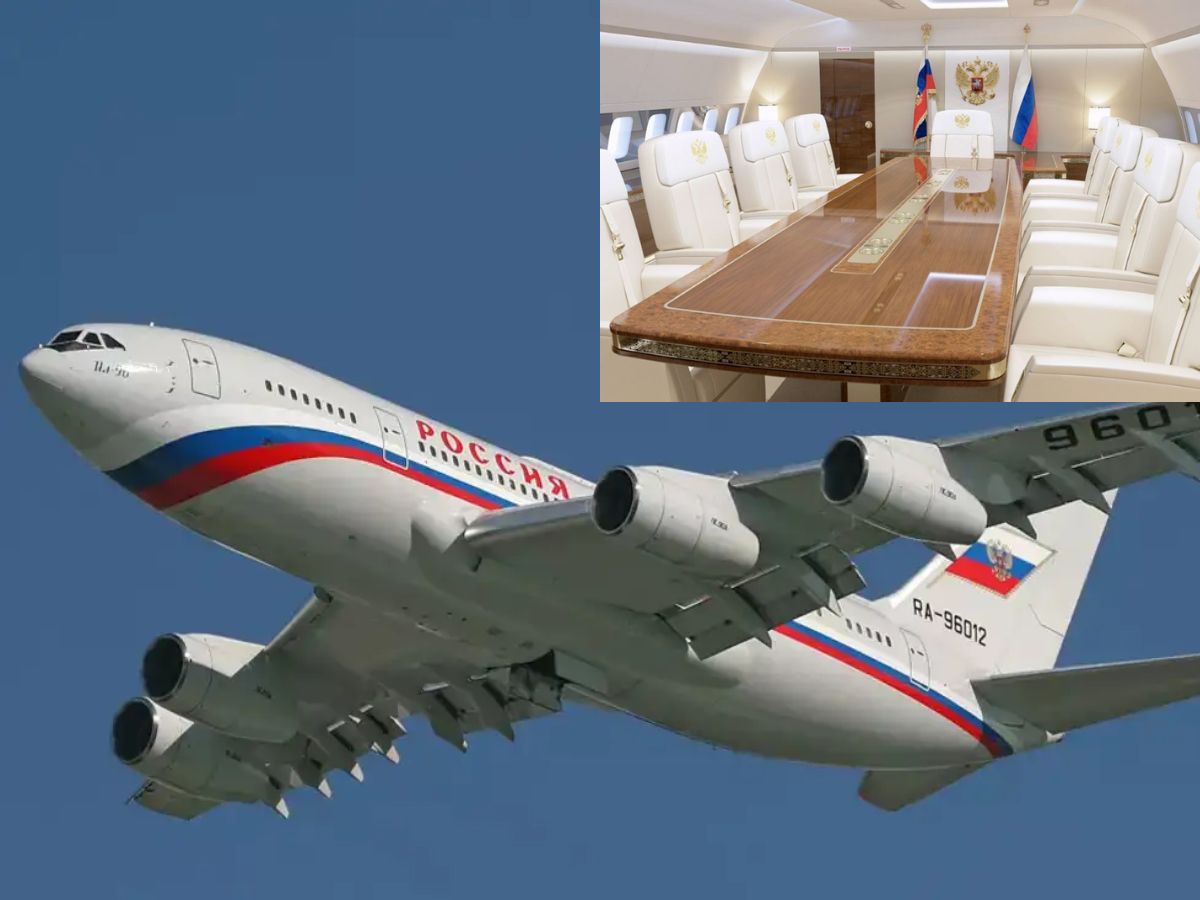
Russian President Vladimir Putin is set to arrive in India on December 4 in the evening for a two-day visit. He will be travelling in his specially modified aircraft, known as the “Flying Kremlin.” The jet is designed to serve as a secure command centre while offering comfort and mobility for the Russian President.
Experts have long speculated about its connection to nuclear command. However, no official evidence confirms that a launch button exists onboard.
What is the ‘Flying Kremlin’?
The Flying Kremlin refers to Putin’s Ilyushin Il-96-300PU aircraft. It is modified for long-distance official travel and equipped with advanced security and communication systems. The plane acts as a mobile office, conference room, and living quarters for the President during trips abroad.
It is believed to provide encrypted communication channels and command systems, allowing the President to stay connected even during emergencies or conflicts.
Flying Kremlin: Does it Have a Nuclear Button?
Reports suggest the jet can support nuclear command functions if required. Analysts say it may allow Putin to communicate securely and maintain control during wartime.
However, Reuters and other sources clarify that Russia’s nuclear authorization is tied to the Cheget nuclear briefcase, not a physical button on the plane. Defence experts emphasize that a “nuclear button” is symbolic. It represents strict protocols, secure authentication, and code words, not a single button that can launch weapons.
“A nuclear button does not essentially refer to a single physical button that a leader presses to launch nuclear weapons. Instead, it represents a complex chain-of-command system, strict protocols, and secure authentication processes and code words for nuclear attack.”
Flying Kremlin: Key Features (Ilyushin Il-96-300PU)
The aircraft is heavily fortified with advanced technology. Key features include:
Long-Range Capabilities:
Wide-body, four-engine jet capable of transcontinental flights without frequent refuelling.
Modern Avionics:
Glass cockpit with multiple LCDs, fly-by-wire controls, and advanced navigation systems.
Secure Communications:
Encrypted satellite and data links allow secure contact with the Kremlin and military command worldwide.
Defensive Systems:
Radar jamming, electronic warfare, missile defense, and hardened electronics for protection against attacks.
Mobile Command Centre:
Functions as a “Punkt Upravleniya” (Command Point), enabling airborne management of state and military operations.
Luxury Interiors:
Offices, conference rooms, guest salons, private working quarters, and meeting spaces onboard.
Medical and Utility Facilities:
Onboard medical block, kitchen, shower, and possibly a gym for long-haul comfort.
High Security Measures:
Multiple identical jets may fly together as decoys; EMP shielding and electronic protections are in place.
Multi-Functional:
Allows the President to work, rest, meet with staff, and plan strategic decisions during flights.
Putin India Visit: Security Measures
Putin’s visit to India comes with tight security. Russia’s Federal Protective Service (FSO) oversees security on its side, while India deploys the National Security Guard (NSG), specialized snipers, anti-drone systems, and AI-powered surveillance.
One unusual aspect of his travel security is the reportedly custom ‘poop suitcase’ that travels with him to prevent interruptions during long flights. These measures ensure that the President’s safety and operational readiness are maintained at all times.
Flying Kremlin: Why is it in Headlines?
The Flying Kremlin attracts attention due to its unique combination of comfort, technology, and security. While the media often link it to nuclear capabilities, experts stress that it primarily functions as a mobile command hub. The plane ensures that Putin remains in full control, even while travelling internationally.
During his visit, the Flying Kremlin symbolizes Russia’s strategic planning, modern aviation capabilities, and strict security standards.