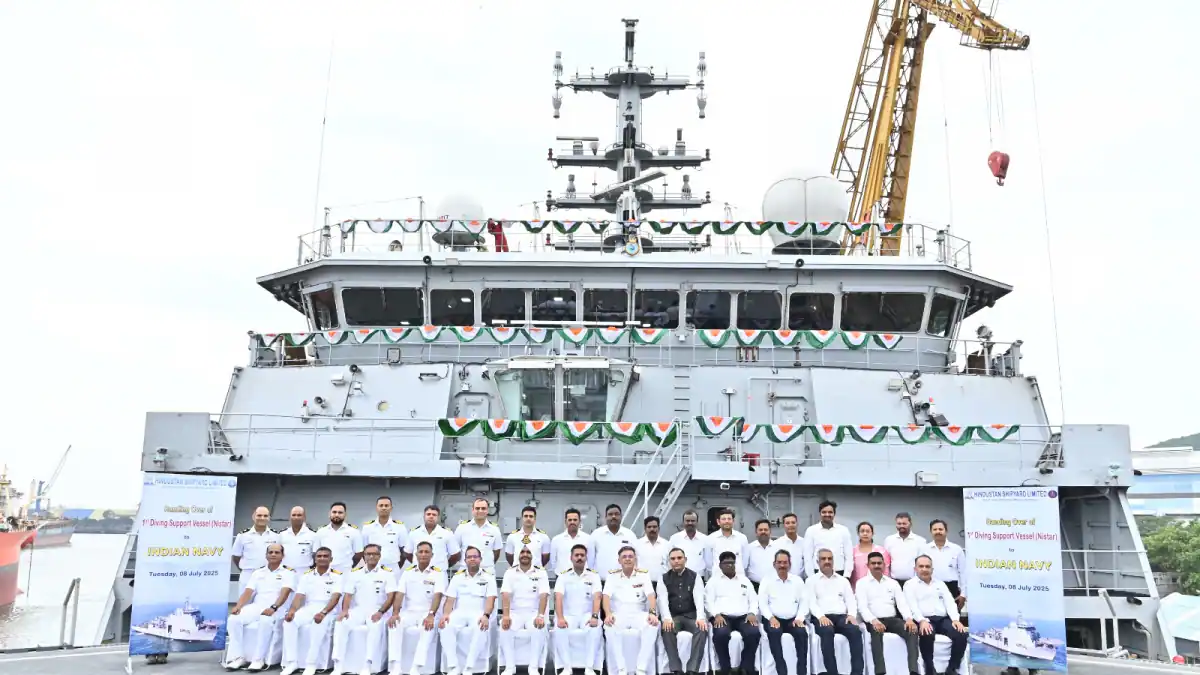
The Indian Navy will hold a ceremony at the Naval Dockyard in Visakhapatnam on Today, July 18, 2025, to formally commission INS Nistar, its first-ever entirely indigenous Diving Support Vessel (DSV).
In a major milepost in Indian maritime self-reliance, the Indian Navy formally inducted INS Nistar, the first ever Diving Support Vessel (DSV) salved fully indigenous in design and construction in India’s active arsenal. Developed by Hindustan Shipyard Limited (HSL), the technologically advanced platform will significantly boost India’s strategic capabilities in underwater rescue, saturation diving and submarine support-the core competencies for modern maritime operations in the Indian Ocean Region (IOR).
Strategic Importance in the Indian Ocean Theatre
The commissioning of INS Nistar marks a paradigm shift in the entire submarine rescue and deep-sea operational architecture of India. As regional naval dynamics change, this vessel further consolidates sovereign control over underwater contingencies while reducing foreign dependency for critical missions like submarine crew extractions, salvages and subsea retrievals.
Nistar is capable of providing saturation diving support to 300 m and side diving operations up to 75 m, and thus positions India among a select few countries which own top-notch independent infrastructure for deep-sea rescue and salvage. Central to its role is its function as a mother ship to the Deep Submergence Rescue Vehicle (DSRV), which will be capable of rescuing personnel trapped inside distressed submarines from depths nearing 1,000 meters.
Technological Profile and Capabilities
Built to exacting standards defined by the Indian Register of Shipping (IRS), this vessel spans nearly 118.4 m with a beam of 22.8 m, displacing between 9,350 and 10,000 tons depending on the mission profile. Powered through dual diesel propulsion, it permits the ship to cruise further at the speed of 14 knots and, besides, has a sea endurance of over 60 days-which is crucial for extended and isolated operations.
The Dynamic Positioning System Level 2 (DP2) is fitted onboard, ensuring very high precision station-keeping during critical underwater activities. It also hosts an underwater crane-below 15 tone-side scan SONAR, Remotely Operated Vehicles (ROVs) and a moonpool, all enabling simultaneous diving and salvage operations.
Equipped for that mission, this integrated diving complex is one of the most modern in the fleet of India, with accompanying hyperbaric treatment systems, a decompression chamber for six people, and a self-propelled hyperbaric lifeboat-capabilities critical to long-duration deep-sea operations and emergency evacuation.
Medical Infrastructure and Combat Survivability
To boost the platform’s potential in high-risk operations, INS Nistar has a well-equipped medical suite with an operating room, ICU, and eight-bed onboard hospital, managing cases for decompression-related trauma as well as complex injuries acquired in undersea missions.
It has a helideck, capable of handling 15-tonne aircraft, that guarantees aerial support for casualty evacuation, replenishment and maritime reconnaissance.
Armament of the platform includes dual AK-630 CIWS (Close-IN Weapon Systems), thereby ensuring good defense against airborne and missile threats.
Legacy and National Industrial Footprint
INS Nistar is a modern homage to its eponymous predecessor a Soviet-origin submarine rescue vessel that served in the Indian Navy from 1971 to 1989, rendering invaluable service during the Indo-Pak War, particularly operations following the sinking of PNS Ghazi.
Symbolically and functionally, present-day Nistar embodies Navy’s commitment to self-strategic autonomy. More than 80 percent of these were made in India, courtesy of over 120 Indian MSMEs, and thus represent practical outcomes of the ‘Make in India’ and Aatmanirbhar Bharat initiatives in the defense realm.
This ship’s insignia a dolphin and anchor and its Sanskrit name “Nistar” meaning deliverance, and its motto “Surakshita Yatharthta Shauryam“, would accord with its mission of executing critical underwater tasks with fidelity, courage, and technological sophistication.
Implications for India’s Naval Doctrine
As undersea warfare, salvage, and rescue increasingly come to define naval readiness, INS Nistar as well as its sister ship INS Nipun brings about a qualitative change in India’s operational depth and state’s sovereignty on the maritime dimension. These indirectly enable the Indian Navy to carry out very high-stakes missions such as wreckage recovery, submerged inspections, and crew extraction without logistical or technological dependencies.
Nistar, which, in addition to endurance, cutting-edge subsea systems, and medical preparedness, not only augments India’s deterrent posture but also strengthens the country’s capability for humanitarian and non-war underwater interventions, constitutes a paradigm shift in the regional architecture of maritime security.