
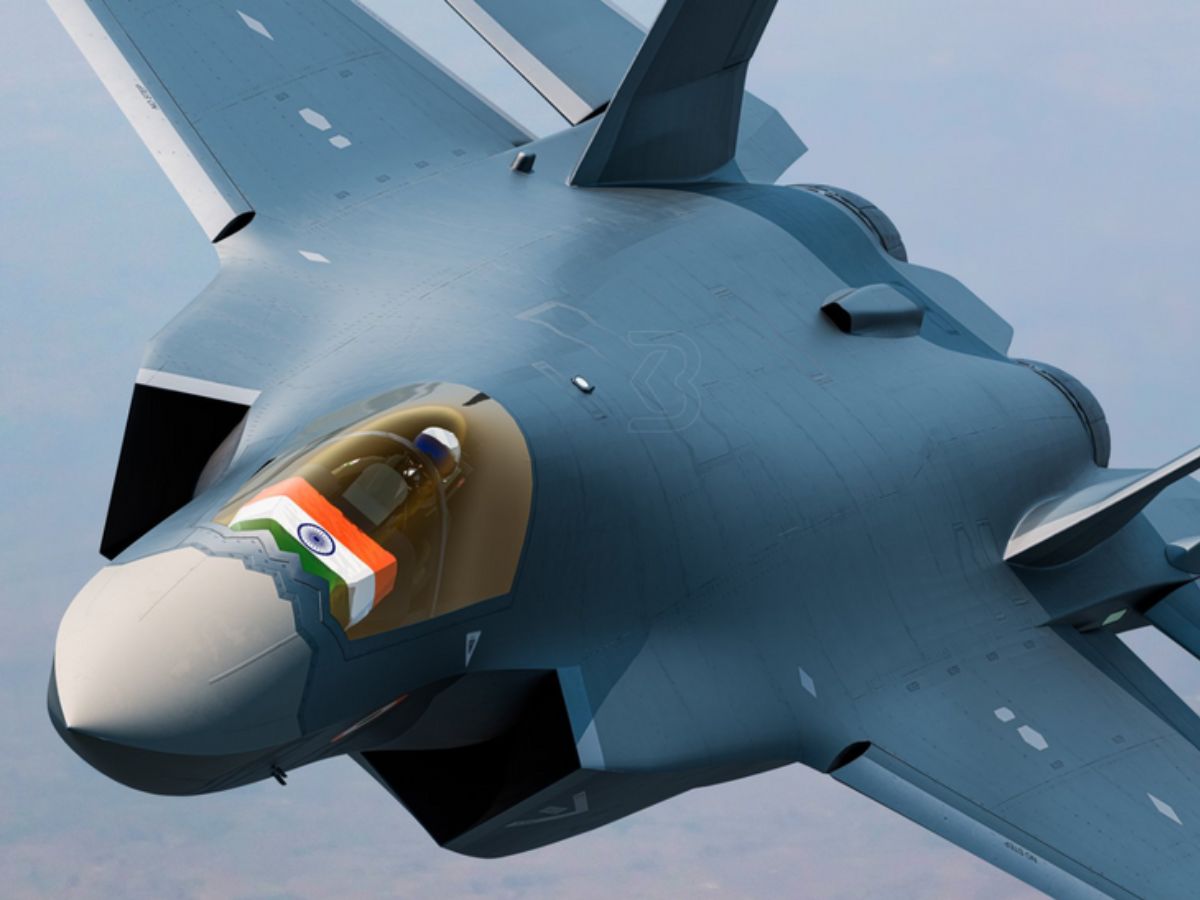
India’s ambitious push to develop an indigenous fifth-generation stealth fighter aircraft has entered a decisive phase, with the Ministry of Defence issuing a Request for Proposal (RFP) for the Advanced Medium Combat Aircraft (AMCA) programme to shortlisted private-sector-led consortiums. The move marks one of the most significant transitions in India’s defence manufacturing ecosystem, bringing major private players into the core of a strategic combat aviation project traditionally dominated by public sector entities.
The proposed programme, estimated at around ₹15,000 crore for the prototype development stage, is aimed at building India’s first indigenous fifth-generation stealth fighter jet for the Indian Air Force. The shortlisted contenders include Tata Advanced Systems, the Larsen & Toubro-Bharat Electronics Limited combine, and Bharat Forge in partnership with BEML.
The AMCA project represents a major strategic milestone in India’s pursuit of defence self-reliance under the broader Atmanirbhar Bharat vision. Designed by the Aeronautical Development Agency under the Defence Research and Development Organisation, the twin-engine stealth aircraft is expected to feature advanced avionics, internal weapons bays, AI-assisted mission systems, supercruise capability and low radar observability.
Unlike earlier fighter aircraft programmes that relied heavily on public-sector execution, the AMCA initiative reflects a deliberate policy shift toward a competitive and distributed industrial model. Officials view private-sector participation as critical for improving execution timelines, technological innovation and manufacturing efficiency in complex aerospace programmes.
The programme has also attracted attention because Hindustan Aeronautics Limited (HAL), India’s principal aerospace public sector undertaking, is reportedly not among the shortlisted bidders for the prototype phase. While HAL is expected to remain part of India’s wider combat aviation ecosystem and may participate in future production opportunities, the present framework signals the government’s intent to expand the role of private industry in advanced military aerospace development.
Strategically, the urgency behind the AMCA programme is tied to evolving regional security dynamics. China has already operationalised the J-20 stealth fighter and continues work on next-generation combat platforms, while Pakistan is reportedly exploring access to advanced Chinese fighter technologies. Against this backdrop, India’s effort to develop a domestic fifth-generation platform is seen as essential for maintaining long-term air combat capability and strategic deterrence.
According to current projections, the first AMCA prototype could roll out by late 2026 or early 2027, followed by its maiden flight around 2028. Induction into the Indian Air Force is expected in the mid-2030s after testing and certification phases are completed.
Beyond its military significance, the AMCA programme is expected to strengthen India’s aerospace manufacturing base, create high-technology supply chains and deepen collaboration between government agencies, research institutions and private industry. If executed successfully, the project could position India among a select group of nations capable of independently designing and producing fifth-generation stealth combat aircraft.