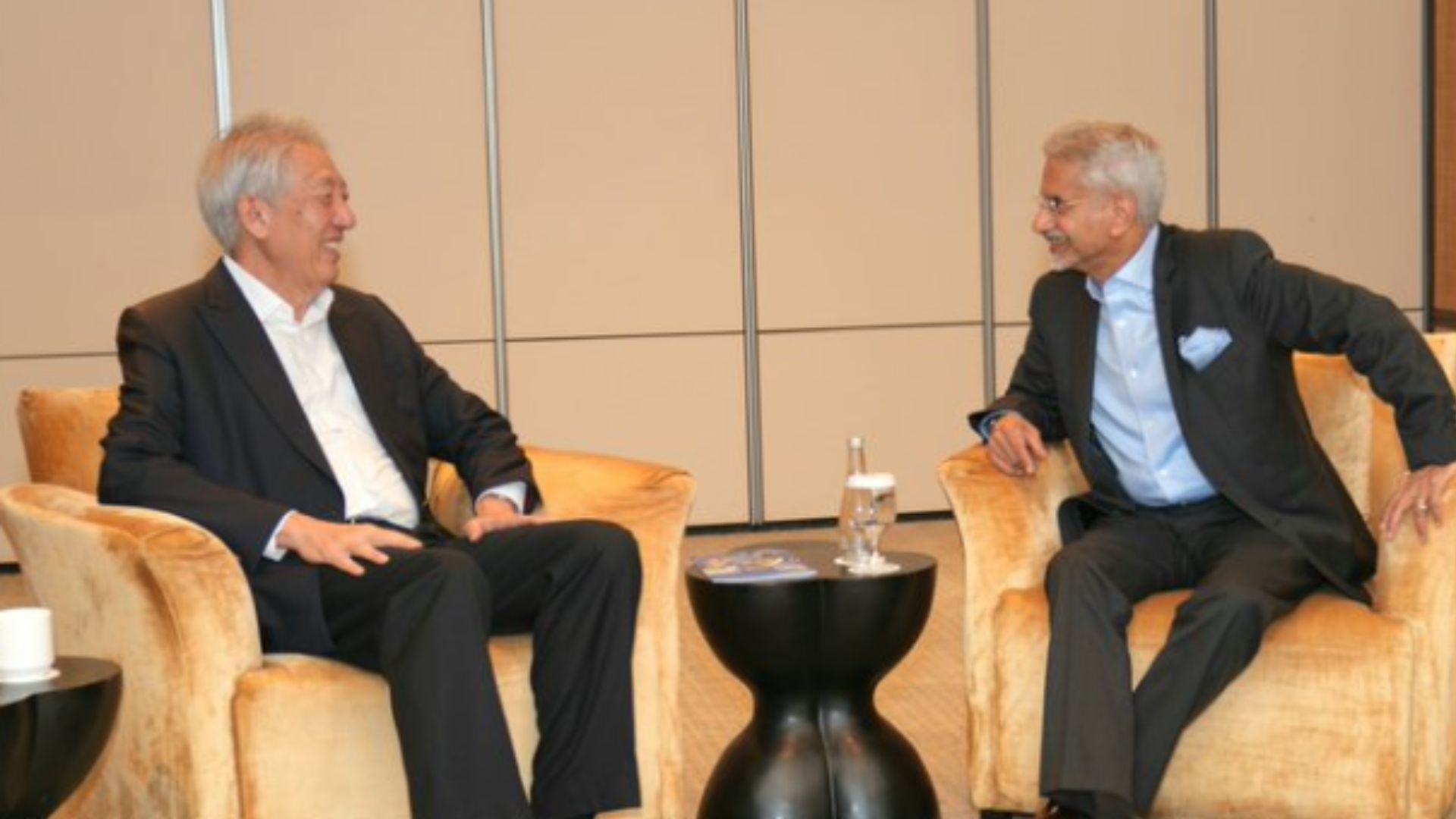
Singapore’s Foreign Minister Vivian Balakrishnan has said that India will take on a bigger role in shaping global affairs as the world steadily moves toward a multipolar international order. His remarks came after holding talks with India’s External Affairs Minister S. Jaishankar during the latter’s visit to Singapore on Sunday.
While in Singapore, Jaishankar also had meetings with President Tharman Shanmugaratnam and Deputy Prime Minister Gan Kim Yong to discuss bilateral ties and global developments.
Singapore: A Key Partner in India’s Act East Policy
Following his meeting with Balakrishnan, Jaishankar emphasized Singapore’s importance in India’s foreign outreach. He said that “Singapore is central to India’s Act East Policy.” He will now continue his diplomatic journey with a visit to China.
Singapore is at the heart of our Act East Policy. Always insightful to exchange views there.
Great to meet FM @VivianBala this morning in Singapore.
🇮🇳 🇸🇬 pic.twitter.com/3QWZGyEy68
— Dr. S. Jaishankar (@DrSJaishankar) July 13, 2025
The partnership between India and Singapore was elevated to a Comprehensive Strategic Partnership during Prime Minister Narendra Modi’s visit to Singapore last September. Balakrishnan highlighted India’s rising influence in a social media post, stating, “As the world inexorably transitions into multipolarity, India will play an increasingly important role as one of these major poles of opportunity.”
A great pleasure to meet Chairman-designate of Temasek Holdings Teo Chee Hean today.
Discussed the transformation underway in India and its investment opportunities.
🇮🇳 🇸🇬 pic.twitter.com/iKjXWF1fgz
— Dr. S. Jaishankar (@DrSJaishankar) July 13, 2025
Ministerial Roundtable to Be Held in New Delhi
Both ministers agreed to organize the third India-Singapore Ministerial Roundtable soon in New Delhi. According to India’s Ministry of External Affairs, the discussions covered updates on decisions made during PM Modi’s last visit and progress since the second ministerial roundtable.
Key Areas of Cooperation
The two countries are strengthening collaboration in several sectors such as:
-
Investments
-
Industrial parks
-
Semiconductor production
-
Infrastructure development
-
Skill training
-
Connectivity
Jaishankar and Balakrishnan also discussed regional and global issues, including the role of ASEAN, developments in the Indo-Pacific, and other international matters.
Meetings with Other Key Leaders
During his visit, External Affairs Minister S. Jaishankar also met with Teo Chee Hean, a respected statesman in Singapore. Teo, who previously served as Senior Minister and Coordinating Minister for National Security, now holds the position of chairman-designate at Temasek Holdings, one of Singapore’s most influential state-owned investment companies.
Their meeting underscored the importance of economic cooperation and strategic investments between India and Singapore. With Temasek playing a major role in global finance and infrastructure, discussions may have included possible collaborations in technology, startups, green energy, and digital economy, all of which are areas of mutual interest. The dialogue reflected the deepening trust between both nations and their shared vision for long-term economic growth and regional stability.
Next Stop: China for SCO Meeting
Following his successful engagements in Singapore, Jaishankar will now travel to China to attend the Shanghai Cooperation Organisation (SCO) Foreign Ministers’ meeting. This will be a significant diplomatic step, as it marks his first visit to China since the 2020 Galwan Valley clashes, a violent incident along the Line of Actual Control that led to the deaths of soldiers on both sides and severely impacted bilateral ties.
Jaishankar’s presence at the SCO meeting signals India’s continued engagement with regional multilateral platforms, even as tensions with China remain unresolved. The meeting is expected to bring together foreign ministers from key regional players, and discussions will likely cover security cooperation, regional connectivity, counterterrorism, and economic development across Eurasia.
While the visit is centered around multilateral dialogue, all eyes will be on whether any India-China bilateral discussions take place on the sidelines, especially amid ongoing border disputes and calls for de-escalation and peace.