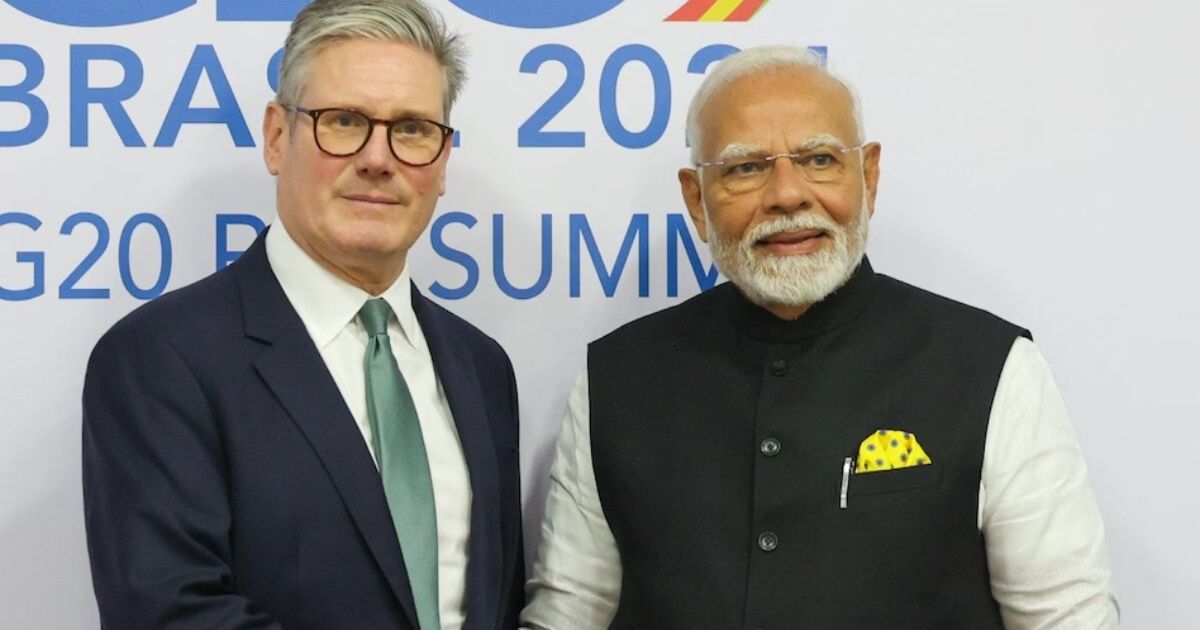
India and the United Kingdom signed a historic free trade agreement (FTA), welcomed by both UK PM Keir Starmer and PM Narendra Modi. The agreement removes tariffs from 99 per cent of Indian exports, exposing a massive opportunity for labour-intensive industries such as textiles, footwear, gems, jewellery, and pharmaceuticals.
With this, India is to gain a big advantage over export competitors such as China, Vietnam, Bangladesh, Indonesia, and Pakistan. The FTA will double bilateral trade to $120 billion by 2030 from $55 billion in 2023–24. Although negotiations on a standalone Bilateral Investment Treaty (BIT) are still being held, this agreement alone is set to benefit India to the value of $2 billion.
What the Deal Covers?
The FTA eliminates duties on a vast array of products. India’s textile, leather, apparel, and toy sectors—most of which are presently subject to 4% to 16% duties—will gain significantly. More than 1,100 products in textiles alone will now have duty-free access. These include readymade garments, carpets, handicrafts, and much-loved traditional wear such as pashmina shawls and Kanchipuram sarees.
Footwear, such as sports shoes, athleisure footwear, and Indian-style chappals like Kolhapuris, will become price-competitive overnight in the UK market. India is presently the UK’s fourth-largest textile supplier, accounting for 6% of imports. With this pact, India can reach even higher.
Pharma, Chemicals, and Jewellery to Gain
India could also increase its market share in the UK’s $30 billion pharma imports. India’s exports in 2024 were a mere $1 billion. But with generic drugs and diagnostic equipment like ECG and X-ray machines getting duty-free entry, India’s market share would increase dramatically.
In chemicals, which had $570 million worth of Indian goods exported in 2024, the Centre anticipates a 30-40% increase. More than 1,200 chemical products will now enter the UK free of duties. Just like that, the gems and jewellery industry, already worth $940 million, will increase immensely.
India’s Competitive Advantage Over China & Neighbours
The actual shift is in India’s emerging advantage over China and others. China’s control over exports to the UK, e.g., machine parts, coffee, silver jewellery, and footwear, can be constricted. In 2024, China shipped machine parts to the UK worth $248.5 million; India trailed only slightly at $215.3 million. Indian coffee shipments ($12 million) trumped China’s ($11.1 million) this year, a difference that will grow wider after the FTA.
In footwear and silver jewellery, India still exports only a third of the volume that China does. Tariff removal can shrink this gap in a matter of minutes. India can price-bomb China even in processed foods and cakes.
Ripple Effect on Other Countries
Indonesia could see 10% of its exports to the UK impacted, specifically in the toys and footwear segments. Thailand could lose business in food and baked goods, impacting $200 million worth of business or 3.8% of its exports.
Vietnam’s exports to the UK, amounting to $346.6 million, may be in for tough competition. Bangladesh and Pakistan might suffer substantially—Bangladesh might lose 7.6% of its exports to India’s cheaper leather and textiles. Pakistani exports of up to 15% of their total might be hit, particularly in clothing, spices, fish, and footwear.
Long Term Impact
Officials think the agreement will potentially assist Indian leather exports alone in capturing five percentage points of the UK market share. The trade agreement is not only a diplomatic achievement but an obvious strategic victory for India’s export economy.
With tariffs removed, India now possesses the means to undercut and overpower many of its regional competitors in one of the largest consumer markets in the world.