
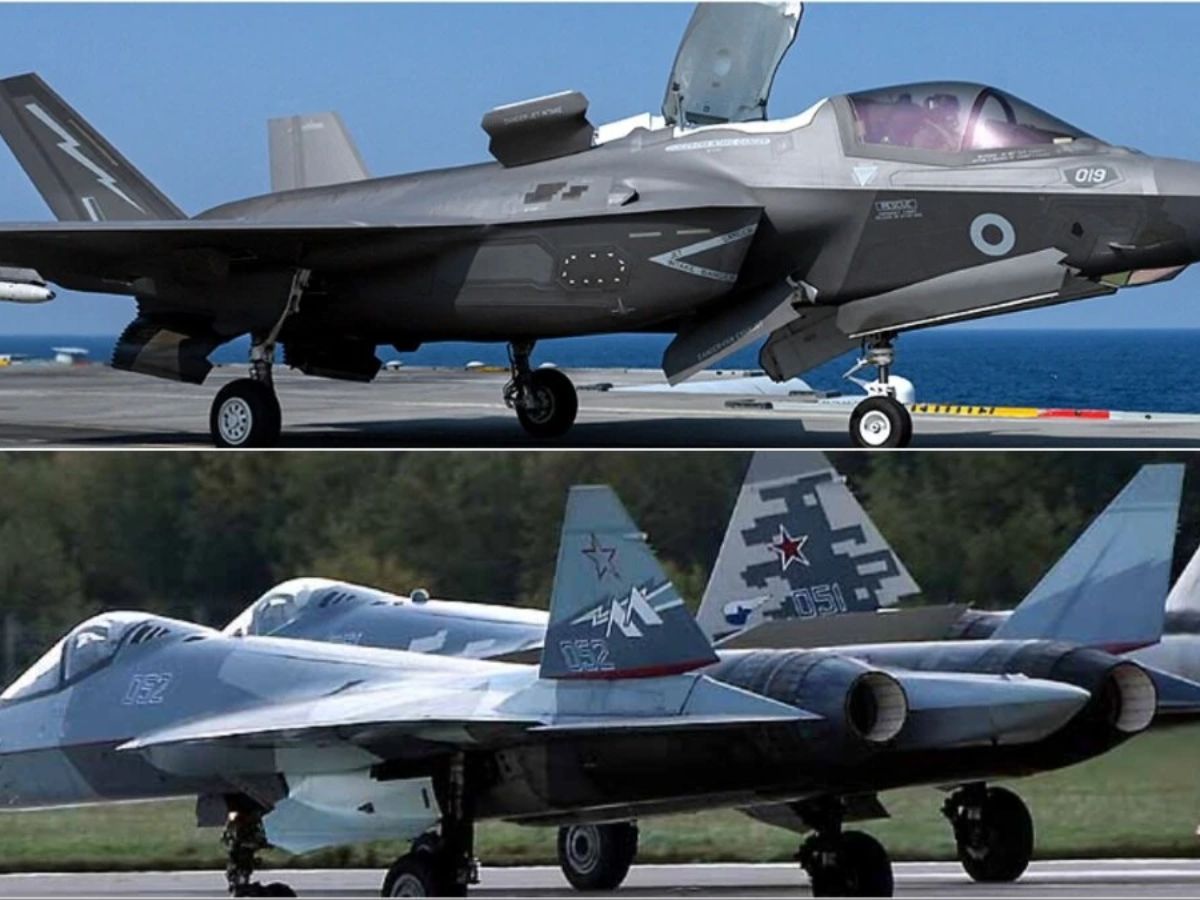
As global air forces gear up for the fifth generation of fighter aircraft, India finds itself at a crossroads, caught between ambitious indigenous plans and the allure of foreign options. With the homegrown Advanced Medium Combat Aircraft (AMCA) still years from operational readiness, speculation has intensified around whether India will look abroad to fill the gap, and if so, from whom.
The Big Question: F-35 or Su-57?
Two potential foreign contenders have emerged: the American F-35 Lightning II, and Russia’s Su-57 Felon. Both jets promise cutting-edge stealth and performance, but neither option seems like a straightforward pick for India.
While there were murmurs that India had sent feelers to the U.S. regarding the F-35, the Ministry of External Affairs recently clarified in Parliament that no formal discussions have taken place. Minister of State Kirti Vardhan Singh pointed to a February 2025 joint statement between Prime Minister Narendra Modi and former President Trump, where the U.S. agreed only to “review” its policy on selling fifth-generation systems to India. A review, however, is not a deal—and certainly not a guarantee.
Why F-35 May Not Be India’s Best Bet (Yet)
At first glance, the F-35 seems like the crown jewel of modern air combat: advanced stealth, global reputation, and sophisticated systems. But dig a little deeper, and the cracks begin to show, at least from India’s perspective.
For one, India’s current fighter jet ecosystem is built around platforms like the Su-30MKI, Rafale, Tejas, Mirage 2000, and Jaguar. The infrastructure training, maintenance, spare parts, and armament integration are deeply invested in this hybrid setup.
Introducing the F-35 would mean introducing an entirely new ecosystem. A senior Indian Air Force pilot, speaking anonymously, explained:
“You can’t just plug in an aircraft. You need compatibility with your existing systems—communications, weapons, and support. The F-35 would bring in an American ecosystem that’s alien to India’s current setup.”
Dinakar Peri, Security Fellow at Carnegie India, echoed similar concerns:
“The F-35 is top-tier, no doubt. But integrating it into India’s existing systems would be a long and resource-heavy process—one that might not make strategic sense right now.”
Also Read—India Debunks ‘Fake News’ Amid US Tariff Blow, Sixth Round of Talks on Cards++++
Russia’s Su-57: Familiar, but Risky
Given India’s long-standing defence ties with Russia, the Su-57 Felon appears to be a more compatible option. India’s current Russian-origin fleet is more suited to its architecture. Moscow has also demonstrated an openness to technology transfer, which is a big plus for New Delhi
The Su-57 has faced development delays, questions over its stealth capabilities, and geopolitical turbulence, particularly regarding sanctions. According to analysts, depending on Russia in the current situation could only make diplomatic and procurement difficulties worse.
AMCA: India’s Indigenous Hope
India’s most promising answer to this fifth-gen dilemma is homegrown. The Advanced Medium Combat Aircraft (AMCA), being developed by the DRDO, aims to give India a self-reliant edge. The program, recently greenlit for private and public sector collaboration, has gained momentum. But timelines are ambitious.
A prototype isn’t expected before 2027-28, and full induction might only begin by 2036. That’s more than a decade away—far too long considering the Indian Air Force’s current situation.
Bridging the Gap: What’s the Way Forward?
Currently, the IAF has 30–31 squadrons operating out of a 42.5 authorized strength. That is a substantial deficit. Although planes such as the LCA Tejas Mk1A and Mk2 were designed to close this gap, the situation has gotten worse due to their delays.
With China and Pakistan ramping up their aircraft fleets, the need to strengthen India’s air capabilities is more urgent than ever.
Security analyst Dinakar Peri offers a practical solution:
“Rather than chasing fifth-gen imports, India should focus on ramping up LCA production and the Multi-Role Fighter Aircraft (MRFA) deal. The real crisis is not about not having the F-35—it’s about not having enough aircraft, period.”
India’s path to fifth-generation air power won’t be decided overnight. Whether it leans towards a foreign acquisition, waits for AMCA, or strengthens 4.5-gen capabilities in the interim, one thing is clear: any decision must align not just with global trends but with India’s unique operational, logistical, and strategic needs.