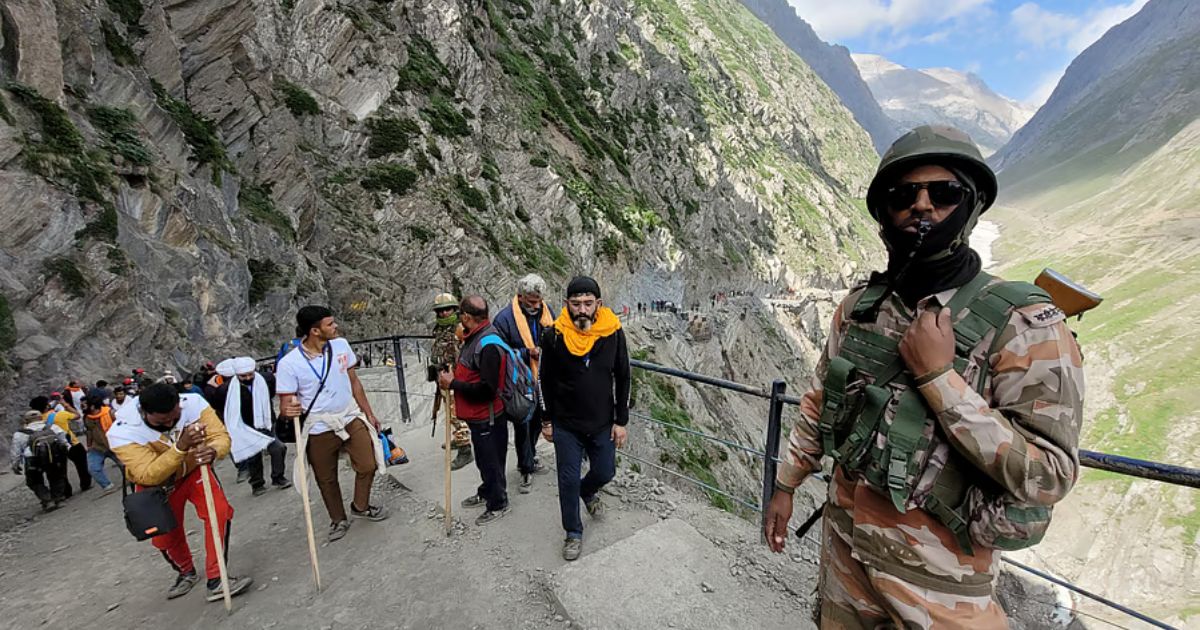
The Indian army has launched Operation Shiva, a huge annual security operation to safeguard pilgrims during the ongoing Amarnath Yatra, ending on August 9, coinciding with Raksha Bandhan. More than 8,500 soldiers have been deployed along the northern and southern routes to the holy cave shrine of Kashmir.
The deployment is in response to increased threats from Pakistan-sponsored terror proxies, particularly after the aegis of Operation Sindoor. The operation is to provide a safe and secure pilgrimage season through integrated, high-technology surveillance and ground cover.
Army Launches Operation Shiva for Security
Defence spokesperson Lt Col Suneel Bartwal said that Operation Shiva is a high-tempo operation with direct coordination among the Indian Army, civil administration, and central armed police forces (CAPFs). The objective is to create a robust security blanket on all routes and entry points of the yatra.
Lt Col Bartwal said that this year’s operation combines the army’s entire tactical, medical, engineering, and surveillance strengths.
Twin Paths Secured with 8,500 Troops
The soldiers are deployed on both Nunwan-Pahalgam in Anantnag and Baltal in Ganderbal, the twin base camps which are the points of origin for the pilgrims for the trek to the 3,880-metre-high cave shrine.
These troops are armed with state-of-the-art weapons and live surveillance devices to identify and neutralize any danger on the pilgrimage trail.
Counter-Drone Grid and Live Surveillance in Action
To neutralize aerial threats, the military has also put up a counter-UAS (unmanned aerial surveillance) network. It comprises more than 50 anti-drone equipment and early warning (EW) units. Daily UAV, Round-Drives and Real-Time Monitoring of the yatra routes and holy cave are an integral component of the operation.
PTZ cameras with high resolution and drones facilitate real-time monitoring of pilgrim convoys from Jammu to the cave, providing total situational awareness and swift threat response.
Medical and Logistical Support for Pilgrims
Besides tactical preparedness, the army has established a strong medical and logistical safety net. More than 150 doctors and medical personnel are present on duty, backed by two state-of-the-art dressing stations, nine medical aid posts, and a 100-bed hospital.
The army has commissioned 26 oxygen booths with more than 2 lakh litres of oxygen to assist pilgrims with altitude-related ailments.
Heavy Machinery, Standby Emergency Teams
Army engineers have been sent in to widen tracks, repair bridges, and conduct disaster mitigation. Signal companies facilitate uninterrupted communications, while technical detachments, bomb disposal units, and quick reaction teams (QRTs) are on standby.
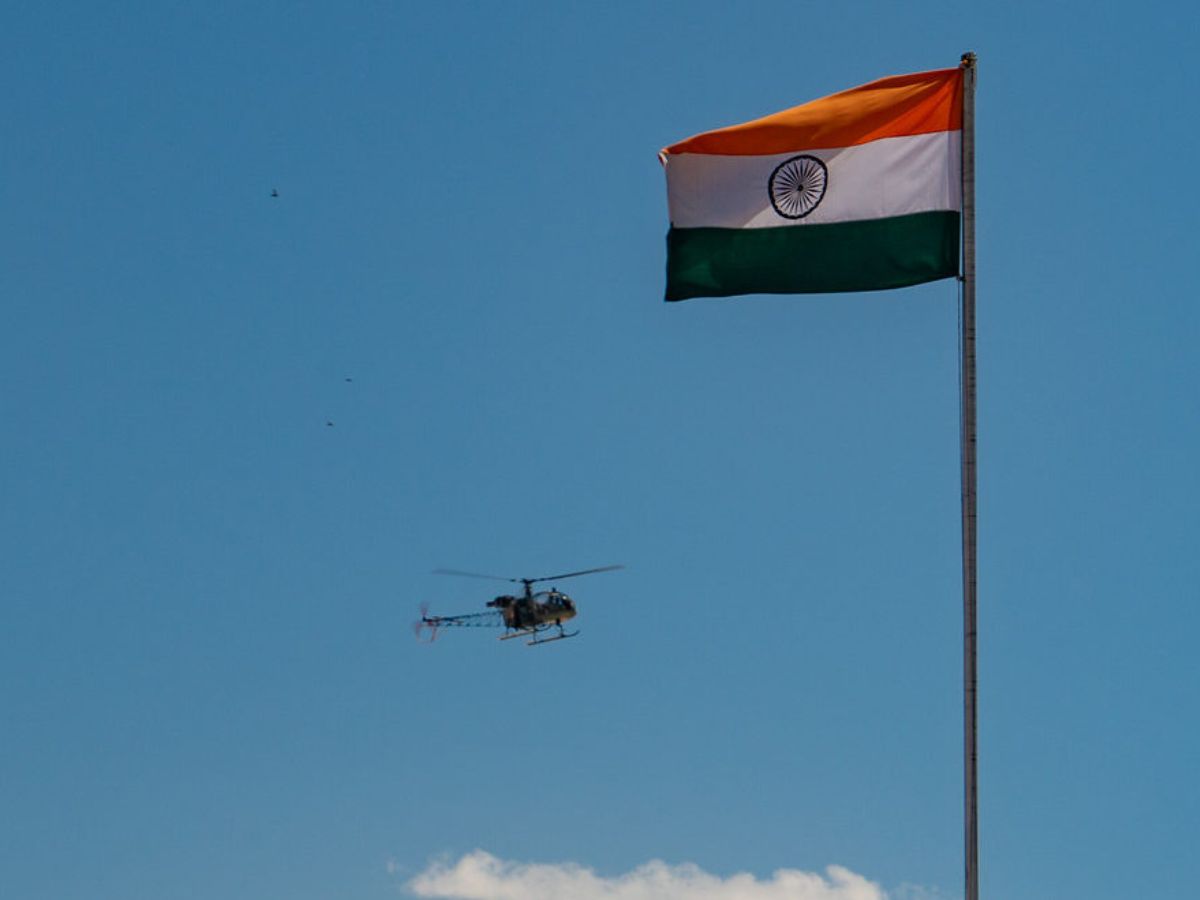
Emergency rations for 25,000 individuals, tent cities, water sources, and machinery such as bulldozers and excavators are already deployed. Helicopters are also on standby to undertake immediate evacuation or rescue operations.
Real-Time Tracking of Convoy and Multi-Agency Coordination
Lt Col Suneel Bartwal highlighted that the Indian Army is carrying out live tracking of yatra convoys by using sophisticated surveillance equipment. Real-time signals are closely monitored by military and civilian agencies to identify disruptions. Effective coordination among multiple agencies guarantees prompt response and safe crowd management, particularly during the busy weeks of the yatra.
As the Amarnath Yatra remains a magnet for thousands of pilgrims, Operation Shiva is a testament to devotion and defence. Better prepared and better coordinated than ever before, the Indian Army is not only protecting an ancient tradition—it is guaranteeing that devout pilgrims can fulfil their religious pilgrimage in safety and serenity.