
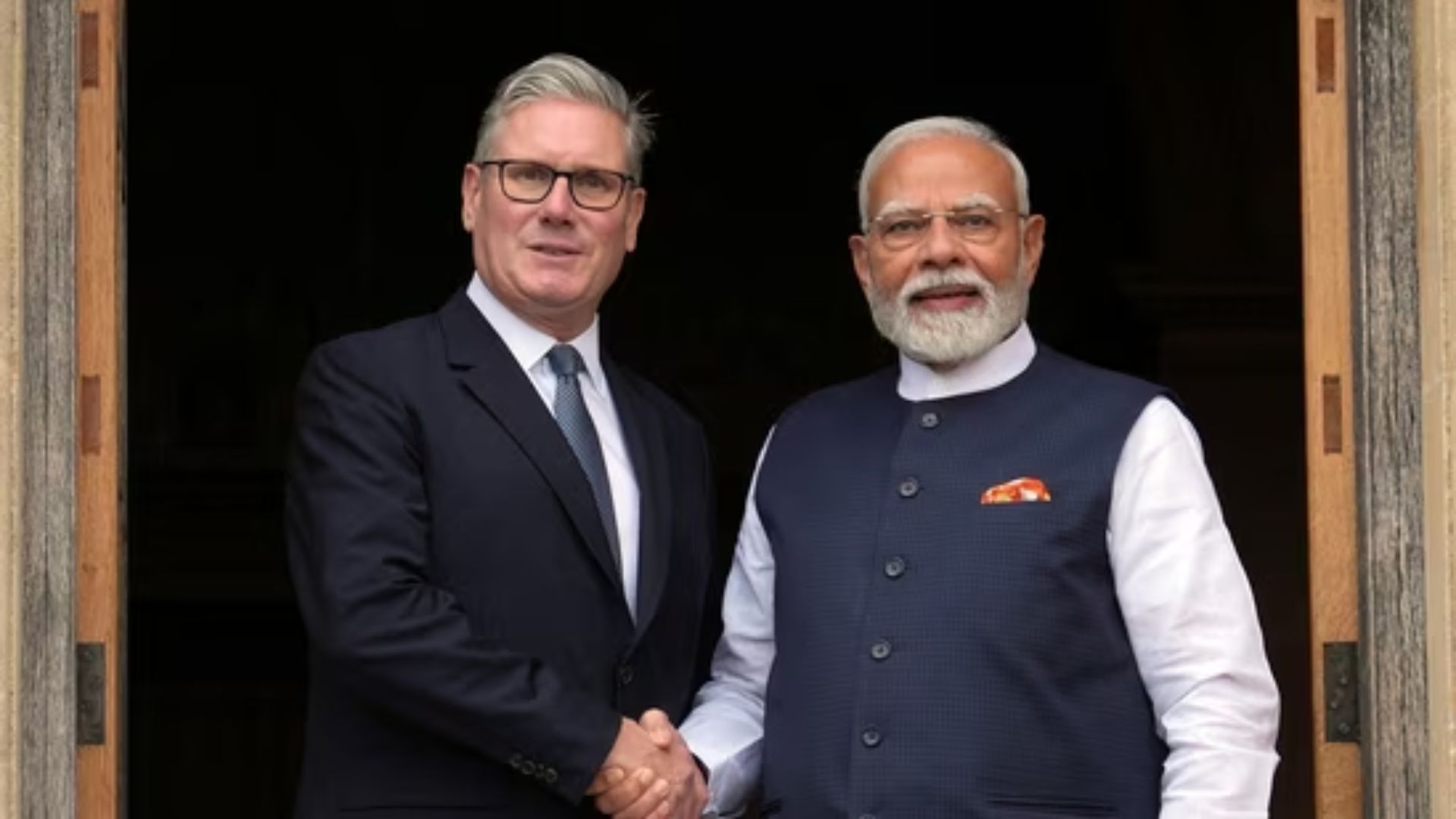
In a historic move towards economic collaboration, India and the United Kingdom have formally signed an extensive Free Trade Agreement (FTA), which UK Prime Minister Keir Starmer termed as ‘the most important agreement the UK has signed since the country left the European Union’.
Meets Indian Prime Minister Narendra Modi in Aylesbury on Thursday, Starmer hails the broad implications of the agreement, saying, “It will bring huge benefits to both of our countries, boosting wages, raising living standards and putting more money in the pockets of working people.”
Emphasizing the sweeping nature of the agreement, Starmer went on to say, “It is a wide-ranging trade deal indeed possibly the widest-ranging India has ever made. The agreement is a strong signal that the UK is open for business.”
Mutual Benefits for Both Nations
The deal is to prove to be a game-changer, yielding mutual benefits across industry sectors. UK-based think tank Centre for Economics and Business Research (CEBR) finds that a properly negotiated FTA could increase the GDP of the UK by as much as £28 billion by 2035. The professional services sector, food and drink, and pharma are some of the main industries set to gain.
India’s fast-growing middle class also offers a rich market opportunity for British exporters, most notably in premium consumer goods. The pharmaceutical industry in the UK, most notably, has opportunities to benefit through joint ventures with Indian firms in drugs research and access regulation.
On the other hand, the agreement provides duty-free access to virtually 99% of Indian exports, opening up almost $23 billion in potential trade in labour-intensive products. Union Commerce Minister Piyush Goyal, in a statement, called the agreement “a new era for inclusive and gender-equitable growth.”
Starmer added, “It is good for jobs, it is good for business, putting tariffs and making trade cheaper, quicker and easier.”
‘Historic Day’ for Bilateral Ties
During the joint address, PM Modi welcomed the agreement as a watershed moment in India-UK relations. “This is a historic day in our bilateral relationship. Both nations have concluded a comprehensive economic trade agreement,” he said.
He reiterated how the agreement would advantage a number of major Indian industries: “Indian products such as textiles, footwear, gems and jewellery, and seafood will find improved access to the UK market. UK products like medical devices and aerospace components will now be accessible to Indians at reasonable prices.”
Building the Future Together
Modi also pointed out how the FTA would create jobs and drive innovation. “This agreement will provide new opportunities for jobs and is part of our commitment from AI and critical minerals to semiconductors and cybersecurity to build the future,” he said.
The agreement is going to further intensify the already robust interdependence of the two countries. UK companies often outsource to Indian drug makers, and Indian companies gain from British innovation as well as regulatory know-how. This model of cooperation is now going to reach new heights with the trade pact in place.