
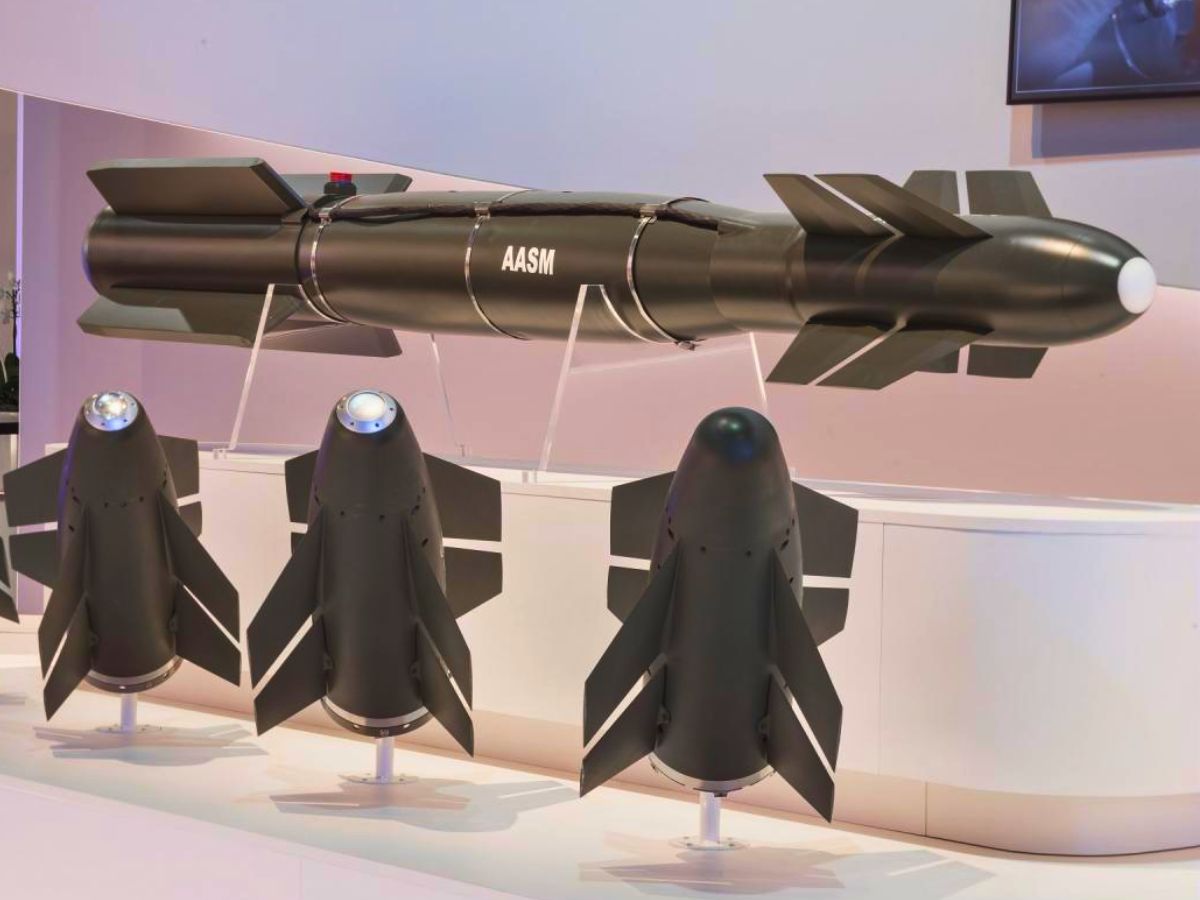
India is set to manufacture the advanced French HAMMER air-to-ground missile system indigenously. Bharat Electronics Limited (BEL) and France’s Safran Electronics and Defence (SED) have signed a Joint Venture Cooperation Agreement (JVCA) to produce the HAMMER weapon in India. The agreement was signed in New Delhi by BEL CMD Shri Manoj Jain and SED Executive Vice President Alexandre Ziegler.
Senior officials, including Secretary (Defence Production) Shri Sanjeev Kumar and Safran CEO Olivier Andries, were also present. This move strengthens India’s defence-manufacturing ecosystem and supports the government’s “Make in India” and “Aatmanirbhar Bharat” goals.
What is the HAMMER Missile?
HAMMER (Highly Agile Modular Munition Extended Range) is a French medium-range precision-guided air-to-surface weapon. It is designed to target well-protected structures like bunkers and hardened shelters.
The missile offers a strike range of over 70 km, allowing fighter aircraft to launch it from safe distances without entering hostile air defence zones. It is also autonomous and highly resistant to jamming, making it reliable in contested environments.
The missile can integrate with different bomb sizes, including 125 kg, 250 kg, 500 kg, and 1000 kg. It is already in service on the Rafale fighter jets. India also plans to use it with the indigenous Light Combat Aircraft (LCA) Tejas.
BEL–Safran JV: What Does the Agreement Mean?
The latest JV agreement builds on a Memorandum of Understanding signed during Aero India 2025. Both companies will form a 50-50 private limited Joint Venture Company (JVC) to manufacture the HAMMER system in India.
According to the firms, the JV will handle the local manufacturing, supply, and long-term maintenance of HAMMER missiles for the Indian Air Force and Indian Navy. The indigenisation level will gradually rise to 60 per cent. Key sub-assemblies, electronics, and mechanical parts will be produced in India.
The production transfer will take place in phases. BEL will be responsible for the final assembly, testing, and quality assurance of the missiles. Safran will support technology transfer and provide the required expertise.
India–France Defence Cooperation Expands
This deal adds to India’s growing list of strategic defence collaborations with France. Earlier, WION had reported on several major projects, including:
- RBE2 Active Electronically Scanned Array (AESA) radar for Rafale
- Aravalli engines for India’s Medium Lift class helicopters
- Development support for HAL’s Indian Multi-Role Helicopter (IMRH)
- Deck-Based Multi-Role Helicopter (DBMRH)
India currently operates 36 Rafale fighter jets and has also ordered 24 Rafale-M jets for aircraft carrier operations.
Boost to India’s Joint Strike Capabilities
The local production of HAMMER missiles is not just a manufacturing milestone. It significantly strengthens India’s joint strike capabilities across air and sea. With Rafale, Rafale-M, and Tejas all capable of using HAMMER, India will have a unified precision-strike weapon across multiple platforms.
This simplifies logistics, cuts import costs, and ensures rapid missile availability during conflict. Experts say the deal reflects India’s long-term push to build a diversified, self-reliant arsenal independent of global supply chain disruptions.