
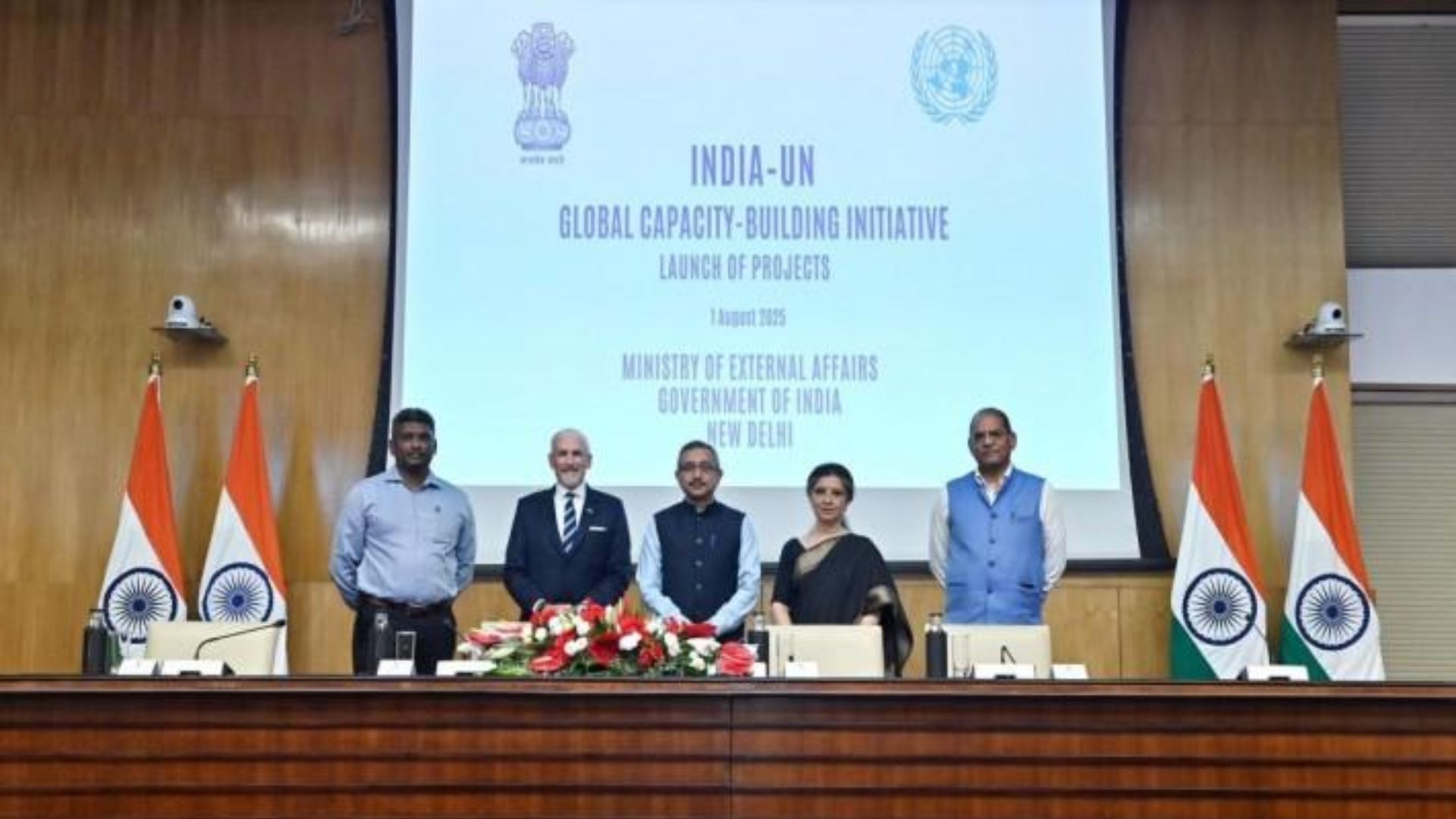
The Government of India officially launched the first four projects under the “India UN Global Capacity Building Initiative.” Secretary (West) Tanmaya Lal of the Ministry of External Affairs (MEA) led the launch. According to an MEA press statement, the event saw participation from UN Resident Coordinator Shombi Sharp, heads of various UN agencies in India, and envoys from the countries involved.
Initiative Announced at UN General Assembly in 2023
India had introduced the initiative in September 2023 on the sidelines of the 78th UN General Assembly in New York. The announcement was made in the presence of External Affairs Minister S. Jaishankar. Since then, the MEA and the UN country team in India have worked closely to identify suitable projects and design ways to implement them. The effort aims to strengthen South-South cooperation and accelerate progress on the Sustainable Development Goals (SDGs).
Building on India’s ITEC Legacy
India has long played a key role in supporting the Global South through its Indian Technical and Economic Cooperation (ITEC) programme. Under ITEC, India provides over 12,000 training slots every year across 400+ specialised courses for participants from nearly 160 countries. So far, more than 2.25 lakh individuals have been trained through this flagship programme.
The new UN-backed initiative builds on this legacy, with a focus on demand-driven, SDG-aligned programmes. It partners with various UN agencies and helps design skill-building projects tailored to local needs. While the UN helps the host country identify priorities and goals, the actual training will be carried out through the ITEC framework.
Four Projects Identified in First Phase
As part of its commitment to supporting sustainable development in the Global South, India has identified four key projects under the first phase of the India UN Global Capacity Building Initiative. These projects, selected in collaboration with various UN agencies, are scheduled to begin implementation in September 2025 and aim to address country-specific development needs through tailored training and capacity-building efforts. The training component for each project will be delivered through specialised ITEC (Indian Technical & Economic Cooperation) institutes.
Here is a detailed overview of the four initiatives:
-
Nepal – Rice Fortification and Supply Chain Management
In partnership with the World Food Programme (WFP), this project focuses on enhancing food security and nutrition in Nepal. It aims to strengthen the rice fortification process and improve the overall efficiency of supply chains related to fortified food distribution. -
Zambia and Lao PDR – Digital Health Platform Development
Supported by the United Nations Development Programme (UNDP), this project will help both countries modernise their healthcare delivery systems by building robust digital health platforms. These platforms are expected to improve access to medical services, especially in remote areas. -
Caribbean Nations – Census Preparedness Programme
With the support of the United Nations Population Fund (UNFPA), this initiative will assist Belize, Barbados, St Kitts & Nevis, Suriname, and Trinidad & Tobago in enhancing their technical readiness for upcoming census exercises. It will focus on improving data collection methods, statistical capacity, and census logistics to support better policymaking. -
South Sudan – Vocational Training Programme
In collaboration with UNESCO, this project aims to provide skill-based vocational training to young people in South Sudan. The programme will help equip participants with practical skills for employment and entrepreneurship, contributing to economic development and social stability.
Each of these projects reflects India’s broader goal of strengthening South-South cooperation and demonstrates the country’s leadership in global capacity-building efforts. By combining UN expertise with India’s development experience and training infrastructure, these initiatives are expected to make a meaningful impact in their respective regions.