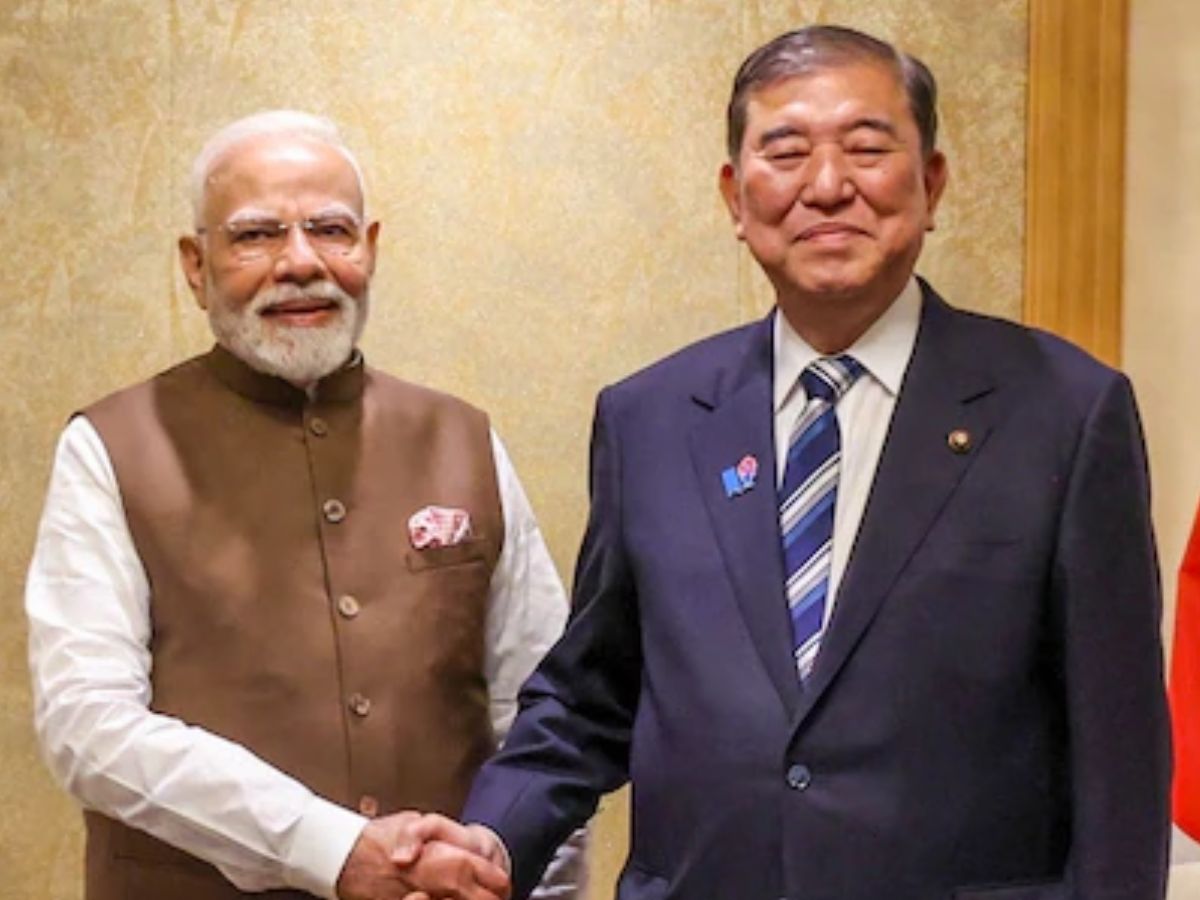
Japan will invest 10 trillion yen ($67 billion) in India over the next decade, PM Narendra and Japanese PM Shigeru Ishiba announced at the 15th India-Japan Annual Summit in Tokyo.
The deals focus on defence, technology, high-speed rail, critical minerals, and training for 50,000 Indians. PM Modi urged Japanese firms to “make in India, make for the world,” signalling a strong push for long-term collaboration.
Major Deals & Agreements
The summit produced 21 outcomes, including 13 formal agreements. Japan will invest in critical mineral exploration and support India’s semiconductor sector. The two countries will boost their cooperation on high-speed rail, such as the Mumbai-Ahmedabad bullet train, and train skilled and semi-skilled Indian personnel.
The leaders also endorsed Japan Industrial Townships in India and agreed to review the Comprehensive Economic Partnership Agreement (CEPA) to make it more future-ready.
ALSO READ: PM Modi’s Japan Visit: Historic Deals, Defence Ties and More Explained in Detail
PM Modi said, “The engagement will not remain limited to India and Tokyo, but deepen through institutional cooperation between Japanese prefectures and states of India, opening new doors.”
Strengthening State-Prefecture Links
India and Japan are linking Indian states with Japanese prefectures. Andhra Pradesh is connected with Toyama, Tamil Nadu with Ehime, Uttar Pradesh with Yamanashi, and Gujarat with Shizuoka. Modi will address the governors of several Japanese prefectures to strengthen collaboration.
Focus on Startups and SMEs
Japan will provide special attention to small and medium enterprises and startups in India. PM Modi said the partnership will foster innovation and create an ecosystem for research and real-world applications. Japan’s space agency JAXA will also support India’s Chandrayaan-5 launch.
ALSO READ: What is Chandrayaan-5, and why is it crucial for India-Japan space ties?
Technology, Defence, & Infrastructure
PM Modi described Japan as a “tech powerhouse” and India as a “talent powerhouse.” He said, “India and Japan’s partnership is strategic and smart. Powered by economic logic, we have turned shared interests into shared prosperity.”
The leaders plan to work together in AI, semiconductors, quantum computing, biotech, space, and defence. They reaffirmed support for a free and rules-based Indo-Pacific and condemned actions that threaten freedom of navigation.
Japan also offered the E10 Shinkansen series for India’s high-speed rail and pledged investments in ports, aviation, shipbuilding, road transport, and logistics.
Roadmap for Next Decade
The summit highlighted eight pillars of cooperation: economic security, technology and innovation, ecological sustainability, health, and state-prefecture engagement. PM Modi and Ishiba set a roadmap for deepening defence ties, boosting trade, and increasing people-to-people exchanges.
The leaders also welcomed India’s new consulate in Fukuoka to strengthen links with the Kyushu region and reaffirmed their commitment to the Quad.
What This Means for India-Japan Ties?
Japan’s pledge comes at a time of global trade uncertainty, including US tariffs. With 150 Memorandums of Understanding worth $13 billion inked in the last two years and $67 billion in anticipated investments, the India-Japan collaboration is expected to strengthen, strengthening India’s economy, technological prowess, and international infrastructure.