
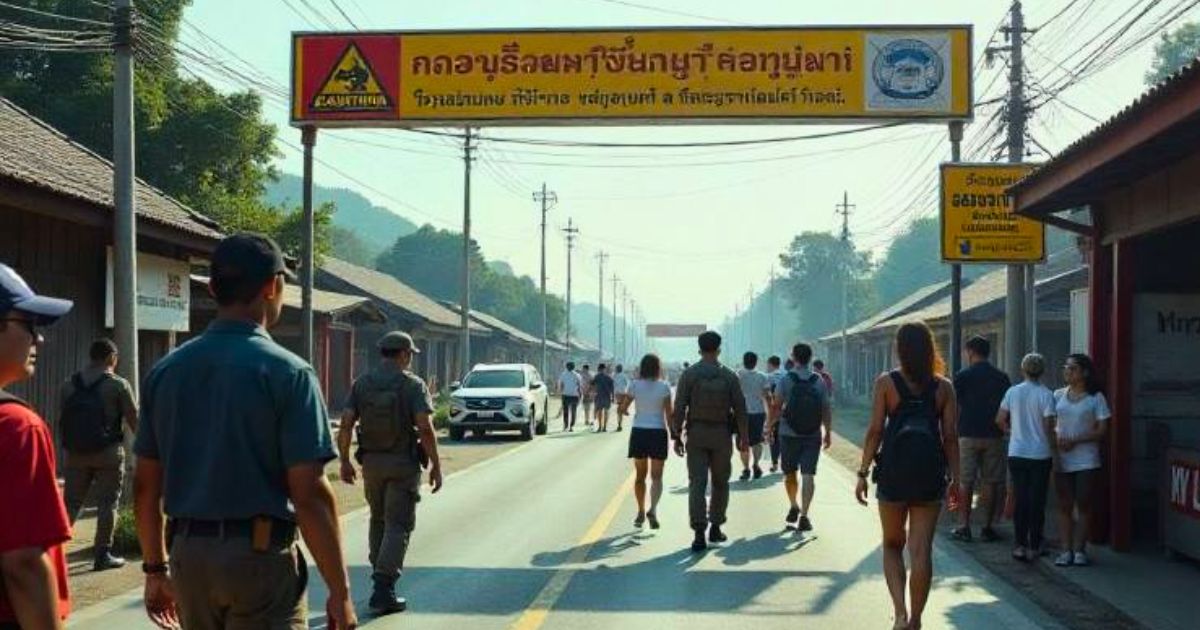
India has posted a travel advisory to its citizens in Thailand following violent border clashes with Cambodia that entered their second day. At least 16 people have died. More than 100,000 civilians have been forced out of their homes. The advisory, released Friday, asks Indian nationals to steer clear of seven eastern provinces close to the Cambodian border.
Heavy artillery and rocket systems have transformed the disputed frontier into a war zone. Diplomatic relations are strained, and peace demands are becoming increasingly vocal from ASEAN, the US, and now India.
Seven Thai Provinces Now Off-Limits
The Indian embassy advisory, posted on social media site X, advises against travelling to Ubon Ratchathani, Surin, Sisaket, Buriram, Sa Kaeo, Chanthaburi, and Trat. These eastern border provinces are among the areas of increased fighting. The embassy has recommended that all Indian travellers keep track of announcements by the Tourism Authority of Thailand (TAT Newsroom) for real-time notifications and mobility restrictions.
The warning follows Thailand’s tourism ministry stating that “a number of attractions” in the affected provinces are no longer safe. Indian officials reiterated the alert, citing increasing dangers to civilian security.
Conflict Spreads Quickly
The battle started on Thursday when explosions from landmines hurt two Thai soldiers, one of whom lost an arm. Thailand blamed Cambodian forces for laying the mines and issued a quick military response. Cambodia denied the accusation but responded with a counterattack.
It began as a minor border skirmish, but soon escalated into one of the most severe clashes in more than ten years. Cambodian BM-21 rocket systems had attacked Thai forces, according to the Thai military. Thailand sent six of its F-16 fighter jets in retaliation, at least one of which hit Cambodian targets.
Shelling was heard at six locations on the 209-km-long frontier. There were huge military convoys, tanks, and soldiers marching through farmlands in Surin and Ubon Ratchathani provinces.
Increased Casualties and Large-Scale Displacement
There were 15 confirmed Thai deaths, 14 of them civilians, and at least 46 injuries. There is one confirmed civilian death and five injuries admitted by Cambodian authorities in Oddar Meanchey province. Approximately 1,500 Cambodian families have been evacuated from border villages.
On the Thai side, more than 100,000 civilians have been relocated from high-risk areas. Emergency camps and field hospitals are being established as concerns over a long-drawn conflict increase.
India Joins Global Call for De-escalation
India’s travel warning is in step with increasing global alarm. The United States, a close Thai ally, has urged an end to hostilities immediately. Malaysian Prime Minister Anwar Ibrahim, as ASEAN chair, talked with leaders from both sides and heard “positive signals” for future negotiations.
Anwar said Malaysia is willing to stage peace talks in the ASEAN spirit of camaraderie and responsibility. Nevertheless, fighting on the battlefield is not abating.
Military Imbalance Escalates Risk
Thailand’s employment of F-16s highlights its military superiority over Cambodia, which lacks fighter planes and minimal defence equipment. Pundits are worried that this imbalance may encourage Thailand to push its advantage, pulling the region into a broader conflict.
The border conflict has its origins in an old dispute over land surrounding the Preah Vihear temple. Previous efforts to solve the problem have not succeeded. With rising nationalism in both nations, diplomacy now needs to move quicker than the guns.
Outlook for Indian Citizens
India’s warning is a precautionary measure, but it indicates more profound concern about the course of the conflict. People are advised to steer clear of travel in affected areas and stay in contact with the embassy for safety information.
With the border war entering a perilous new stage, the protection of civilians, both local and international, must remain paramount. In the coming days, the region will face the challenge of preventing the limited conflict from escalating into an all-out war.