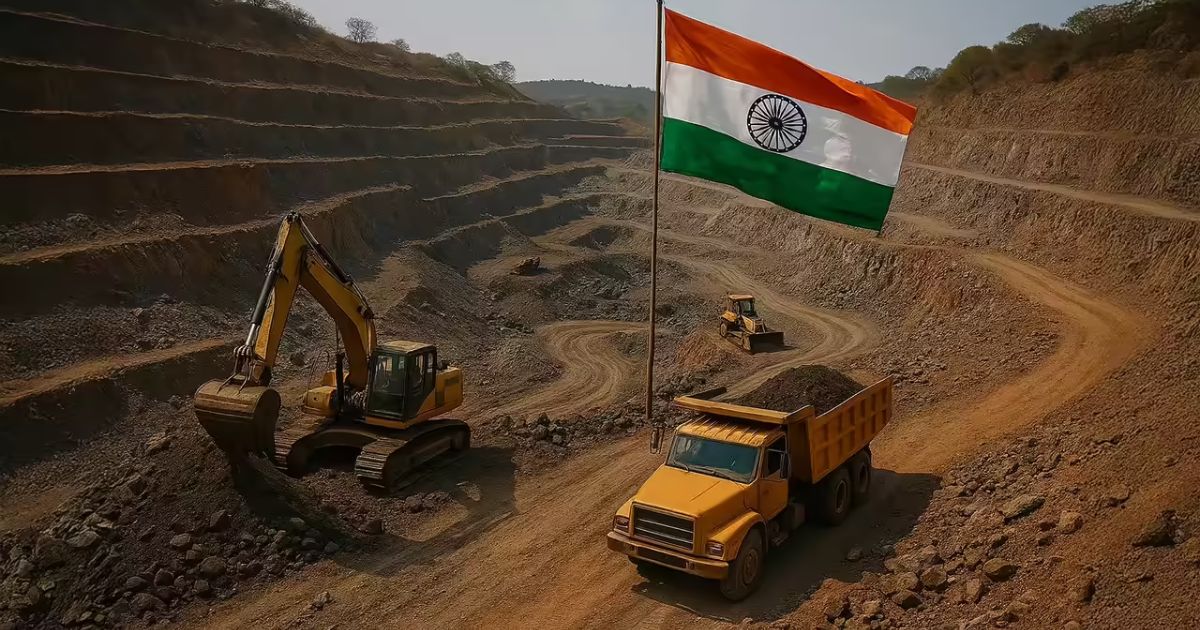
India has found a rare earth bonanza in Rajasthan’s Balotra and Jalore districts. The Geological Survey of India (GSI) and the Department of Atomic Energy (DAE) have confirmed indications of vital minerals such as neodymium and dysprosium. These are crucial minerals for contemporary technology and defense.
The Centre is now gearing up for auctioning land to start rare earth mining, as part of India’s larger effort to reduce reliance on Chinese supply and achieve self-reliance. The effort is under the National Critical Mineral Mission (NCMM) and is supported by a ₹1,000-crore PLI scheme to increase indigenous magnet production.
Why Rare Earths Matter Now?
Rare earth elements (REEs) drive contemporary life. They are the 17 minerals that are used in everything from smartphones and electric cars to defence hardware and satellites. Although the name suggests otherwise, they are not precisely rare as a quantity. Rather, it is difficult and costly to extract them. They often exist with other minerals, hence making separation challenging.
At present, China holds a virtual monopoly on the processing of rare earth. This confers on it considerable geopolitical clout. India must thus build its rare earth facility. The Rajasthan find could be a game-changer.
Balotra and Jalore: New Hubs of Strategic Minerals
The Rajasthani discovery surpasses both Jalore and Balotra. The rare earth element source minerals, xenotime, britholite, and bastnasite, are found in these regions. Metals like cerium, lanthanum, neodymium, praseodymium, gadolinium, and dysprosium can be produced by these minerals.
The Department of Atomic Energy and the Geological Survey of India have conducted early exploration. Although at preliminary stages, indications are encouraging. CNN-News18 reports affirm that auctions for mining patches will be conducted shortly.
India Ramps Up Rare Earth Push
This finding is also in line with the Centre’s National Critical Mineral Mission (NCMM). The mission seeks to encourage exploration, mining, and processing of important minerals. India has also initiated a ₹1,000-crore Production-linked Incentive (PLI) scheme. The aim is to encourage local manufacturing of rare earth magnets for use in appliances, electric vehicles, and fighter aircraft.
The US Geological Survey (USGS) has also mentioned that India possesses the third-largest rare earth reserves in the world. Nevertheless, India still has a problem. Its ores tend to have low metal concentration, which complicates processing.
Step Towards Self-Reliance
IREL India, a public sector company dedicated to rare earth mining, has mentioned that Rajasthan’s hard rock reserves can mitigate this problem. Increased concentration in these rocks can lower processing challenges.
India’s strategic effort to build its rare earth supply chain is making progress. Balotra and Jalore discoveries are a significant step in that direction. While auctions are ongoing and policy support is already on the table, India is finally inches closer to an assured critical mineral future.