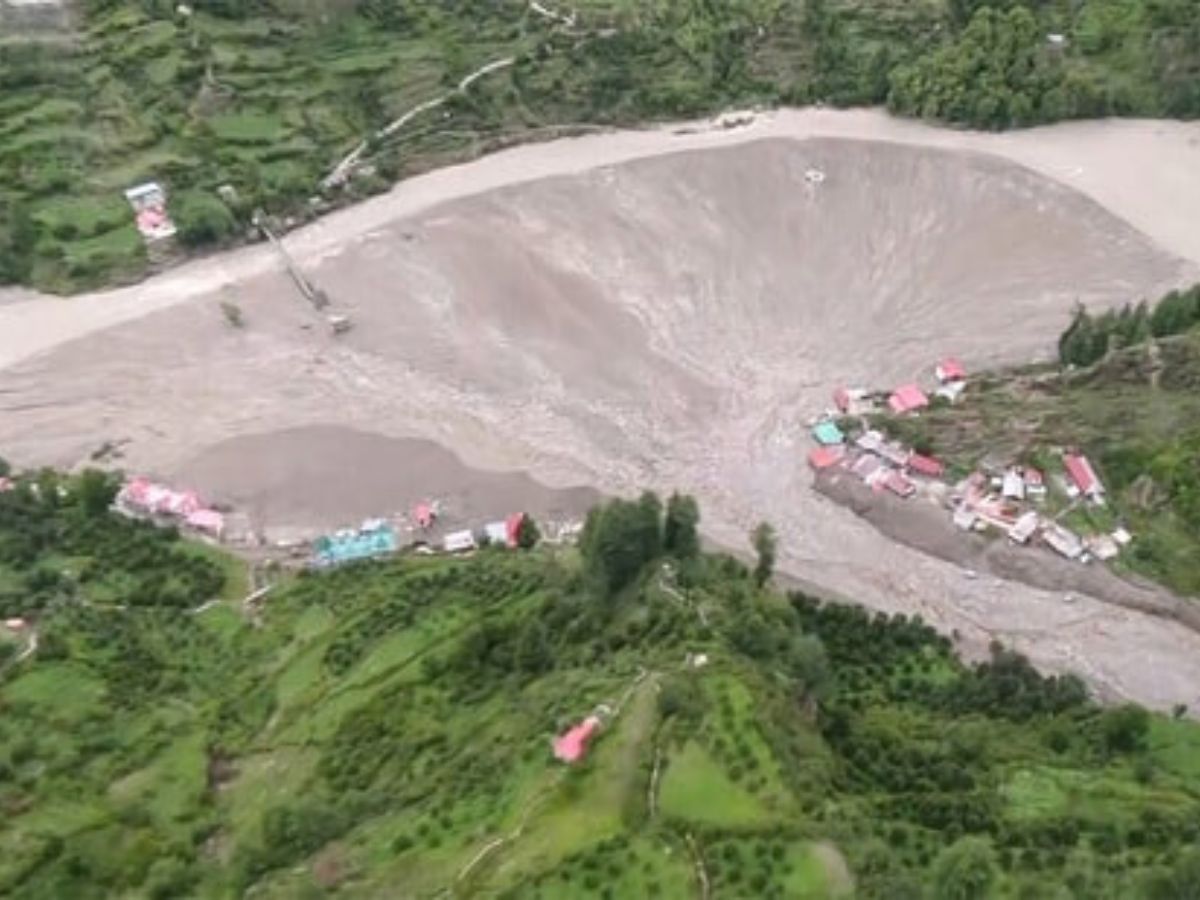
A team from the Indian Institute of Science (IISc) suspects that a “hanging glacier” feeding the Kheer Ganga channel may have played a major role in triggering the devastating flash floods in Dharali, Uttarakhand, on August 5.
A preliminary analysis by the National Disaster Management Authority (NDMA) also pointed towards a glacier collapse as the likely cause.
According to the Divecha Centre for Climate Change at IISc, there are 219 hanging glaciers in the Alaknanda and Bhagirathi basins. As part of an ongoing study, researchers recently completed a detailed geospatial mapping of these glaciers.
What Are Hanging Glaciers—and Why Are They Dangerous?
Hanging glaciers originate high on the steep walls of a glacier valley and descend only partway, without reaching the main glacier surface.
“They are very sensitive to warming, with surface melt starting earlier than in other glaciers,” said Anil Kulkarni, distinguished visiting scientist at the Divecha Centre.
The glacier on the Kheer Ganga channel, IISc scientists found, was in a “very vulnerable” position. Two hanging glaciers in the vicinity have a combined ice volume of roughly 1 cubic kilometer.
Historical satellite images show changes over time, and the flood’s sudden onset suggests either a glacier detachment or the outburst of a lake formed by blocked river flow.
Civil Society Warned of Disaster Months Earlier
The Himalayi Nagarik Drishti Manch has written to multiple authorities, including the Bhagirathi Eco-Sensitive Zone Monitoring Committee and the Ministry of Environment, demanding accountability for the Dharali disaster.
The group pointed to an April 30, 2024 letter warning of impending disasters and calling for a halt to indiscriminate construction in sensitive river and hill zones.
Rescue Operations: Racing Against Time
Rescue teams, including the Indian Army and the National Disaster Response Force (NDRF), are in a high-stakes search for missing persons.
Ground-penetrating radar (GPR) devices have been airlifted from the Siachen Glacier, adding to the existing equipment on site. These devices, usually deployed in avalanche rescues, are helping teams locate possible survivors trapped under layers of mud and debris.
Nearly 200 NDRF personnel are using advanced radars and life-detection devices to comb through a 4-km stretch between Dharali and Harshil. The State Disaster Management Authority (SDMA) has divided the search area among multiple agencies.
Also Read: Europe on Fire: Mediterranean Heatwave Sparks Deadly Infernos, Mass Evacuations
Mountains of Debris and Buried Buildings
“The scale is massive, some buildings as tall as three stories are completely buried under the mud,” said a senior NDRF officer.
Locals and eyewitnesses are guiding rescue teams to spots where victims might be trapped. The process involves both manual digging and machine-assisted excavation.
Experts warn that hanging glaciers across the Himalayas are under increasing threat due to rising temperatures. Without urgent monitoring and disaster preparedness, similar incidents could strike other vulnerable regions in Uttarakhand and beyond.