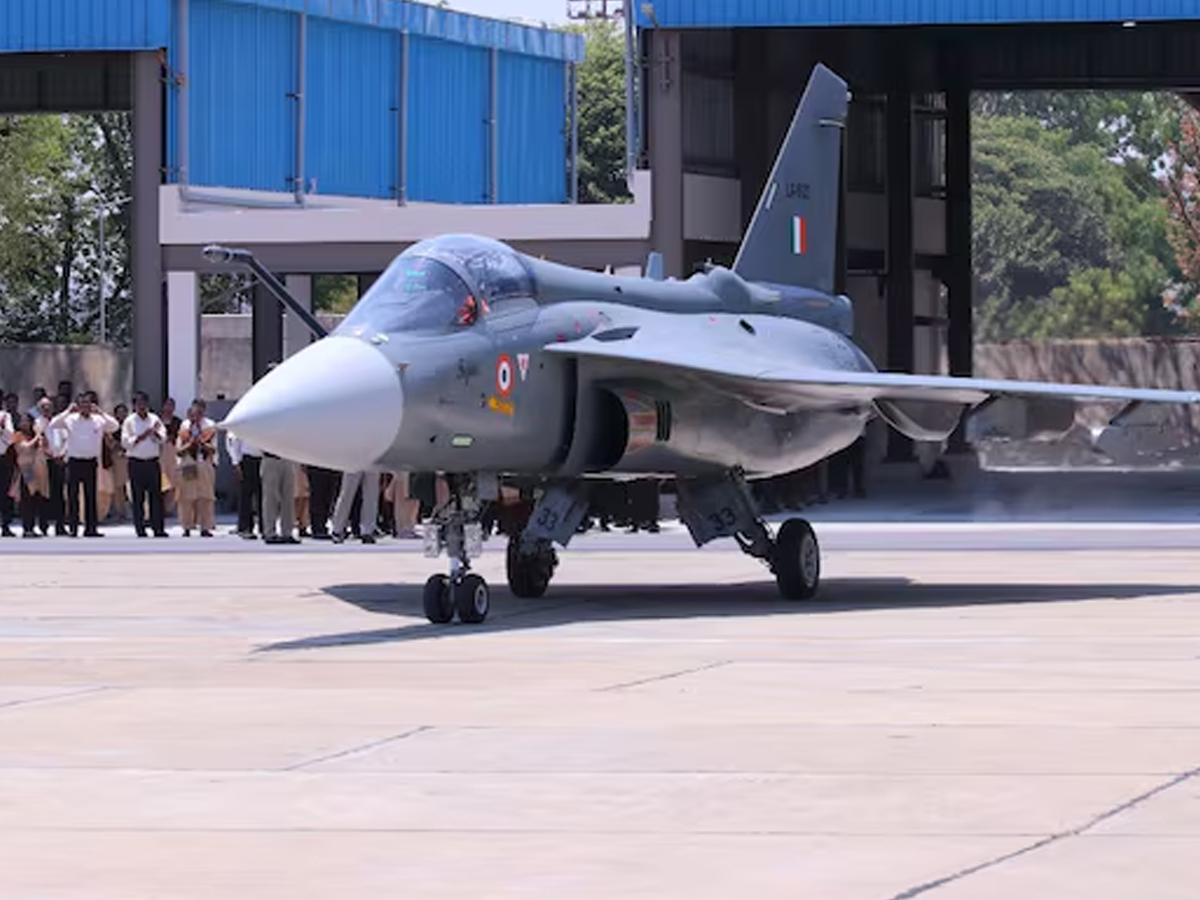
India’s homegrown fighter jet program is set for a major milestone this month. Defence Minister Rajnath Singh will witness the first flight of the Tejas Mk1A aircraft in Nashik on October 17, officials confirmed. The event marks an important step in India’s ongoing efforts to strengthen its air combat capability through indigenous technology.
The Defence Minister will also visit the Hindustan Aeronautics Limited (HAL) facility in Nashik and interact with engineers and staff engaged in the production of the advanced fighter jets.
Delay in Delivery Due to Slow Engine Supply
The much-awaited rollout of the Tejas Mk1A jets faced multiple delays. HAL was originally expected to begin deliveries of the aircraft in February 2024, but production slowed down due to delayed engine supplies from General Electric (GE Aerospace).
According to officials, GE has been delivering only one or two engines per month, far below the expected supply rate. This has directly affected HAL’s assembly schedule. The defence manufacturer is now targeting to complete deliveries within four years, provided the engine supply stabilises and there are no further setbacks.
Officials at HAL said that while airframe production is progressing steadily, the shortage of engines has been the single biggest bottleneck. Once deliveries from GE increase, HAL plans to accelerate the assembly line to meet the Indian Air Force’s (IAF) urgent demand.
83 Tejas Mk1A Fighters on Order, 97 More Under Negotiation
India has already signed a ₹48,000 crore contract for 83 Tejas Mk1A aircraft, but the Defence Ministry is also in the final stages of negotiating an additional 97 fighters. Talks between the ministry and GE Aerospace are ongoing to ensure faster and more consistent engine supply for the extended order.
The Tejas Mk1A — an improved version of the Tejas Mk1 — features advanced avionics, modern radar, electronic warfare systems, and mid-air refuelling capability. Once fully deployed, these aircraft will significantly enhance the IAF’s light fighter fleet.
IAF’s Fighter Shortage Remains a Concern
Defence experts have repeatedly raised concerns about the IAF’s declining squadron strength. Currently, the force operates with 29 squadrons, well below its sanctioned strength of 42.
Even after Operation Sindoor, which highlighted the importance of air superiority, no major progress has been made in replenishing fighter numbers. Two MiG-21 squadrons have recently been decommissioned, further widening the gap.
IAF Chief Air Chief Marshal Amar Preet Singh voiced his concern, saying, “Hungry mouths are ready; we are waiting for the food.” He stressed that to maintain operational readiness, the IAF requires two squadrons — around 30 to 40 aircraft — to be produced every year.
Focus Shifts to Rafale and Indigenous AMCA
While HAL works to ramp up Tejas production, the IAF’s plan to acquire 114 Multi-Role Fighter Aircraft (MRFA) is progressing through procedural stages. The Defence Ministry is evaluating a proposal to buy ‘Made in India’ Rafale jets, with 18 aircraft expected to be delivered off-the-shelf in the near term.
French manufacturer Dassault Aviation confirmed that 533 Rafale jets have been ordered globally, with 233 still in production. The company recently increased its production rate to four aircraft per month to meet growing demand.
In parallel, India has also committed over ₹15,000 crore for developing the Advanced Medium Combat Aircraft (AMCA) — the country’s first indigenous fifth-generation stealth fighter. The aircraft is expected to take flight within this decade and enter service by 2035.
India’s Future Air Power Goals
Defence analysts estimate that India will need at least 200–250 additional fighters over the next decade to maintain air dominance. A strong mix of imported and indigenous fighters, supported by reliable engine supply chains, will be key to achieving that goal.
With the Tejas Mk1A’s first flight around the corner and negotiations for new fighters underway, India is taking a major step toward building a self-reliant and combat-ready air force.