
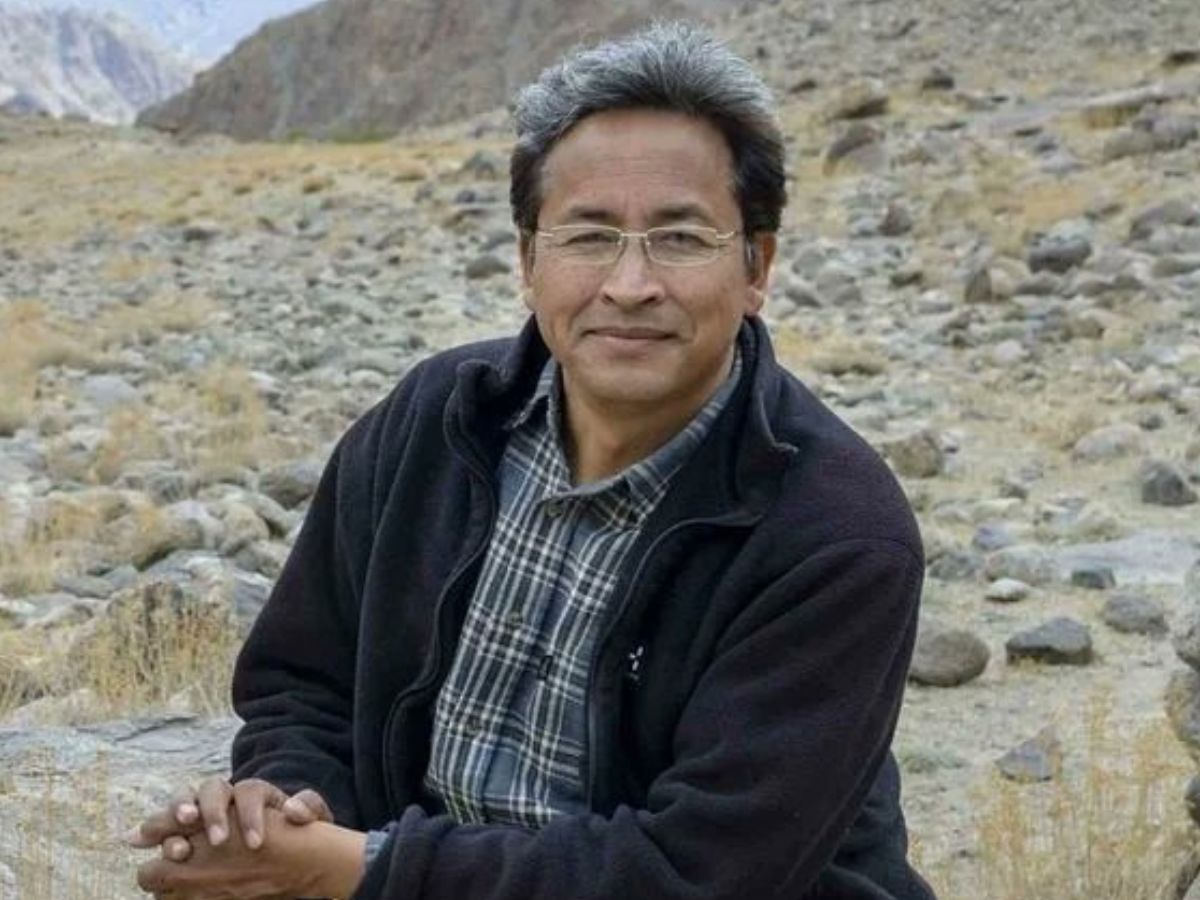
Sonam Wangchuk, the renowned Ladakhi engineer and education reformist, has recently been at the center of statehood protests in Ladakh. Beginning his hunger strike in September 2025 to demand greater autonomy and protection for tribal communities, Wangchuk’s peaceful activism was overshadowed by violent clashes in Leh that left several people dead and injured. His involvement highlights his ongoing commitment to advocating for Ladakh’s rights and self-governance.
Sonam Wangchuk has highlighted that all is not well in Ladakh, according to villagers. One of his notable initiatives, the Ice Stupa, is an artificial glacier project designed to tackle water scarcity in the region. During winter, meltwater is piped from nearby rivers and sprayed upward, forming large, cone-shaped ice towers. These ice stupas slowly melt in spring, providing much-needed irrigation water for crops when it is most required. The project not only ensures water availability for villages but has also emerged as a model for sustainable water management in the Himalayas.
Career and Contributions
Wangchuk, born on 1 September 1966 in Uleytokpo, Ladakh, is an Indian engineer, innovator, and education reformist who has become a symbol of creativity and sustainable development. He is best known as the inspiration for the movie character Phunsukh Wangdu in 3 Idiots. Wangchuk has dedicated his life to improving education and addressing environmental challenges in his native region. Wangchuk is the founding-director of the Students’ Educational and Cultural Movement of Ladakh (SECMOL), established in 1988 by a group of students who felt alienated by the traditional education system imposed on Ladakh. SECMOL focuses on providing quality education, fostering creativity, and empowering students to think independently. Wangchuk personally designed the SECMOL campus, which operates entirely on solar energy and does not rely on fossil fuels for cooking, lighting, or heating.
Beyond education, Wangchuk is known for his environmental innovations. He invented the Ice Stupa, an artificial glacier that stores water in Ladakh’s arid regions, helping farmers and communities manage water scarcity during harsh winters. His creative solutions to local problems have earned him international recognition and awards, including the prestigious Ramon Magsaysay Award.
Net Worth and Income In Rupees
Although his primary focus is education and social work, Sonam Wangchuk has a presence on digital platforms. His YouTube channel, @wangchuksworld, has over 1.7 million subscribers. His estimated net worth is around ₹75 lakh (approximately $90,000), with monthly earnings ranging from ₹3.5 lakh to ₹5.5 lakh, and an annual income of ₹43 lakh to ₹67 lakh from ad revenue, sponsorships, and other digital streams.
While these figures reflect his online work, Wangchuk’s influence is measured far more by his impact on education and sustainable development than by monetary wealth.
Personal Life
Sonam Wangchuk is married to Gitanjali Angmo, a co-founder of the Himalayan Institute of Alternatives Ladakh (HIAL). Together, they work to provide alternative education and promote sustainable development solutions in the Himalayan region. Gitanjali has played a crucial role in establishing and expanding HIAL, supporting Wangchuk’s vision for a greener and more educated Ladakh.
Legacy and Impact
Sonam Wangchuk’s work bridges education, innovation, and environmental sustainability. From transforming Ladakh’s educational system to designing solutions like the Ice Stupa, he has shown that creativity and practical problem-solving can bring lasting change to society.
His story is a reminder that true wealth lies not in material possessions but in the positive impact one leaves on the world.