Prime Minister Narendra Modi extended his wishes to the nation, emphasizing the courage and sacrifice of Indian soldiers whose efforts secured a historic victory in 1971 on Vijay Diwas. He highlighted that their selfless service protected India, creating a moment of pride in the nation’s history. The Prime Minister noted that the heroism of these soldiers continues to inspire generations of Indians.
On Vijay Diwas, we remember the brave soldiers whose courage and sacrifice ensured India had a historic victory in 1971. Their steadfast resolve and selfless service protected our nation and etched a moment of pride in our history. This day stands as a salute to their valour and…
— Narendra Modi (@narendramodi) December 16, 2025
Significance of Vijay Diwas
Vijay Diwas, observed on December 16, remembering India’s decisive victory over Pakistan in the 1971 War, which led to the liberation of Bangladesh. The day serves to honor the sacrifices of soldiers and celebrate military strength.
The 1971 war was led by then-Prime Minister Indira Gandhi and Chief of the Army Staff Field Marshal Sam Manekshaw. The important event included the Battle of Longewala, where Indian troops successfully defended against a heavy Pakistani armored assault, and the Tangail Airdrop, which accelerated the fall of Dhaka. Around 3,900 Indian soldiers were martyred, and nearly 10,000 were injured during the conflict.
Let’s explore the history of 1971, a year of immense importance, as Vijay Diwas is observed to honor this historic victory.
December 16, 1971: A Historic Victory on Vijay Diwas
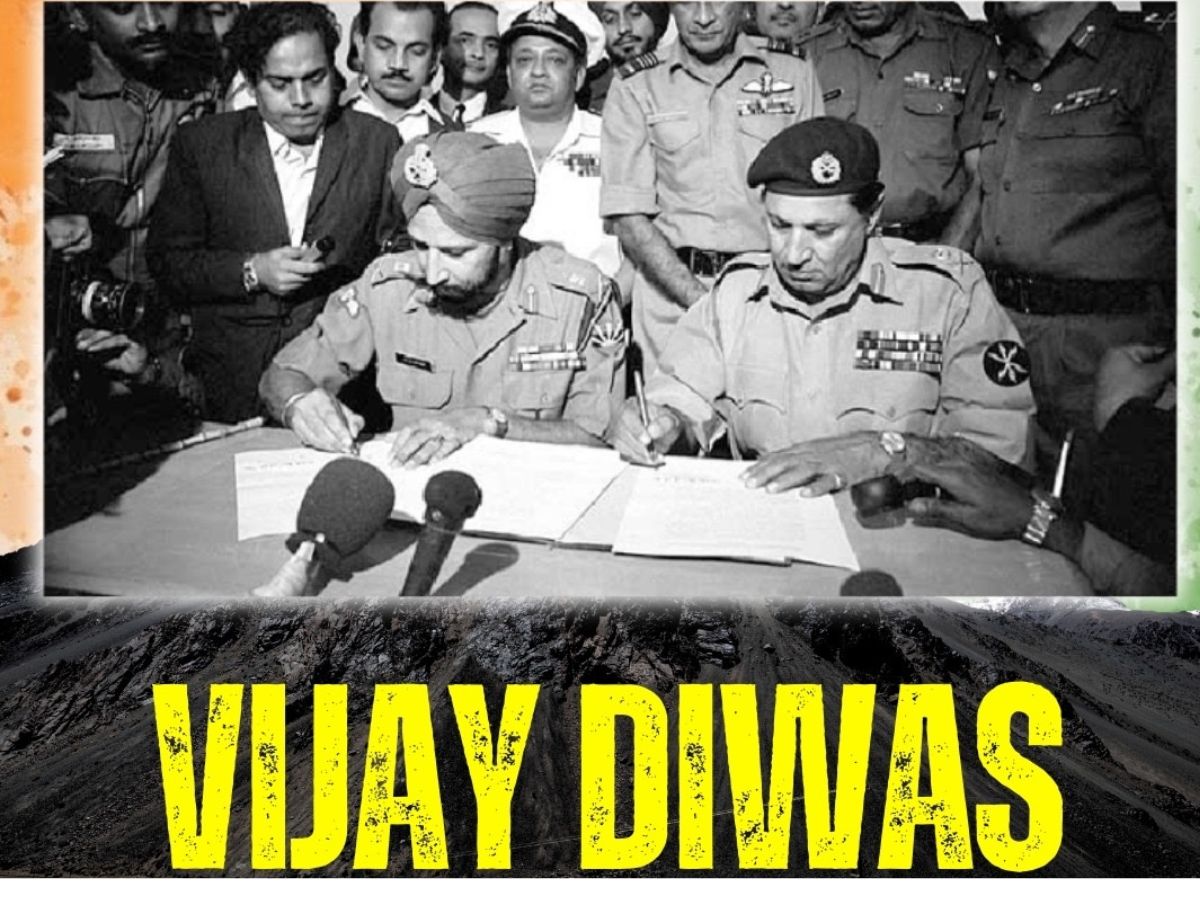
The surrender of over 93,000 Pakistani soldiers in Dhaka marked the end of the 1971 conflict and the creation of Bangladesh. The India–Pakistan War of 1971, also called the Third Indo-Pakistani War, began on December 3, 1971, with Pakistan’s preemptive airstrikes on eight Indian airbases under Operation Chengiz Khan. India responded by formally entering the war on the side of Bengali nationalist forces seeking independence from East Pakistan.
How India Planned the 1971 War in Just 13 Days
Within just thirteen days, India gained a decisive advantage. On December 16, 1971, the Eastern Command of the Pakistan military signed the instrument of surrender in Dhaka, resulting in Bangladesh’s independence. Among the 93,000 prisoners captured, 79,676 to 81,000 were uniformed Pakistani soldiers, with the remainder being civilians or collaborators.
Mass Genocide in the 1971 War
The conflict led to immense human suffering. Estimates suggest that Pakistani forces and pro-Pakistani militias killed between 300,000 and 3,000,000 civilians in Bangladesh. Additionally, eight to ten million people fled to India as refugees. A systematic campaign of genocidal rape by the Pakistan military and militias affected between 200,000 and 400,000 Bangladeshi women and girls.
How did the 1971 War Start?
The war stemmed from the Bangladesh Liberation struggle, triggered by Pakistan Army violations of East Pakistan’s rights. Political tensions escalated due to historical grievances: the partition of India in 1947, the Bengali language movement in 1950, mass riots in 1964, and widespread protests in 1969. These events culminated in President Ayub Khan resigning and General Yahya Khan taking control of Pakistan’s central government. The vast geographical distance between East and West Pakistan also hindered cultural integration and governance.
India’s Strategic Planning
By April 1971, then Prime Minister Indira Gandhi sought the opinion of Army Chief Gen. Sam Manekshaw on going to war with Pakistan. Manekshaw initially refused, citing the monsoon season and the need for army preparation, even offering his resignation. Gandhi accepted his conditions and allowed him to prepare for a calculated offensive. By mid-July, India finalized its attack strategy. The dry ground in East Pakistan by November would allow rapid advancement, while snow in the Himalayan passes by December would limit potential Chinese intervention.