
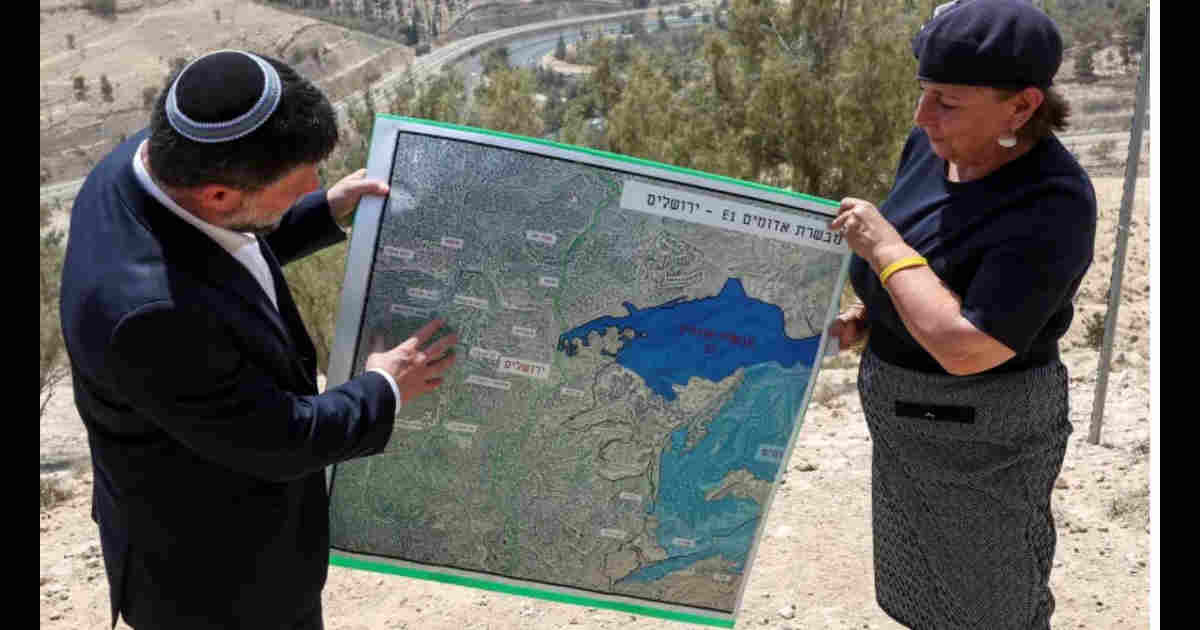
Britain and France joined 19 other countries on Thursday in condemning Israel’s decision to approve a controversial settlement project in the occupied West Bank. The joint statement described the move as “unacceptable and a violation of international law.”
Details of the Settlement Plan
On Wednesday, Israel gave the green light to construction on a 12-square-kilometre (five-square-mile) stretch of land known as the E1 area, located just east of Jerusalem. The project aims to build about 3,400 housing units in this highly sensitive zone, which links Jerusalem with the existing Israeli settlement of Maale Adumim.
International critics argue that if carried out, the project would split the West Bank into two disconnected parts, making it almost impossible to establish a viable Palestinian state.
Strong Condemnation from World Leaders
The joint statement was signed by the foreign ministers of Australia, Canada, Italy, Belgium, Denmark, Estonia, Finland, Iceland, Ireland, Japan, Latvia, Lithuania, Luxembourg, the Netherlands, Norway, Portugal, Slovenia, Spain and Sweden, along with the European Commission’s foreign affairs chief.
In their statement, the ministers declared: “We condemn this decision and call for its immediate reversal in the strongest terms.” They also quoted Israeli Finance Minister Bezalel Smotrich’s own remarks that the plan “will make a two-state solution impossible by dividing any Palestinian state and restricting Palestinian access to Jerusalem.”
The statement further stressed: “This brings no benefits to the Israeli people. Instead, it risks undermining security and fuels further violence and instability, taking us further away from peace. The government of Israel still has an opportunity to stop the E1 plan going any further. We encourage them to urgently retract this plan.”
Palestinian and UN Reactions
The Palestinian Authority (PA), based in Ramallah, sharply criticised the approval, calling it another step towards preventing the establishment of an independent Palestinian state.
UN Secretary-General Antonio Guterres and Philippe Lazzarini, head of the UN agency for Palestinian refugees (UNRWA), also voiced concern. Lazzarini warned that the project would “completely cut off the northern and central West Bank from the southern West Bank – meaning that there would no longer be any territorial contiguity.” He added that Israel’s decisions were making the prospect of a two-state solution “increasingly impossible.”
Britain Summons Israeli Envoy
Taking diplomatic action, Britain summoned Israeli ambassador Tzipi Hotovely to its foreign ministry in protest. In a separate statement, the UK foreign office said: “If implemented, these settlement plans would be a flagrant breach of international law and would divide a future Palestinian state in two, critically undermining a two-state solution.”
Also Read: Earthquake of 8.0 magnitude strikes Drake Passage; Tsunami warning issued
Background on Settlements
Israel has occupied the West Bank since 1967, and all its settlements there are considered illegal under international law, even if they receive approval under Israeli regulations. The E1 plan, in particular, has long been seen by world leaders as a “red line” because of its potential to block any future Palestinian state from having a geographically connected territory.