
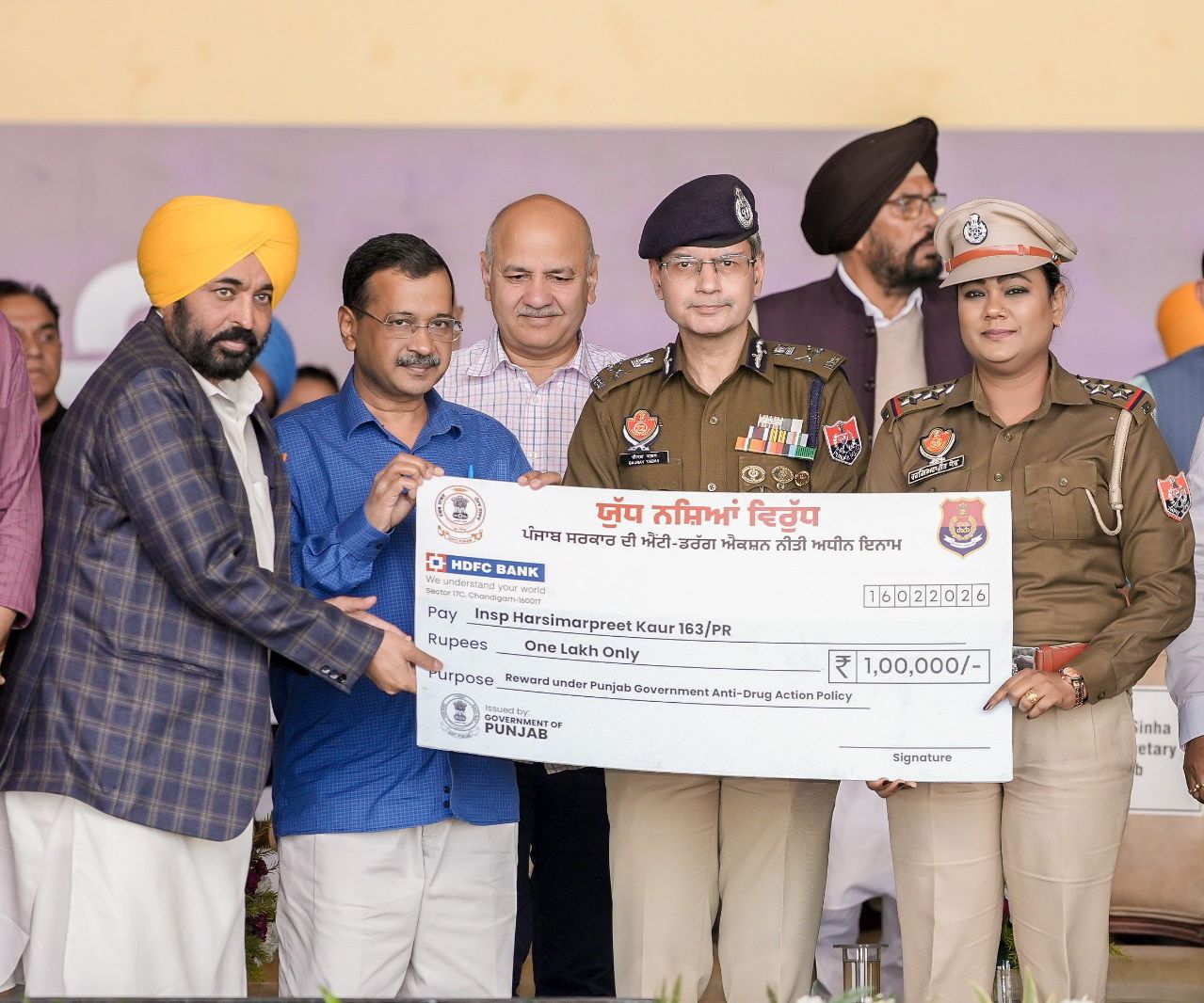
CHANDIGARH: Killi Chahal village in Moga district turned into the epicentre of Punjab’s anti-drug campaign on Monday as scores of members in lakhs gathered for the mega Village Defence Committee meeting under “Yudh Nasheya Virudh 2.0.” The scale of the rally reflected a growing statewide mobilisation against narcotics, with villagers, local representatives, youth groups and officials assembling in what the government described as a movement rather than a routine programme.
Political observers viewed the gathering as a strong show of organisational strength by the ruling Aam Aadmi Party ahead of the upcoming Vidhan Sabha elections. Yet beyond the political interpretations, the turnout signalled a rare convergence of administrative resolve and public participation on one of Punjab’s most pressing social challenges.
By placing bureaucrats at the forefront and introducing the VDC app directly to the public, the government signalled a shift toward deeper community engagement. Equipping residents with the ability to report anonymously is expected to create continuous pressure on drug suppliers and restrict their operations in rural pockets.
Addressing the gathering, the Chief Minister declared, “Today is not just a meeting; it is a movement. From the sacred soil of Killi Chahal in Moga, we send a clear and powerful message to the entire state: Punjab stands united in its war against drugs and crime.”
Bureaucrats stepped forward in a significant departure from convention, the state’s top bureaucratic leadership took the stage to directly engage with villagers. For the first time since the Village Defence Committee initiative began, senior officers explained the technological backbone of the campaign and urged citizens to actively use it.
IPS officer Gaurav Yadav, Director General of Police, Punjab, and Chief Secretary KAP Sinha personally briefed the gathering about the VDC mobile application and the broader mission to dismantle drug networks. Their presence underscored the government’s attempt to project the campaign as an institutional priority rather than merely a political narrative.
Officials informed residents that the app enables anyone to anonymously alert the police about drug peddlers, trafficking routes or suspicious activities in their locality. The anonymity feature, they stressed, is intended to eliminate fear of reprisal, a factor that has historically discouraged people from sharing information.
The DGP said community intelligence can become a decisive weapon against narcotics, as residents are often the first to notice unusual activity. He urged villagers to treat the platform as a collective security mechanism and assured them that every credible input would trigger swift action.
Chief Secretary Sinha described the mission as a partnership between citizens and the administration, noting that technology now allows real-time communication between villages and enforcement agencies. The direct outreach by top officials was widely seen as an effort to build trust and encourage deeper community involvement.
RISE OF THE VILLAGE DEFENCE COMMITTEES
The Village Defence Committees have rapidly evolved into a grassroots framework aimed at strengthening surveillance while fostering cooperation between citizens and the police. According to figures shared at the rally, more than 1.5 lakh people have voluntarily joined the initiative, and nearly 16,000 Village Defence Committees have been formed across Punjab to activate and strengthen this network.
The Chief Minister described the VDCs as the “true strength of our villages,” adding that they represent vigilance, responsibility and collective courage.
“Our VDC members include village sarpanches, retired government officials, teachers, youth and respected elders. These are individuals whose integrity is unquestioned and whose commitment to society is unwavering. You are the eyes and ears of the community. You are the bridge between the people and the police, and this unity is already delivering results,” he said.
Security experts believe that structured citizen participation not only enhances intelligence gathering but also helps rebuild public confidence in law enforcement, particularly in rural regions where distrust has sometimes hindered investigations.
Technology-driven policing: The VDC app, integrated with the Safe Punjab WhatsApp chatbot platform, has emerged as a central pillar of the initiative. Authorities said the system allows residents to pass on information discreetly and efficiently.
Within a short period, the government reported receiving 1,165 actionable tips that led to the registration of 178 FIRs and the arrest of 268 accused persons.
“This proves one thing: when citizens and government work together, change is unstoppable,” the Chief Minister said, citing the data as evidence that community participation can produce tangible results.
Experts note that anonymous reporting tools reduce hesitation among informants and create sustained pressure on local drug operators, who often rely on silence within communities to function.
CAMPAIGN ENTERS A DECISIVE PHASE
The rally marked a renewed push for “Yudh Nasheya Virudh,” operational since March 1, 2025, which the government has framed as a mission-mode strategy rather than routine enforcement. The campaign rests on three pillars: zero tolerance against drugs, accountability at every level and active community participation.
“It is a whole-of-government strategy to break drug supply chains, dismantle trafficking networks and ensure strict action against every stakeholder in the narcotics trade,” the Chief Minister said.
Between March 1, 2025, and February 12, 2026, Punjab registered 34,522 cases under the NDPS Act, including 1,799 involving commercial quantities. Authorities arrested 44,792 accused, among them 404 identified as major traffickers.
Recoveries during the period included 2,196 kilograms of heroin, 658 kilograms of opium, 25 tonnes of poppy husk and nearly 49 lakh pills and capsules. Drug money amounting to Rs 16.5 crore was also seized.
The government emphasised that the crackdown extends beyond arrests to targeting the economic infrastructure of the narcotics trade. Officials said 569 proposals involving properties worth Rs 241 crore were sent to the competent authority, while 544 properties valued at Rs 233 crore were confirmed for forfeiture.
“We will not only arrest drug traffickers; we will dismantle their economic empires,” the Chief Minister asserted.
He added that zero tolerance applies within institutions as well, revealing that 21 cases had been registered against police personnel.
“No one is above the law. Not criminals. Not officials. Not anyone,” he said, signalling a message of internal accountability.
POLITICAL LEADERSHIP ADDRESSES THE CROWD
The rally also witnessed the presence of Aam Aadmi Party national convener Arvind Kejriwal and senior leader Manish Sisodia, both of whom addressed what many described as a sea of VDC members. Their participation added a political dimension to the event even as the government projected it as a social movement.
Chief Minister Bhagwant Mann reinforced the appeal, asking citizens to maintain close coordination with law enforcement agencies and report suspicious activity without delay. He said the success of the mission depends on sustained public involvement and warned that the crackdown on traffickers would intensify.
MORE THAN ENFORCEMENT
While enforcement statistics formed a key part of the messaging, the Chief Minister framed the campaign as a broader effort to safeguard Punjab’s future.
“But this mission is not only about enforcement. It is about saving our youth. It is about protecting families. It is about securing Punjab’s future,” he said. Calling upon young people toward sports and education, encourage those struggling with addiction to seek rehabilitation and promote unity in their villages.
“Your role is historic. Future generations will remember that when Punjab faced one of its toughest challenges, its villages rose in unity and courage,” he said.
The government, he added, would ensure administrative support, continuous technological upgrades and strict monitoring.
“This is not a short-term campaign. This is a sustained mission. Together, we will ensure that every village of Punjab becomes drug-free, peaceful and prosperous.”
POWER PRESENTATION OR PUBLIC AWAKENING?
Analysts noted that large-scale mobilisations around emotionally charged issues often carry electoral undertones, particularly with the Assembly polls approaching. The presence of top political leaders alongside bureaucrats reinforced perceptions that the rally also served as a demonstration of the ruling party’s outreach capacity.
However, many argue that the political dimension does not diminish the urgency of the anti-drug effort. Substance abuse has remained a cross-party concern in Punjab for years, affecting families across social and economic lines.
For villagers who attended, the event appeared less about politics and more about collective responsibility. The participation of sarpanches, teachers, retired officials and young volunteers gave the gathering the character of a social coalition.
As the rally concluded, the Chief Minister sought to leave the audience with a message of resolve.