
How a computerisation drive that began in 1986 is entering a new era with India’s next-generation Passenger Reservation System
When Indian Railways introduced its Passenger Reservation System (PRS) in 1986, few could have imagined that one day millions of people would book train tickets in seconds using a mobile phone. Four decades ago, reserving a railway ticket meant standing in long queues outside reservation counters, filling paper requisition forms, and hoping seats were still available when one’s turn arrived.
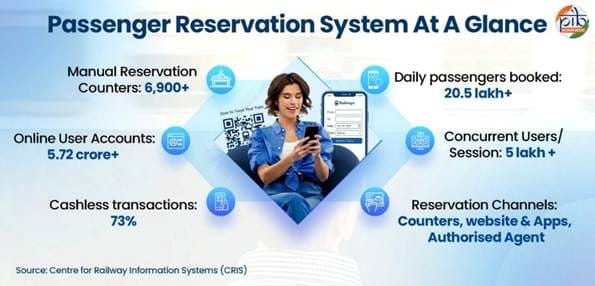
Now, a passenger can check seat availability, predict waitlist confirmation, make digital payments, and receive an e-ticket without ever visiting a railway station with the help of upgraded Passenger Reservation System (PRS) which marks another milestone in the history of Indian railway remarkable journey. The next-generation Passenger Reservation System, whose phased migration began in August 2026. The upgraded system will increase booking capacity from approximately 32,000 tickets per minute to more than 1.5 lakh tickets per minute, while enquiry capacity will jump from around 4 lakh to over 40 lakh enquiries every minute.
The next-generation PRS promises to dramatically increase booking capacity, reduce waiting time during Tatkal bookings, introduce multilingual interfaces, and provide a faster, cloud-enabled digital infrastructure. It is not merely a software upgrade; it represents the latest chapter in one of India’s most successful digital governance stories.
Before Computerisation: The Era of Long Queues
Until the mid-1980s, railway reservations in India were entirely manual. Every reservation office maintained bulky registers containing details of seat availability for individual trains. Reservation clerks manually checked these registers before confirming tickets. Passengers often spent hours waiting outside booking offices, especially during festivals, school vacations and summer holidays.
Booking tickets for trains originating in another city was even more difficult because reservation data was not centrally connected. Communication between stations depended on telephone calls, telegrams or written records, making the process slow and prone to errors.
As passenger numbers increased rapidly after Independence, the manual reservation system became increasingly inadequate.
1986: A Turning Point
Recognising the growing need for efficiency, Indian Railways introduced the Passenger Reservation System (PRS) in 1986. The objective was simple but revolutionary—to replace handwritten reservation registers with computerised records.
The early PRS terminals were installed at selected reservation centres. Although limited in scale, they significantly reduced booking errors, improved transparency and shortened reservation time.
The launch also coincided with the establishment of the Centre for Railway Information Systems (CRIS), which became the technological backbone of Indian Railways’ digital transformation.
The 1990s: Building a National Reservation Network
The biggest breakthrough came during the 1990s when Indian Railways interconnected reservation centres across different railway zones.
Through the Country-wide Network for Computerised Enhanced Reservation and Ticketing (CONCERT), passengers could reserve tickets for trains running anywhere in the country from any connected reservation office.
This was a revolutionary development for a country with one of the world’s largest railway networks. Geography no longer limited ticket booking. A passenger in Delhi could book a train originating in Chennai, while someone in Mumbai could reserve seats on trains departing from Kolkata.
For the first time, Indian Railways functioned as a truly integrated reservation network.
2002: The Internet Changes Everything
The arrival of internet booking in 2002 fundamentally transformed railway reservations.
The launch of online ticket booking through IRCTC eliminated the need to visit reservation counters for millions of passengers. What initially appeared to be an urban convenience gradually became a nationwide service as internet penetration expanded.
Online booking brought several advantages:
• Round-the-clock ticket booking
• Digital payments
• Online cancellations
• Instant PNR status
• Electronic ticket generation
The shift also reduced pressure on physical reservation counters while making railway reservations accessible from homes and offices.
2014: Meeting India’s Digital Explosion
By the early 2010s, India’s internet users had grown exponentially. Existing reservation infrastructure struggled to handle peak traffic, particularly during Tatkal bookings.
In response, Indian Railways introduced the Next Generation e-Ticketing (NGeT) system in 2014.
The upgraded platform significantly increased booking capacity, improved server response times and reduced website crashes during high-demand periods. It represented one of the largest public digital infrastructure upgrades undertaken by any government organisation in India.
Digital India and the Rise of Mobile Booking
The launch of the Digital India programme in 2015 accelerated the shift towards mobile-first governance.
Smartphone adoption transformed passenger behaviour.
Instead of visiting cyber cafés or using desktop computers, travellers increasingly began booking tickets through mobile applications.
The introduction of RailConnect further simplified ticket booking, cancellations and PNR enquiries.
Meanwhile, digital payment platforms such as UPI made railway ticket booking quicker and cashless.
Today, nearly nine out of every ten reserved railway tickets are booked online, illustrating how rapidly passengers have embraced digital services.
Artificial Intelligence Enters Railway Reservations
The newest phase of Indian Railways’ digital journey is driven by Artificial Intelligence.
The RailOne application, launched in 2025, has introduced AI-powered waitlist confirmation prediction, helping passengers estimate the likelihood of ticket confirmation before completing their booking.
Prediction accuracy has reportedly improved dramatically, making travel planning more informed and reducing uncertainty for passengers.
Beyond reservations, AI is also being used to:
• Predict train delays
• Optimise scheduling
• Forecast energy consumption
• Improve maintenance planning
• Analyse operational performance
This marks a shift from simple computerisation to intelligent digital decision-making.
Beyond Ticket Booking
Today’s Passenger Reservation System is no longer just a ticket booking platform.
It connects passengers with an expanding ecosystem of digital railway services, including:
• Real-time train tracking through NTES
• Mobile unreserved ticketing
• Grievance redressal through RailMadad
• Coach cleaning requests via CoachMitra
• Hotel and retiring room bookings
• Tourism packages
• Flight and bus bookings
Indian Railways has gradually evolved into one of India’s largest integrated digital public service providers.
Why PRS Matters
Passenger Reservation System may appear to be a simple booking platform, but it is actually one of India’s largest real-time public databases.
Every day it processes millions of transactions while simultaneously managing:
• Seat allocation
• Reservation Against Cancellation (RAC)
• Waitlists
• Chart preparation
• Cancellations
• Refunds
• Passenger enquiries
Few public digital systems anywhere in the world operate at such scale while remaining available around the clock.
The Road Ahead
Indian Railways is increasingly integrating cloud computing, Artificial Intelligence, Machine Learning, Internet of Things (IoT), blockchain and big data analytics into its digital infrastructure.
The upgraded PRS represents the foundation upon which future innovations may be built—from predictive passenger demand to personalised travel recommendations and smarter capacity planning.
With India aiming to become a global leader in digital public infrastructure, railway reservations offer a compelling example of how technology can improve public services at an unprecedented scale.
A Journey Beyond Technology
The history of the Passenger Reservation System is ultimately the story of India’s digital transformation itself.
From handwritten registers and crowded reservation counters to AI-assisted mobile applications, railway reservations have evolved alongside the country’s technological progress. Every upgrade has sought to solve a real problem—whether reducing queues, improving transparency, increasing booking capacity or enhancing passenger convenience.
The current rollout of the next-generation PRS is therefore more than just a software migration. It is the continuation of a journey that began forty years ago with the simple idea of replacing paper registers with computers. Today, that vision has grown into one of the world’s largest and most sophisticated public reservation ecosystems, serving millions of passengers every day.
As Indian Railways embraces cloud computing, artificial intelligence and next-generation digital infrastructure, the transformation from queues to clicks is entering its most ambitious phase yet—making rail travel faster, smarter and more accessible for the next generation of passengers. The redesigned IRCTC website, introduced in beta form during July 2026, complements this technological transformation with a simplified booking experience.