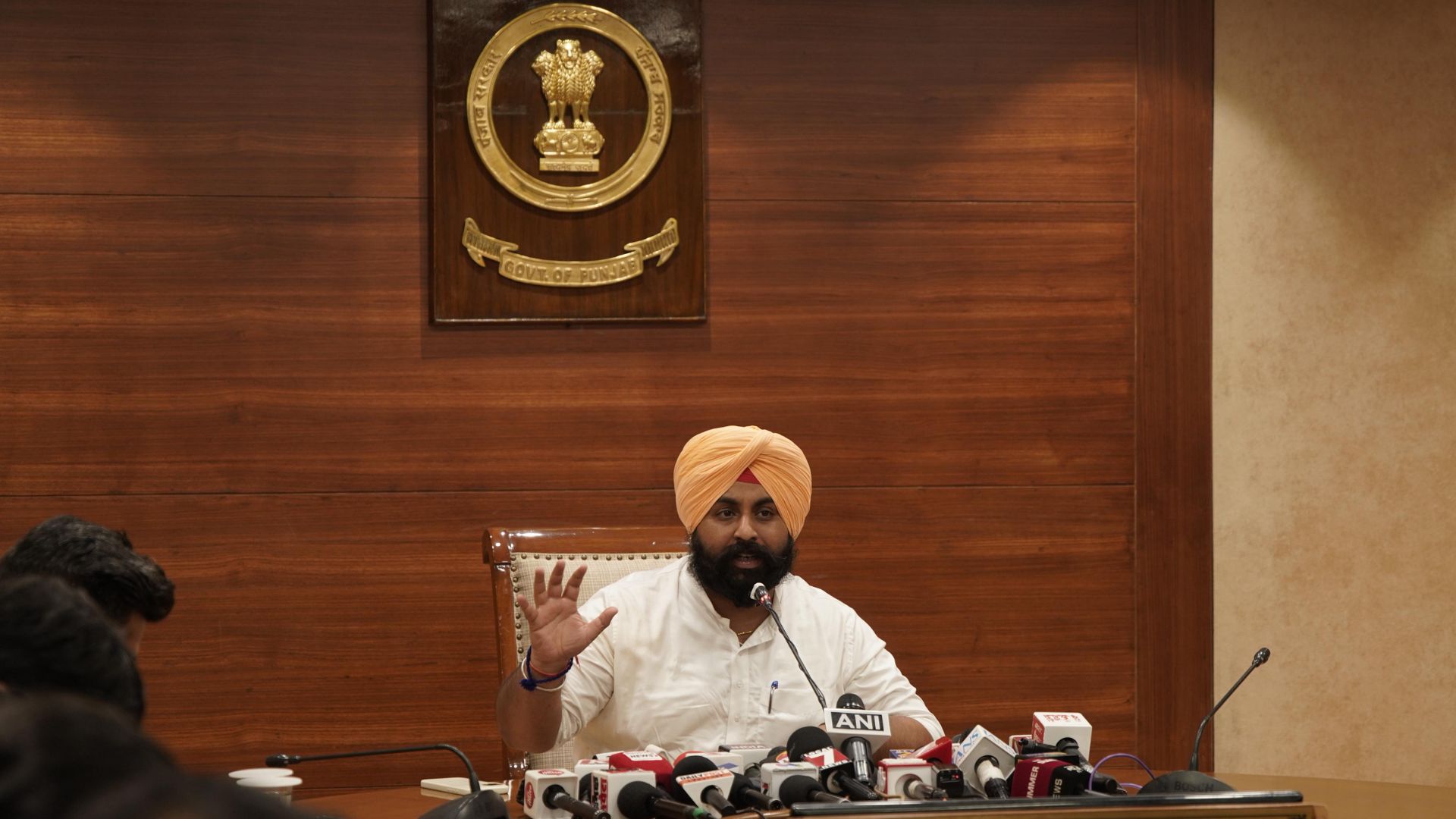
In what Education Minister Harjot Singh Bains calls “the real revolution in prevention,” Punjab has become the first state in the country to implement a structured, film-led, evidence-based drug prevention curriculum targeting more than 8 lakh adolescent students in Classes IX to XII. The initiative, launched across all 3,600+ government secondary schools, is delivered once every 15 days, transforming classrooms into frontline sites in the battle against addiction.
This initiative marks a radical departure from conventional punitive strategies. “From FOMO to ROMO” — from Fear of Missing Out to Relief of Missing Out — the curriculum encourages young minds to break away from peer-driven curiosity and false glamor, and instead embrace informed choice and self-worth.
“This is not just content — this is a shield for our children,” Bains said. “We are no longer waiting for young people to fall into addiction and then treat them. We’re going to classrooms to ensure they never get there in the first place.”
A Science-Backed Strategy
Developed by an international team of behavioral scientists under the leadership of Nobel Laureate Abhijit Banerjee, and supported by the Abdul Latif Jameel Poverty Action Lab (J-PAL), the curriculum is a first-of-its-kind intervention in India. Its design reflects cutting-edge research in adolescent psychology, behavioral economics, and addiction studies.
According to Bains, what sets the curriculum apart is its realism — it doesn’t rely on abstract moralizing or fear tactics. Instead, it presents real stories, real pain, and real hope.
At its core is a collection of short documentaries that chronicle the journeys of nine recovering addicts from Punjab, supplemented with interviews with de-addiction experts. These are not anonymous voices from distant lands — they are sons, daughters, and peers from the same soil, whose lived experiences strike a deep chord with students.
Fortnightly Dose of Awareness: 28 Weeks of Learning
The program is structured across 28 weeks, with one hour-long session every fortnight, seamlessly integrated into the academic timetable. Each session explores one crucial facet of the drug abuse problem — ranging from how peer pressure operates, to media glorification, to breaking myths around gender and class-based narratives of addiction.
Here’s a brief overview of the weekly structure and themes:
Example of Week Curriculum Focus Key Questions that would be discussed
Week 1 How drugs derail youth, talent and future How does peer pressure lead to use? What are familial impacts?
Week 2 Peer pressure as the first push How do we handle peer pressure? How do we say NO?
Week 3 Debunking “chitta is fine once” myth How addictive is chitta? What is its real impact?
Week 4 Media glorification of drugs What does it really mean to be ‘cool’?
Week 5 Drugs as not just a “rich boys’ problem” Can addiction impact anyone, regardless of background?
Week 6 Identifying early signs of drug use What are red flags and how do we intervene?
Week 7 Impact on family and careers What are the economic, emotional, and legal consequences?
“These sessions are not about fear. They are about freedom — the freedom to choose your future,” Bains emphasized.
Each session is paired with quizzes, group discussions, interactive worksheets, and take-home posters. Importantly, the worksheets are adapted from the proposed Anti-Narcotics Task Force Curriculum, adding coherence to the state’s broader anti-drug policy framework.
Teachers as Guardians of a Generation
Recognizing the critical role of educators, Harjot Singh Bains made a passionate appeal to teachers and principals: “This war on drugs begins in your classrooms, not courtrooms. You are Punjab’s first line of defence, its conscience, and its courage.”
To empower educators, the government is organizing statewide orientation programs where teachers are introduced not only to the curriculum but also to basic counseling techniques. “We’re not giving you slogans. We’re giving you tools to save lives,” Bains told educators.
Many teachers have welcomed the initiative. “We’ve waited years for something like this,” said Parminder Kaur, a government school principal in Ludhiana. “Finally, we’re treating students as thinking individuals, not statistics.”
The Language of the Young
Another distinguishing feature is that the curriculum speaks in the emotional language of adolescents. Gone are the traditional ‘don’t do drugs’ commands. Instead, the program builds narratives of self-worth, belonging, and choice.
“To the young Punjabis in front of me — you are not the problem. You are the power,” reads the scripted appeal addressed directly to students. “You already matter. You don’t need drugs to feel accepted or strong. Say no because you can — not because you’re afraid.”
By shifting the emotional fulcrum from FoMO — the fear of missing out on ‘coolness’ or peer approval — to ROMO — the relief of missing out on regret, destruction, and wasted potential — the campaign reframes abstinence as liberation, not restriction.
Grounded in Local Context
What makes this curriculum uniquely effective is its Punjab-centric design. Rather than importing Western or national templates, the stories and data are rooted in local realities — language, culture, music, and slang. Even terms like “chitta” are addressed directly to demystify and disarm their hold over young minds.
“When a student hears a story from someone who once sat where they sit today, it hits different,” said a teacher from Mansa. “They can’t dismiss it as distant or irrelevant.”
This local relevance is also critical in breaking myths — such as that addiction only affects the wealthy, or that it’s a boys-only problem. “Drugs don’t discriminate,” said Bains, “and neither should our education.”
Metrics and Monitoring
The Education Department has also tied up with research agencies to track the impact of the curriculum. Students will be surveyed at regular intervals, and schools will maintain feedback logs. The objective is not only to teach but to measure — and improve.
“We’ll be reviewing what works, what moves children, and what needs tweaking,” said Bains. “We want this to evolve — to stay real, and stay relevant.”
From Classrooms to Communities
While the program is school-centric, its implications go far beyond. As students begin to internalize the message, ripple effects are expected in families and peer networks. “When a child begins a conversation about addiction at the dinner table, change starts,” Bains noted.
The state is also exploring linkages with health services, so schools can refer at-risk students discreetly and promptly. In future iterations, mental health counselors and youth helplines may be embedded into the curriculum’s rollout.
A Political and Moral Commitment
While political leaderships often use drug-related discourse during elections, this initiative by the Punjab Government — and championed personally by Harjot Singh Bains — is being positioned as a non-partisan moral duty.
“This is about our children, not our vote banks. We will stand accountable for what happens in their lives under our watch,” Bains said. He described the project as “the proudest and most urgent undertaking” of his tenure.
Not a Dream, But a Decision
As the curriculum begins unrolling week by week, school by school, the larger message is unmistakable: Punjab is no longer just reacting to its drug crisis. It’s rebuilding its future generation from the inside out.
“A drug-free Punjab isn’t just a dream,” Bains said in closing. “It’s a decision. And we’ve made ours.”
The Road Ahead
Experts believe this curriculum could become a national model. But they also caution that real success depends on long-term institutional commitment, proper resourcing, and sustained engagement with all stakeholders — students, teachers, parents, and health services.
Still, there is a palpable shift in tone, and perhaps in trajectory. From punishment to prevention. From shame to strength. From fear to freedom.
As students across Punjab settle into their desks every 15 days to watch a film, fill out a worksheet, or discuss how to say no — they aren’t just learning. They’re reclaiming their choices and that is where FoMO finally turns into ROMO.