Sotheby’s has formally withdrawn the scheduled auction of more than 300 ancient artifacts associated with the Buddha’s legacy, in response to growing diplomatic and legal pressure from India. Referred to as the Piprahwa Gems, the 334 sacred items were first discovered in the late 19th century from a stupa a Buddhist tomb-mound in Piprahwa, in the region now part of Uttar Pradesh.
These remains, such as bone pieces, gold jewelry, crystal and soapstone reliquary, pearls, garnets, and amethysts, were thought to have been components of sacrifices offered at the time of reburial of Buddha’s remains about 200 years following his demise around 480 BC.
The sale was to occur in Hong Kong this May with the bidding starting at HK$100 million (£9.7 million), before India intervened to ask for their return. The nation claimed the auction was not only ethically wrong but also a break of cultural and religious sanctity.
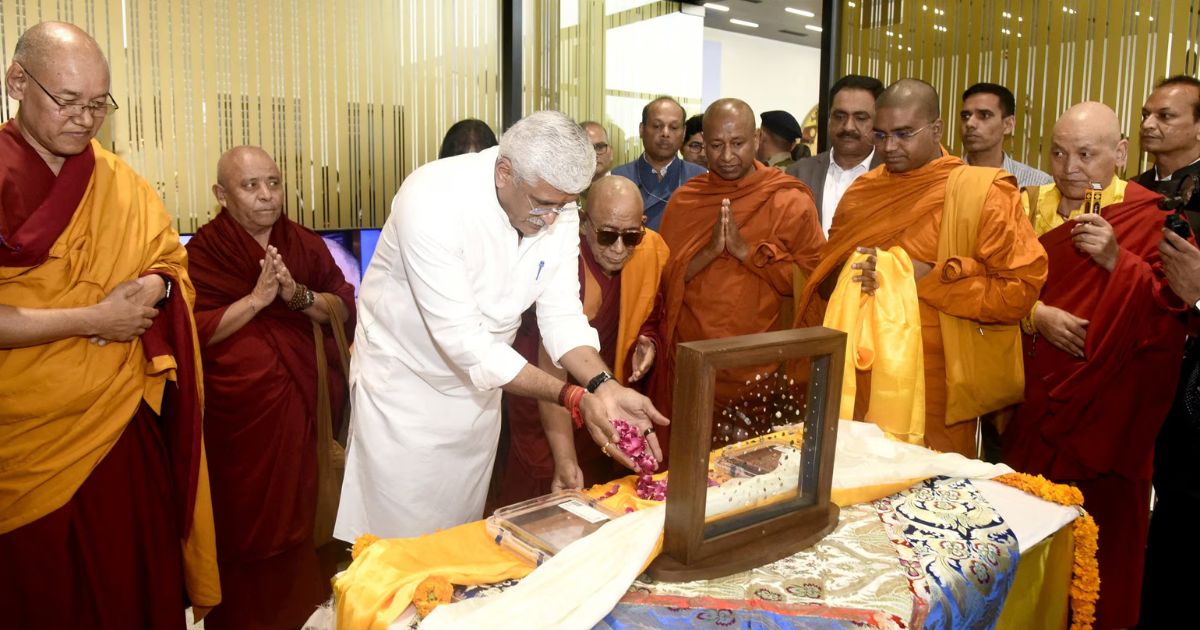
India celebrates return of sacred Buddhist relics
Prime Minister Narendra Modi termed the return as “a joyous day for our cultural heritage,” stressing the close bond between India and the preachings of Buddha. “These holy relics emphasize India’s close link with Bhagwan Buddha and his great teachings,” Modi stated on X. “It also shows our devotion to saving and safeguarding various facets of our glorious culture.”
The Indian government worked in collaboration with the Godrej Industries Group to secure the relics’ return. A large portion will now be housed at Delhi’s National Museum on a five-year loan. The Godrej Group plans to publicly display the entire collection for three months upon its arrival.
“This is not just about artefacts,” said Pirojsha Godrej, executive vice chairperson of Godrej Industries. “These are symbols of peace, compassion, and shared human heritage. We’re honoured to be part of this historic moment.”
Colonial-era legacy and legal conflict
The relics were initially discovered in 1898 by British colonial officer and amateur archaeologist William Claxton Peppe. The British crown, under the 1878 Indian Treasure Trove Act, owned most of the collection, though a fifth belonged to the Peppe family. While the majority of the artefacts fell into colonial museums, the Peppe family inherited part of them in 2013 and had organized the Sotheby’s sale.
India strenuously objected to the auction, labeling it an instance of “continued colonial exploitation” and claiming that the relics were sacred remains, not artifacts to be collected. The culture ministry declared the sale was against both Indian and international law.
In spite of Sotheby’s initial defense and backing by a few members of the Peppe family, the auction house finally pulled the collection from sale and repatriated it to India ending a long-contested chapter of heritage, memory, and ownership.