
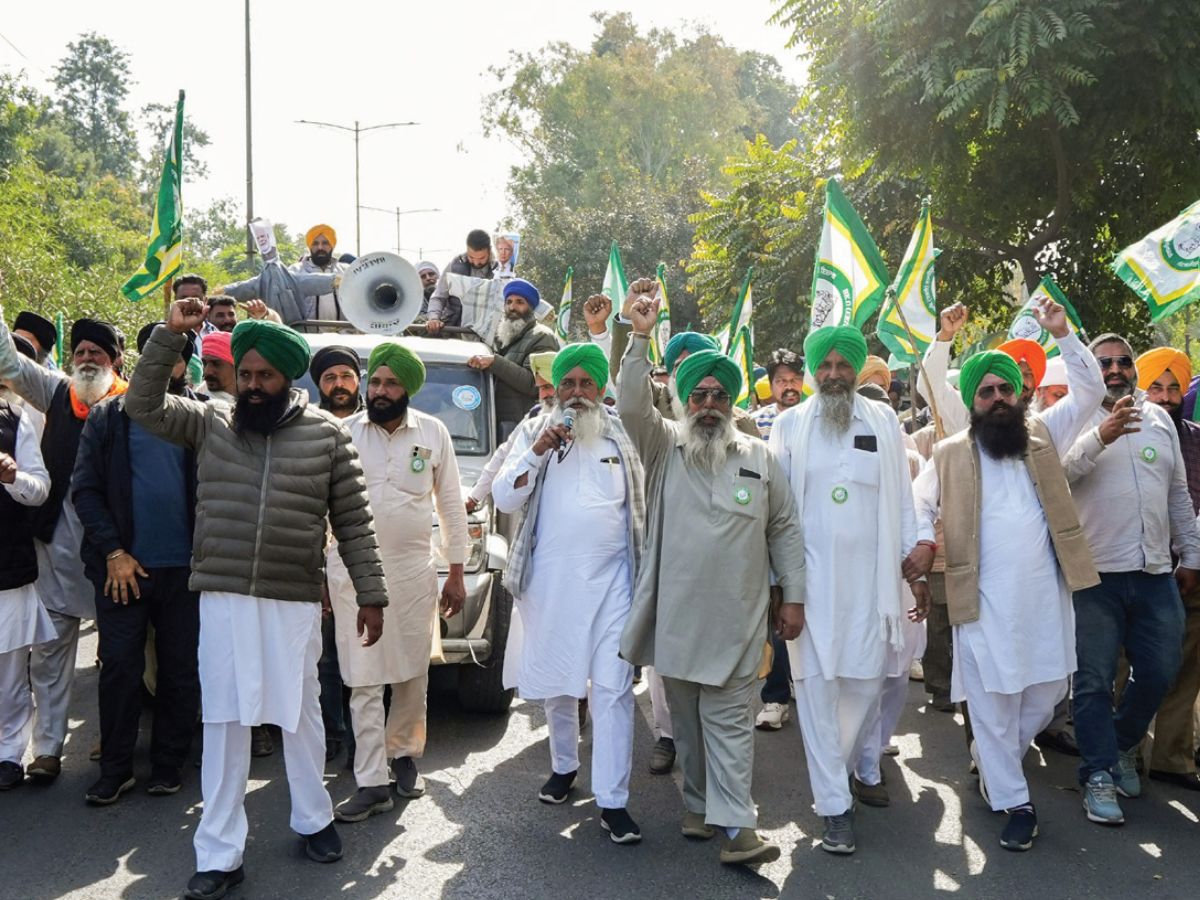
Even as an Indian trade delegation is set to visit Washington next week to finalise the legal text of the first tranche of the India-US trade agreement, the ambiguities in the joint statement and the factsheet shared by the US over the issue have sparked major concerns within the farm bodies and trade experts some of whom have expressed concerns that most concessions emerging from the “unequal deal” “may flow from India to the US.”
While the Sanyukt Kisan Morcha has demanded the resignation of union commerce minister Piyush Goyal for “misleading the Parliament and the country,” trade experts have noted that the tariff cuts on US agricultural products are likely to hurt Indian farmers and trigger domestic opposition.
Even as some are terming the framework to be heavily balanced in favour of the US, some geopolitical observers believe that the deal was necessary to bring down the tariffs imposed by the US which has gone on a tariff imposition spree under Donald Trump.
Deal will hurt Indian farmers, open market for GM products: Sanyukt Kisan Morcha
Terming the framework of the India-US deal as “unequal,” the Sanyukt Kisan Morcha (SKM) has alleged that the government has been repeatedly changing its statements on the deal claiming that agricultural products are not going to be part of the deal.
“The government has been claiming that it will protect the farmers but the very first paragraph of the joint statement on the deal states that India will eliminate or reduce tariffs on a wide range of US food and agricultural products,” All India Kisan Sabha president Rajan Kshirsagar said.
Satyavan of the All India Kisan Khet Mazdoor Sangathan alleged that importing raw cotton at zero tariffs from the US will badly affect the Indian cotton farmers.
Founder-president of the Kisan Sangharsh Samiti (KSS) Dr Sunilam told TDG that the deal will affect the cotton producing farmers which are about 80-90 lakh in numbers across 11 states. He further said that the deal will likely open the Indian market for US cereals and genetically-modified products too.
“We suspect that cereals too will be brought under the ambit of the deal which will also open Indian markets for the genetically modified products,” he said.
A report prepared by the Global Trade Research Initiative (GTRI) states that according to the joint statement issued by India and US, India will reduce or eliminate its Most Favoured Nation (MFN) tariffs on all US industrial goods and on many food and agricultural products, including dried distillers’ grains (DDGs), red sorghum for animal feed, tree nuts, fresh and processed fruits, soybean oil, wine and spirits, and other agricultural items.
“Tariff reductions on US fresh fruits such as apples and oranges, and on soybean oil, are likely to hurt Indian farmers and could face strong opposition from farmer groups,” it states adding that it remains unclear which “additional agricultural products” have been included for tariff cuts.
Similar concerns have been raised by former Jammu and Kashmir CM and Peoples Democratic Party president Mehbooba Mufti too who on Friday urged PM Narendra Modi to exclude apples from the proposed trade deal “to safeguard the interests of Kashmir” while stating that the deal will serve a death-blow to the orchard economy of Kashmir.
“Further, tariff elimination on electronic components, smartphones, and solar panels could adversely affect domestic manufacturing of these products in the future.In return, the US will not reduce regular MFN tariffs on any products. Instead, it will only lower reciprocal tariffs that currently apply to about 55 percent of Indian exports to the US, bringing them down from 50 percent to 18 percent,” the report noted.
“Agreeing to align India’s security and economic policies with US requires great caution”
Under the joint statement, both sides have agreed to strengthen economic security alignment to enhance supply chain resilience and innovation through complementary actions to address non- market policies of third parties.
The GTRI report has warned that agreeing to such a provision could have far-reaching adverse implications, flagging that similar commitments have been obtained by US from Malaysia who may now seek to extend to India.
“If the US were to impose 100 per cent tariffs on imports from countries such as Russia or China on economic security grounds, India will be expected to adopt similar measures. India will also have to restrict transactions in third countries that are sanctioned by the US. Further, India may be required to consult the US before entering into new digital trade agreements with other countries, to ensure that such agreements do not affect US interests. India may also be constrained from entering into agreements on technical or health standards with other countries if those standards are seen as disadvantageous to the US,” the report states.
“Similar commitments have been obtained by the US from Malaysia which now seeks to extend these to India. Given India’s size and sovereign interests, tying its economic and security policies too closely to any single country carries significant risks,” the report warns.
TDG contacted the US Embassy for the US perspective over the concerns raised by farm bodies, opposition parties and other civil society groups over the India-US trade deal but a spokesperson directed this correspondent to the fact sheet issued by the US over the trade deal on February 9.
The spokesperson said that the Embassy doesn’t have any information to add beyond what the White House has stated.
One-sided commitments?
Stating that the US is seeking largely one-sided commitments from India on digital trade by pushing for the removal of barriers to digital commerce and the adoption of clear digital trade rules under the trade deal, the GTRI further warns that it may likely aim to secure from India the same concessions it obtained from Malaysia, including a ban on digital services taxes and similar levies.
“Malaysia has agreed not to levy customs duties on electronic transmissions or impose digital services taxes or similar measures that discriminate against US companies. It has also given up the right to apply certain internal taxes on imports or collect them at the border where such taxes would disadvantage US goods. In addition, Malaysia has accepted a permanent moratorium on customs duties on electronic transmissions and removed the requirement for US social media platforms and cloud service providers to contribute six percent of their local revenue to a domestic fund. Similar demands are likely to be made from India,” the report warns.The GTRI adds that if accepted, “these provisions would weaken India’s long-standing position at the World Trade Organisation (WTO) against a permanent moratorium on customs duties on electronic transmissions.
“Was necessary to enter a trade deal with US”
Speaking to TDG, Harsh V Pant, vice president, Observer Research Foundation (ORF) and Studies said that clarity will come over the trade deal only once it is signed and a draft is out in the open.
He said that while there are fair questions that are being raised by the farm groups and other bodies on broader specifics, it needs to be considered that it was necessary for India to enter into a deal with the US.
“It can be argued that it is an unequal deal but many Indian products were not being exported and there was pressure from the small and medium scale industries on the government. It can be said that the tariffs have only come down to 18 per cent from 50 per cent but it needs to be remembered that there are no equals in the world. We are dealing with the regime of Donald Trump who has slapped many countries with tariffs without any uniformity so we are not negotiating with an equal,” he said.