
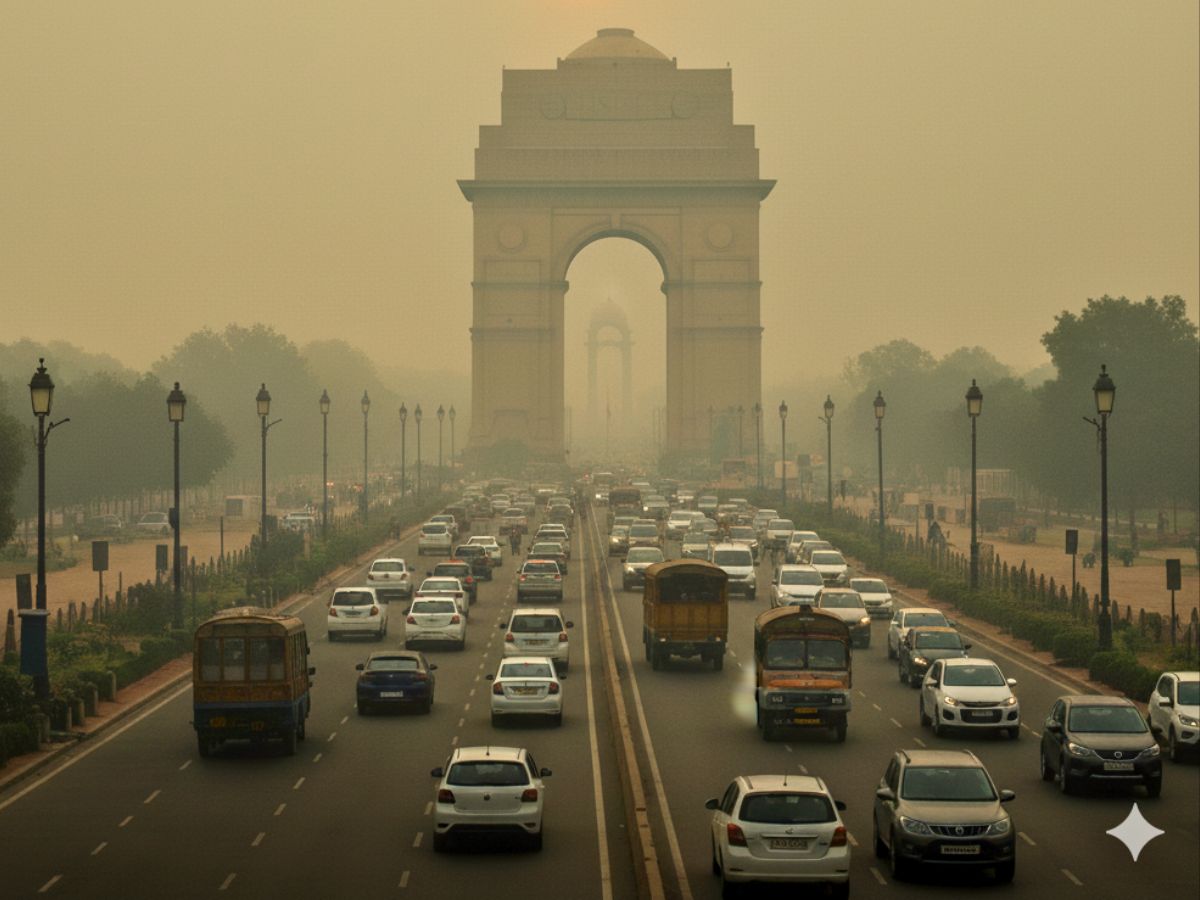
Delhi woke up to another smog-filled morning on Saturday, with the Air Quality Index (AQI) touching 355 at 8 AM, according to the Central Pollution Control Board (CPCB). The city’s air remained in the ‘very poor’ category for over a week, forcing the government to roll out strict measures under the Graded Response Action Plan (GRAP) Stage 2.
By 3 PM, Bawana recorded the worst AQI at 410, while Dwarka showed some relief with a reading of 201. With the air quality worsening every day, authorities have stepped up restrictions on vehicles, work timings, and parking rules to ease the pollution load.
Non-Delhi BS-III Vehicles Barred From Entering the City
To tackle vehicular emissions, the Commission for Air Quality Management (CAQM) has banned the entry of non-Delhi-registered BS-III and lower-grade commercial goods vehicles into the city starting November 1.
BS (Bharat Stage) norms are government-set emission standards that define how much pollution a vehicle can emit. Currently, the latest standard is BS-VI.
The CAQM stated, “The move is aimed at reducing vehicular emissions and improving air quality in the Capital and nearby regions.”
This means that Light, Medium, and Heavy Goods Vehicles (LGVs, MGVs, HGVs) that do not comply with BS-IV standards will not be allowed entry into Delhi.
New Office Timings For Delhi Government Offices
In another move to cut down congestion, CM Rekha Gupta announced changes in office hours for Delhi government and Municipal Corporation employees. Currently, Delhi government offices operate from 9:30 AM to 6:00 PM, while the Municipal Corporation runs from 9:00 AM to 5:30 PM.
But now, the new office timings for Delhi government offices will be 10:00 AM to 6:30 PM, while MCD offices will be open from 8:30 AM to 5:00 PM to reduce peak-hour traffic congestion.
The half-hour overlap leads to severe rush hours. The revised timings aim to reduce traffic density and emissions during peak hours.
CM Appeals for Carpooling and Public Transport Use
CM Rekha Gupta also appealed to residents to choose carpooling and public transport, such as the Delhi Metro, to minimize vehicle pollution. She further urged private companies to offer work-from-home options to employees as a temporary measure until the air quality improves.
Parking Fees Doubled Across New Delhi Area
The New Delhi Municipal Council (NDMC) has doubled parking fees at civic-managed sites across the city. The new rates stand at ₹40 per hour for four-wheelers, ₹20 per hour for two-wheelers, and ₹300 per hour for buses.
However, the hike does not apply to on-street parking or monthly pass holders. Officials said the increase would remain in effect “till the revocation of Stage 2 of GRAP.”
Delhi Faces Growing Health and Mobility Concerns
This winter, Delhi’s pollution problem has again sparked concern among health experts. With smog blanketing the skyline and AQI readings showing no sign of improvement, authorities are urging citizens to follow guidelines and limit outdoor exposure.
The government’s latest measures — from vehicle bans to flexible work timings — highlight the urgent need for collective action to tackle Delhi’s annual air pollution crisis. If conditions persist, stricter curbs under GRAP Stage 3 could be implemented in the coming days, including a wider ban on construction and more traffic restrictions.