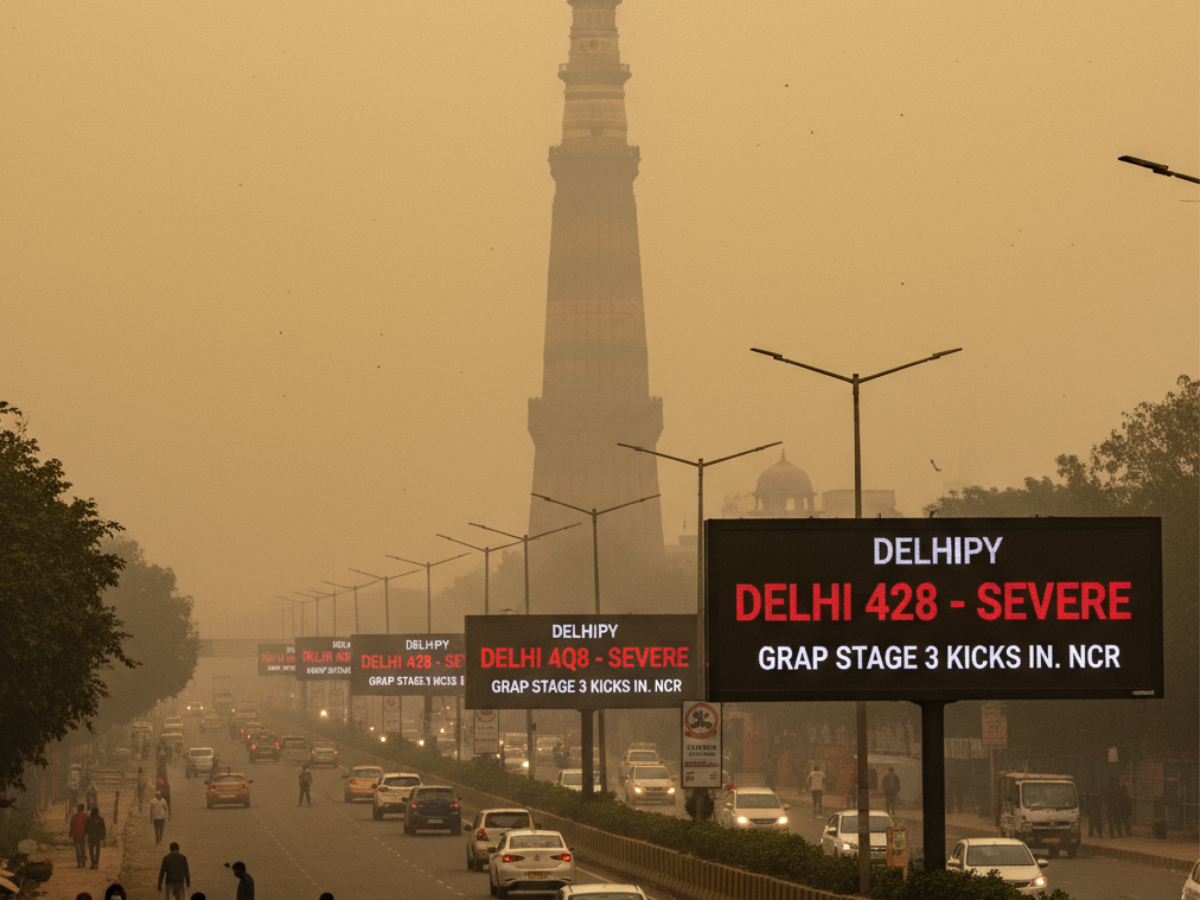
Delhi AQI: Residents of the national capital woke up with thick haze, burning eyes, and breathlessness as Delhi’s AQI surged to 428-the highest since December 2024. As many as 33 out of the city’s 39 air monitoring stations recorded readings in the “severe” category; PM2.5 levels touched around 600 µg/m³ in northern parts of the city.
In response, the authorities implemented Stage III of the Graded Response Action Plan across Delhi-NCR, imposing restrictions on pollution-causing activities with immediate effect.
Why has Pollution Spiked Sharply?
Experts attribute the sudden deterioration to a combination of meteorological and emission factors:
- Windless conditions and temperature inversion: Low wind speed and temperature fall to ground, preventing dispersion of pollutants close to the surface, have trapped it.
- High emissions: vehicular exhaust, industrial emissions, and construction dust continue to add to the toxic mix.
- Regional contribution: Stubble burning in neighbouring states, along with urban emissions, has worsened Delhi’s already fragile air conditions.
The combination of all this stagnant air and continual pollution creates a thick veil hanging over the city.
What has Stage III of GRAP triggered?
With Delhi’s air quality entering the “severe” category, authorities enforced stringent curbs under Stage III:
- Suspension of non-essential construction and demolition work.
- Ban on the use of older vehicles: BS-III petrol and BS-IV diesel.
- Closure of stone-crushing and mining units.
- Schools up to Class 5 asked to shift to online or hybrid learning modes.
These emergency measures involve actions that limit immediate emissions until the weather improves.
What are the Health Implications and Precautions?
With PM2.5 levels surpassing more than 10 times the limit of the safe threshold, Delhi’s air becomes highly threatening to health, particularly for children, the elderly, and people with respiratory or cardiac problems.
Health experts have advised residents to:
- Limit outdoor activities, especially in the morning.
- Wear N95 or KN95 masks when venturing outdoors.
- Keep windows closed and use air purifiers indoors.
- Avoid burning waste and using wood/charcoal for cooking purposes.
Hospitals have reported an increase in admissions of people complaining of eye irritation, throat discomfort, and difficulty breathing.
Will The Air Quality Improve?
Forecasts indicate that slightly stronger winds may offer some relief in the coming days, bringing the AQI down to the “very poor” range. However, a complete turnaround is unlikely before the next major weather change. For now, the haze is expected to persist until Friday, with visibility likely to remain low during early morning hours.
Is This Just Another Seasonal Spike?
This is Delhi’s first “severe” air day of the winter season, a grim reminder of the city’s recurring pollution crisis. Every year, as temperatures drop and winds die down, the capital turns into a gas chamber-the surest evidence of just how intractable the problem of emissions has become.
The experts’ view is that without structural interventions including cleaner transport, strict construction norms, and cross-state coordination to manage stubble burning Delhi’s air quality will continue to collapse every winter.