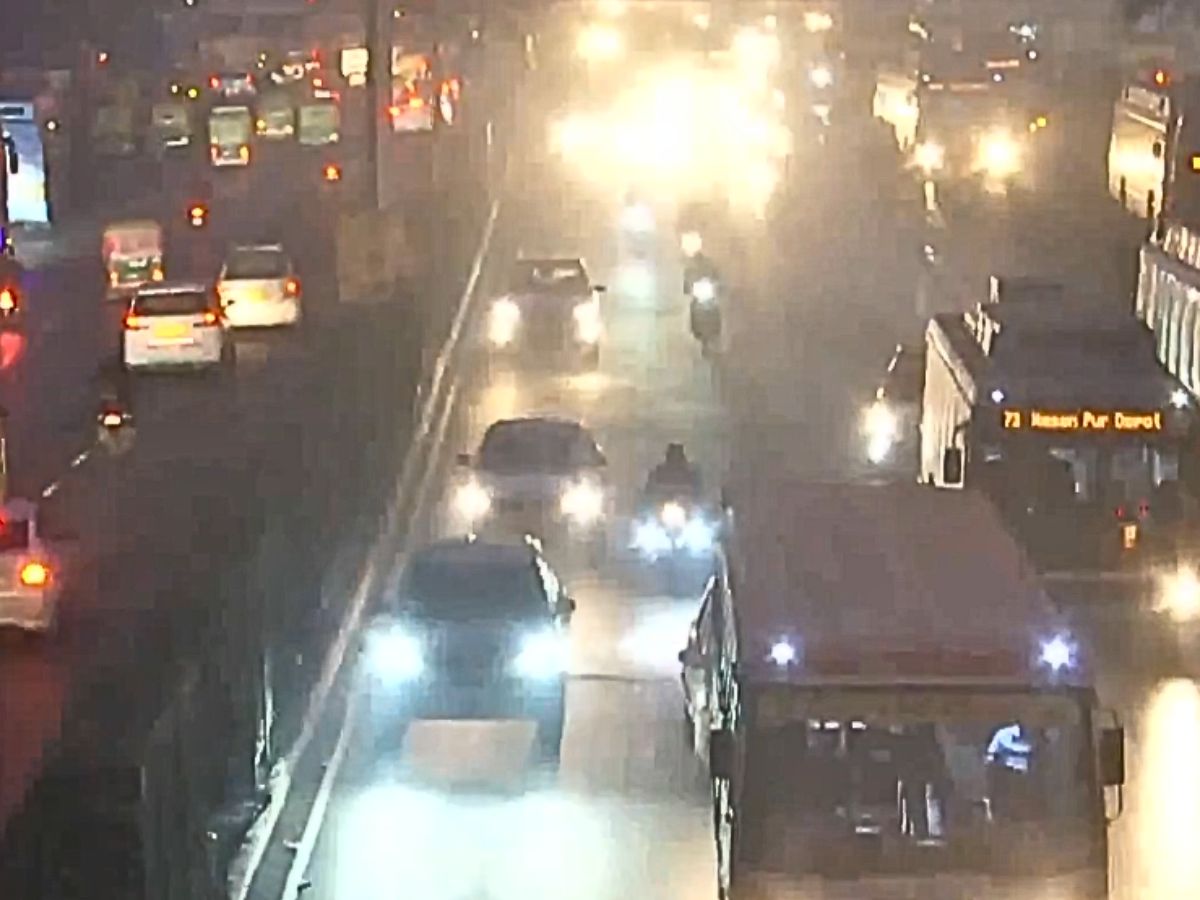
A day after the Commission for Air Quality Management withdrew Stage-3 restrictions of the Graded Response Action Plan, Delhi’s air quality slipped back into the “very poor” zone on Thursday. By 4 pm, the 24-hour average AQI was at 377 and rose further to 381 by 8 pm, with several monitoring stations tipping into the “severe” category.
This sharp deterioration came despite earlier forecasts suggesting only a marginal dip. Authorities had expected wind speeds to fall temporarily before picking up again by late Thursday evening or Friday, preventing the AQI from entering the 400-plus “severe” bracket. However, the sudden reversal exposed the fragility of air-quality gains made earlier in the week.
Why did the CAQM Withdraw GRAP Stage-3 Restrictions?
Stage-3 of GRAP is triggered if the air quality is expected to or has already entered the “severe” range. The stage imposes sweeping curbs, including the ban on construction and demolition, mining and stone-crushing, plying of older BS-III petrol and BS-IV diesel vehicles, office attendance and functioning of schools.
Instead, the decision to roll back these measures was based on a modest improvement in AQI earlier in the week combined with forecasts of stable “very poor” rather than “severe” conditions ahead. However, experts say that with winter meteorological patterns notoriously unpredictable, lifting restrictions on the basis of marginal improvements often backfires.
How Did Lifting GRAP Stage-3 Curbs Affect Pollution Levels?
With Stage-3 measures removed, a wide band of previously restricted activities resumed across the NCR. Construction and demolition projects restarted, older vehicles returned to the roads, and offices and schools fully resumed normal operations.
These relaxations reintroduced several major pollution sources at a time when the weather turned unfavorable with winds slowing down below 10 km/hr and temperature inversion reducing vertical mixing. Therefore, pollutants in the lower atmosphere started building up rapidly to contribute to the steep rise of AQI on Thursday.
For years, environmental analysts have argued that the GRAP’s toggling mechanism-imposing and withdrawing restrictions rapidly-fails to ensure consistent emission control. The resumption of suspended sources often leads to a quick rebound in pollution levels, especially in November-January, when the atmospheric condition is least supportive of dispersion.
How is this year’s Pollution in Delhi?
Thursday was the 22nd consecutive day with AQI above 300, making it the third-longest such streak since 2019. The longest was recorded last year at 32 straight days of toxic air, followed by a 23-day spell in winter 2018–19.
This year’s stretch, therefore, places Delhi in familiar territory, signalling yet another prolonged pollution episode. Last winter’s peak AQI had touched nearly 500, and though this year hasn’t hit such extremes, the pattern of persistent “very poor” days is firmly in place.
What Do Experts Say About the Timing of Restriction Rollbacks?
A number of experts have termed the lifting of curbs “illogical” and pointed out that there was no dramatic difference between an AQI of 320 as against 350. They caution that GRAP, in its present form, suffers from delays in implementation, does not cover key industrial and thermal-power-related emissions, and relies too much on short-term forecasting.
A mild western disturbance weakened the wind flow over the plains on Thursday and led to stagnation, said meteorologists. The winds are expected to gain momentum again from Friday onwards, which may help in dispersing the pollutants and bringing in marginal relief.