
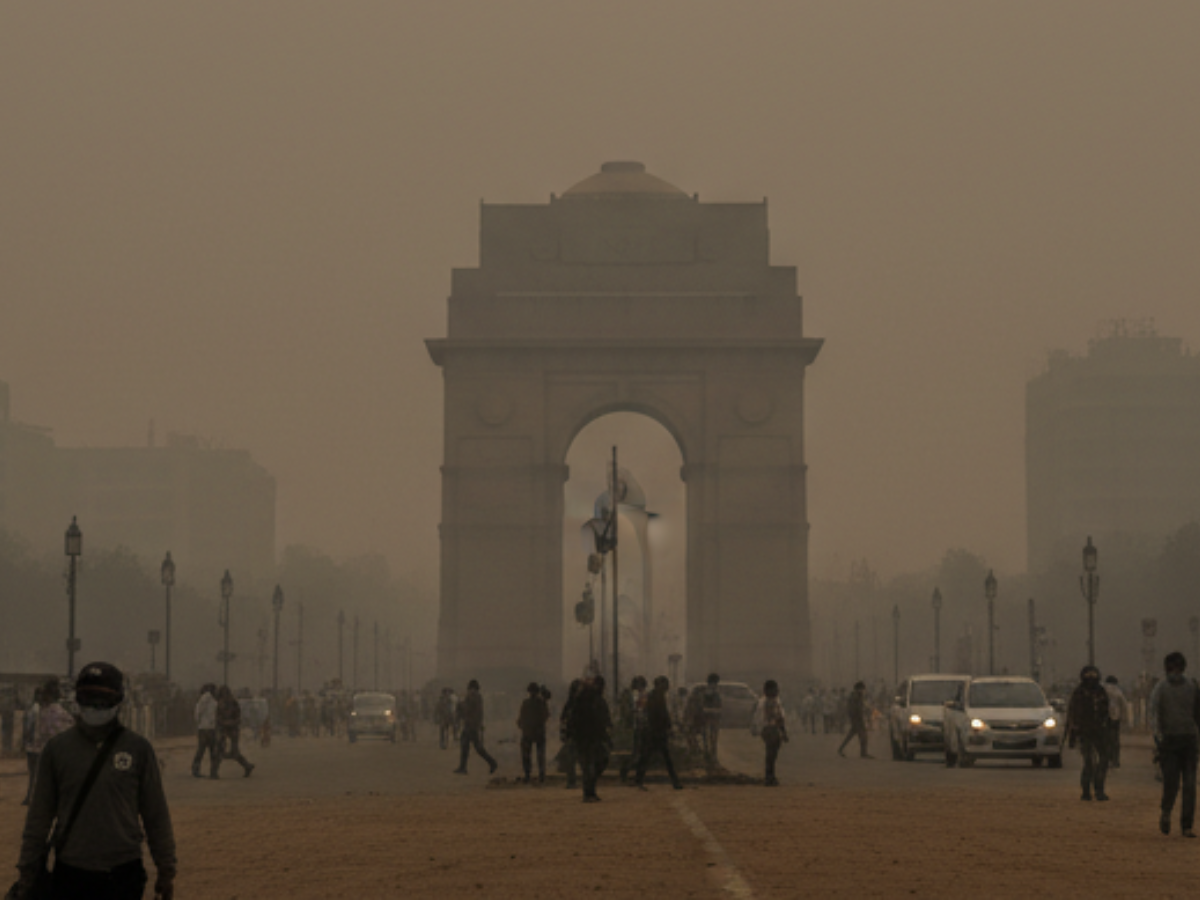
A slight improvement in air quality woke up Delhi on Monday morning but the city’s air remains highly toxic. The overall AQI at 6:05 a.m. was 346, down from a season’s high of 391 the previous day.
Despite this marginal dip, most monitoring stations recorded pollution levels in the range of “very poor” to “severe,” with Bawana at 412, Wazirpur at 397, and Jahangirpuri at 394. The temperature dipped to 11.6 °C, and the city was wrapped in a thick blanket of smog, which made breathing outdoors risky for its residents.
What Caused the Slight Improvement in AQI?
According to experts, the relief can be attributed to a rise in wind speeds, coupled with a minor drop in stubble burning from other regions. This permits some dispersion of pollutants, but the improvement is barely noticeable in daily life.
Vehicle pollution, industrial activity, and dust from ongoing construction are the city’s core pollution sources, which keep PM2.5 and other particulate levels high.
Even with the slight reduction in AQI, the air remains dangerous to breathe, especially for sensitive groups such as children, older adults, and those suffering from respiratory or cardiovascular diseases.
Why Isn’t GRAP Stage 3 Triggered Yet?
The Commission for Air Quality Management reviewed the situation on Sunday evening as the daily averages remained at the upper end of the “very poor” category.
Although Stage 3 of GRAP calls for the stopping of non-essential construction, shifting lower classes to hybrid or online learning and restricting older petrol and diesel vehicles, the sub-committee decided that the stringent measures were not needed at this time.
Instead, the measures under Stages 1 and 2 continue in Delhi and the National Capital Region as the situation remains serious but does not reach the threshold for the highest-level curbs.
The decision becomes nuanced, as authorities balance the continued health risk against the soci-economic effects of more stringent restrictions.
How Bad Is the Pollution in the NCR?
The smog is not confined to Delhi alone. Noida recorded an AQI of 335, Ghaziabad 302, and Greater Noida 314, all in the “very poor” category. Nearby Gurugram is faring slightly better due to wind patterns and terrain but is still under the threat of heavy air pollution.
This thick layer of smog, with falling temperatures, means that residents across the region are inhaling air that is injurious to health. The environmental conditions are especially perilous to outdoor workers, students, and people with pre-existing health conditions. The incessant smog has even affected the visibility on roads, increasing the chances of a road accident.