
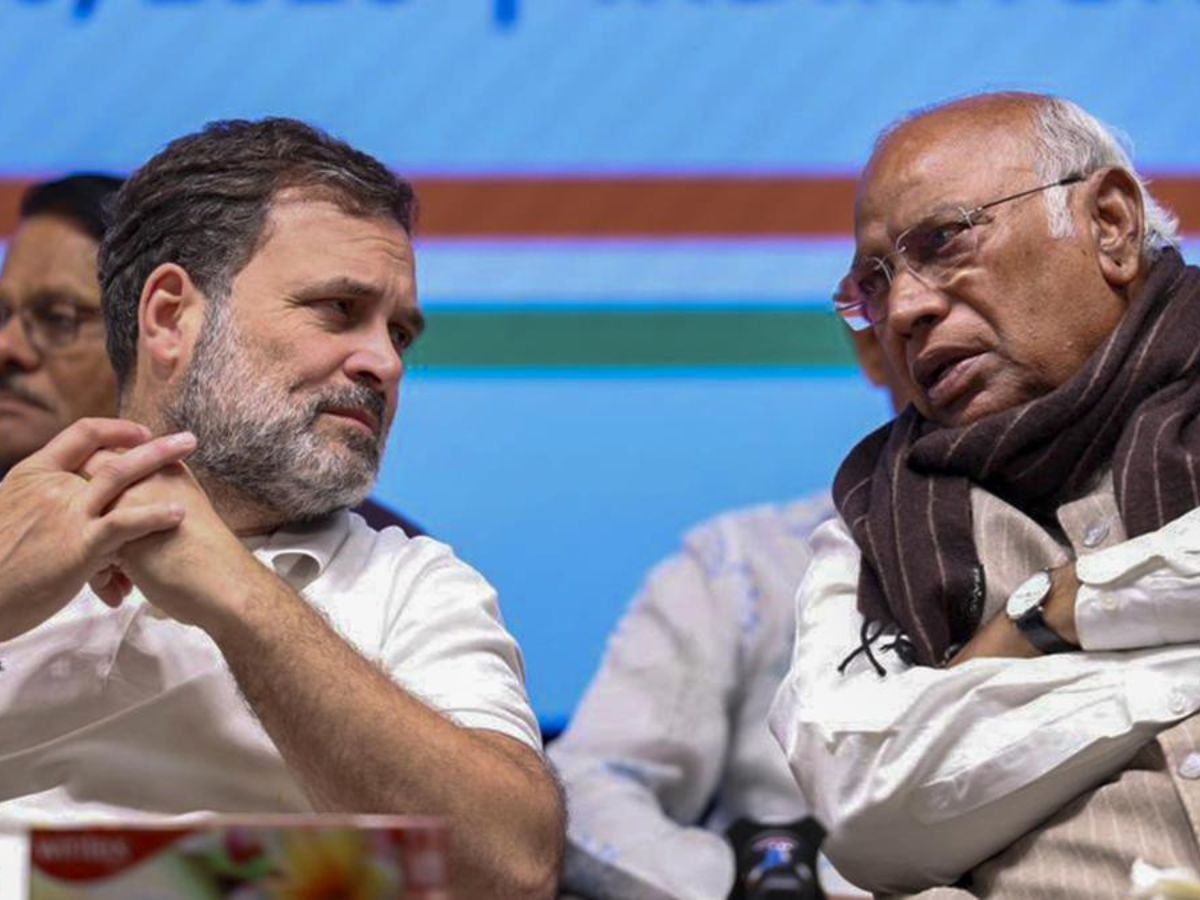
The Congress on held discussions with the leaders of five states and one Union territory over the India US trade deal affect on farmers and decided to hold three public meetings in Madhya Pradesh, Maharashtra and Rajasthan that will be addressed by party chief Mallikarjun Kharge and Leader of Opposition in the Lok Sabha Rahul Gandhi.
Kharge chaired the meeting at his residence that was also attended by Rahul Gandhi, Maharashtra state president Harshvardhan Sapkal, Rajasthan unit chief Govind Singh Dotasara, CLP Tikaram Jully, incharge Sukhjinder Singh Randhawa, Madhya Pradesh unit chief Jitu Patwari, Himachal Pradesh chief minister Sukhwinder Singh Sukhu, Himachal Pradesh unit chief Vinay Kumar, Jammu and Kashmir incharge Syed Naseer Hussain, Sukhpal Singh Khaira and others.
Congress general secretary organisation KC Venugopal, Jairam Ramesh, Randeep Singh Surjewala were also present in the meeting.
After the meeting, Ramesh said that Kharge held meeting with the leaders of five states and one Union territory and discussed the US India trade deal.
He said that India was compelled to sign the trade agreement with the US and the Prime Minister surrendered we discussed that thing.
Ramesh explained that we discussed the affect of US India trade deal in these five states and union territory especially the farmers of cotton, soyabean, maize and others.
“It was decided in the meeting that we will hold a public meetings in Bhopal on February 24, followed by another such meeting in Maharashtra’s Yamatval and the third meeting in Rajasthan’s Sriganganagar before the Match 9 second budget Session,” he said.
Ramesh said that both Kharge and Rahul Gandhi will be attending these meetings in these three states.
The Congress leader also claimed that during the meeting, especially the Congress President and Rahul Gandhi — both emphasized this point —that this is the Prime Minister’s surrender.
He said that the first surrender happened on May 10, 2025, when Operation Sindoor was suddenly halted and now regarding the Indo-US trade deal, about which the government has been saying many things—the reality is that it will have a direct negative impact on farmers.
He said, “On this issue, just as farmers’ organizations carried out a movement for nearly one and a half years against the three “black” farm laws, in the same way we will stand with farmers’ organizations in these six states in the first phase.”
“We will also do this in other states, but in the first phase we will focus on these six states. Through this, we will expose the threat that this trade deal poses to the livelihood of lakhs of our farmers, and we will also take this issue to the people,” Ramesh added.