
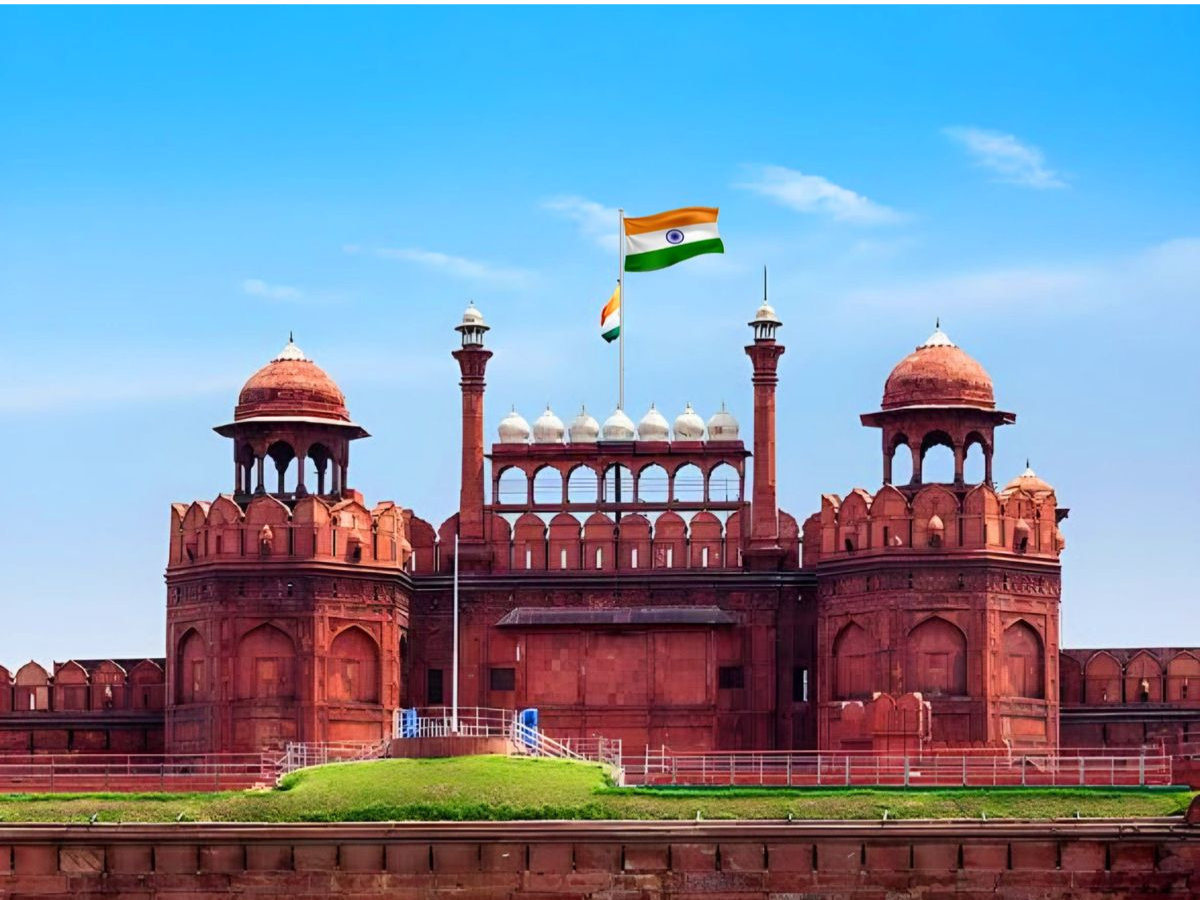
Delhi’s all time pride, the Red Fort, is slowly losing its iconic beauty and its charm now-a-days. A new study has revealed that the fort’s red sandstone walls are being covered with “black crusts” caused by the city’s toxic air. The finding has alarmed conservationists and citizens alike, as the Red Fort is not only a historic monument but also a powerful symbol of India’s independence and unity.
Who Constructed the Red Fort and Why?
Red Fort, or Lal Qila, was constructed in 1638 by Mughal Emperor Shah Jahan when he moved his capital from Agra to Delhi. Architect Ustad Ahmad Lahori (also the designer of Taj Mahal) designed the fort, which was constructed using red sandstone to symbolize Mughal power and grandeur. It remained the central residence of the Mughal emperors and the hub of political, cultural, and economic life for almost 200 years.
Shah Jahan constructed the fort as not only a military fortress, but as an establishment of government and art as well. Its walls, domes, gardens, and halls represent a combination of Persian, Timurid, and Indian architecture, and it is one of the world’s most prized monuments.
Also Read: Viral Video: Bhojpuri Song ‘Lagawelu Lipstick’ Rocks India-Pakistan Asia Cup 2025 Match in Dubai
Why the National Flag Is Hoisted Here
Few know why the Indian National Flag is raised every year at the Red Fort on Independence Day, when India has so many other historic sites. The reason is in the past. On August 15, 1947, when India attained freedom from British rule, Jawaharlal Nehru, the first Prime Minister of India, decided upon hoisting the tricolor and speaking to the nation from the Red Fort.
The Red Fort was used because it represented India’s fight against colonialism and the victory of freedom. Every Prime Minister has thereafter followed suit, and the fort is now a living embodiment of India’s independence.
Also Read: Wedding Guest Caught Sneaking Chicken into Her Purse Internet Can’t Stop Laughing Goes Viral
Why Is the Red Fort Turning Black?
According to experts, the darkening of the walls of the fort is caused by a range of factors:
Air Pollution: Delhi has among the worst pollution rates in the globe. The release of sulfur dioxide, nitrogen oxides, and carbon particles from autos and industries interacts with the sandstone to create a black crust.
Particulate Matter (PM2.5 and PM10): Particles of fine dust and soot fall on the walls and darken the stone over time.
Weathering and Moisture: Rains during different seasons mix with pollutants, forming acidic deposits that corrode the stone.
Neglect and Overcrowding: High tourist traffic and poor cleaning speed up the damage further.
These black layers not only ruin the monument’s looks but also deteriorate its stone structure with the passage of time.
Red Fort’s blackening is not only an aesthetic issue remember how pollution is washing away centuries of history. Unless drastic steps are taken, future generations might only witness a defaced form of this heritage. Conservationists recommend better control over pollution, scientific cleaning techniques, and awareness campaigns to conserve the monument.