
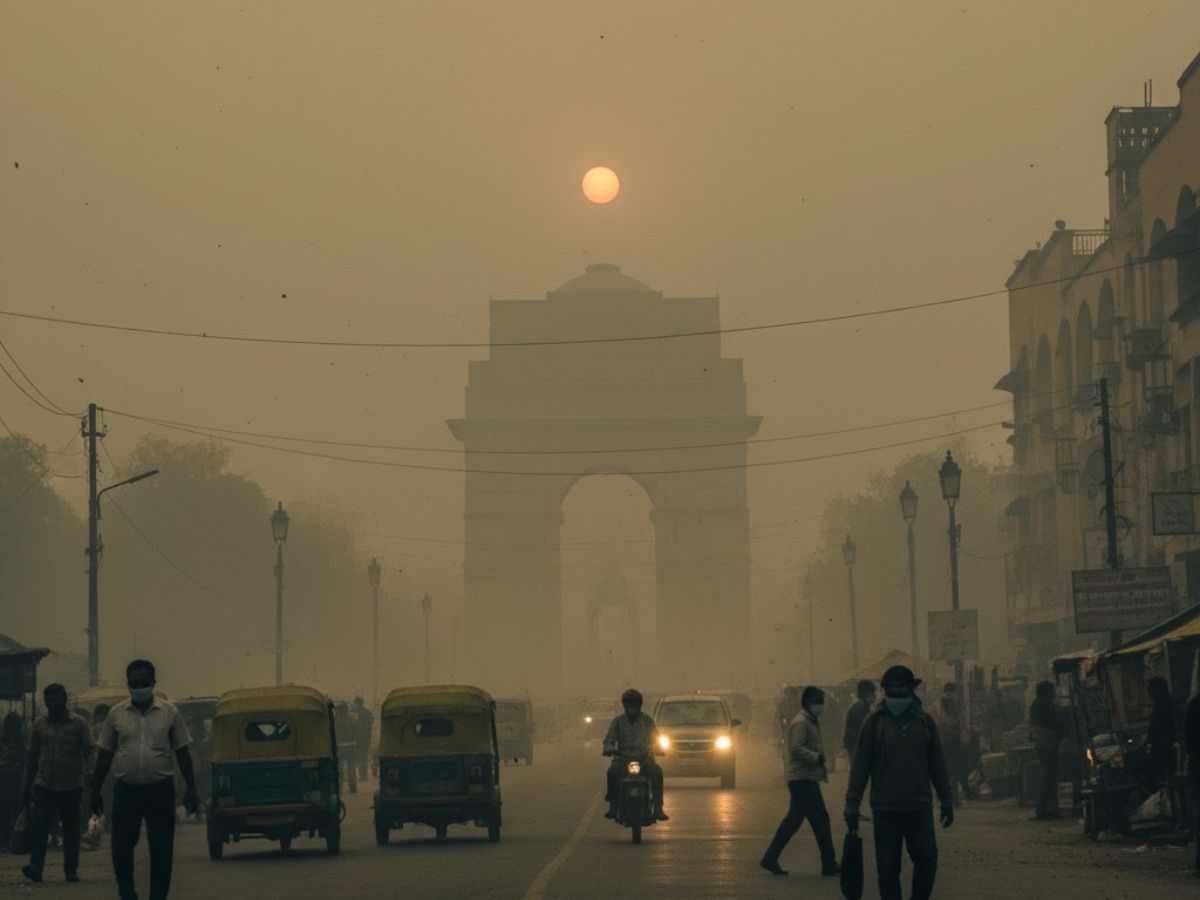
Delhi’s air quality drastically declined, putting the city on the verge of the “severe” category and posing serious health risks to its citizens. On Saturday, pollution levels breached the critical 400-mark at numerous monitoring stations across the city, solidifying Delhi’s position as one of the most polluted cities in the country.
How Widespread is the Pollution?
The scale of the problem became clear through real-time data from the Central Pollution Control Board’s (CPCB) Sameer app. By 6 PM on Saturday, a troubling 15 out of the city’s 39 air quality monitoring stations registered an AQI at or above 400. This list includes prominent locations like ITO, Punjabi Bagh, Rohini, and Vivek Vihar. Wazirpur and Bawana were the worst-hit areas, both recording a dangerous AQI level of 424.
The extent of this pollution makes it evident that the bad air is a citywide emergency that affects millions of people, not just a local issue.
Also Read: Interstellar Object 3I/ATLAS Emits ‘First Ever’ Radio Signal, Fuels Scientific Intrigue
What Does the AQI Number Actually Mean?
The Air Quality Index (AQI) is a simplified tool to communicate how polluted the air currently is. The transition from the “very poor” to the “severe” category represents a significant public health escalation. An AQI between 301-400 is classified as ‘very poor,’ which can lead to respiratory illness on prolonged exposure. When the AQI crosses 401 into the ‘severe’ zone, the effects are more drastic; it can cause respiratory effects even in healthy people and serious impacts on those with existing diseases.
How Much Worse Did It Get?
The capital’s air quality has shown a consistent downward trend over the weekend. On Friday, Delhi recorded an AQI of 322, which already earned it the top spot among India’s most polluted cities. By Saturday at 4 PM, the 24-hour average had worsened to 361. The aggregate AQI reached 372 by 6 PM as the situation continued to worsen. This dramatic decline in a single day highlights how dangerous and erratic the city’s winter pollution is.
What About the NCR and the Key Pollutants?
The toxic haze was not confined solely to Delhi’s boundaries. Neighbouring NCR cities also experienced ‘very poor’ air quality. Noida’s AQI was 354, while Greater Noida and Ghaziabad recorded 336 and 339, respectively. The major cause of the smog was PM2.5 and PM10—fine particles small enough to enter the lungs and bloodstream, leading to severe health risks.
Also Read: James Watson Dies at 97: The Nobel Laureate Who Discovered DNA’s Double Helix
Is There Any Relief in Sight?
The Air Quality Early Warning System for Delhi predicts more tough days ahead. The city’s air is likely to stay in the ‘very poor’ range for several days. People must be prepared for ongoing pollution and take appropriate safety precautions unless the weather drastically changes, such as with rain or stronger winds.