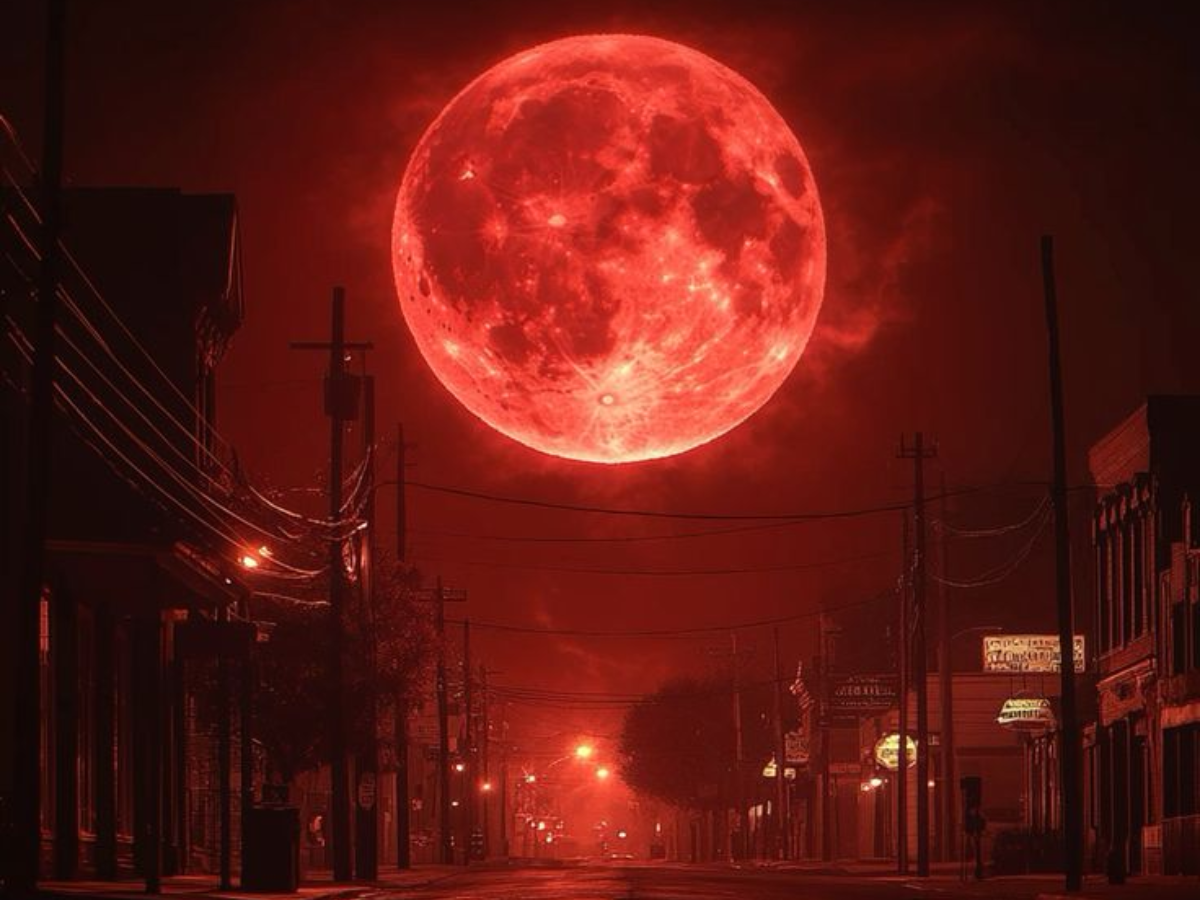
India will see a spectacular lunar eclipse the Blood Moon tonight, an astronomical event rarely seen. Once the shadow of Earth passes over the full moon a deep red color will shine clearly on the horizon and be visible to the naked eye across a large region.
When And from What Locations Can the Blood Moon Be Seen?
According to authenticated Skywatch data a total lunar eclipse starts at about 9:58 PM IST on September 7, 2025, attaining its peak at 11:00 PM and closing by 12:22 AM on September 8. Too long would be provided for this spectacle a good 82 minutes in totality for the best viewing across Asia through India and China while faintly in parts of Europe and Africa.
What Makes the Moon Appear Red in a Total Lunar Eclipse?
Rayleigh scattering is the answer for the Moon’s red tint, that weird phenomenon responsible for painting sunsets and making the sky blue. Rayleigh scattering is a technique where sunlight is bent around the world and short-wave blue is scattered by the atmosphere of the Earth and allowing warm shades of red and orange to reach the surface of the Moon and give it that characteristic Blood red glow.
An astrophysicist at Queen’s University Belfast in Northern Ireland Ryan Milligan, claims that the reason the moon appears red during a lunar eclipse is because blue light scatters more readily in the Earth’s atmosphere than red light does.
ALSO READ: Lunar Eclipse September 2025: Big Changes for These Zodiac Signs
How Long Has It Been Since the Last Time Happened?
Astronomically, an interval occurs between two total lunar eclipses that is what this event will be the second total lunar eclipse of 2025 and the longest of the year is due to the Moon travelling more slowly near its apogee (apogee being the point of the Moon farthest from the Earth).
Astronomers see this as cosmic curtains rising ahead of the total solar eclipse crosser expected next year during August 2026, through parts of Europe.
How Does This Eclipse Compare to Past and Future Events?
The event will be the second total lunar event this year after the one in March, and most likely the longest since the one in 2022. For the amateur and professional astronomers this event serves as the appetizer to the much-anticipated total solar eclipse coming forward within a year.
In Spain, a belt of lunar journey light will cast a totality across a band approximately 160 kilometers (100 miles) wide between Madrid and Barcelona, although neither city will see the full show.
ALSO READ: Don’t Miss the Planet Parade and Blood Moon in September 2025
Is It Necessary to Have Any Special Gear to Watch It?
While solar eclipses need special glasses, but lunar eclipses can be watched without any special apparatus aided vision is provided by a common eye. Binoculars or a small telescope can also be good for distinguishing crater detail, while a tripod set up with a smart device or camcorder provides excellent time lapse photography opportunities.
Where Will the Eclipse Be Visible?
This lunar event is visible across Asia, Africa, Australia and parts of Europe. North and South America will have no view of the eclipse being in daylight during the occurrence. The two will instead have to rely on reputable astronomical platforms to livestream the event.
ALSO READ: Lunar Eclipse 2025: Food and Health Myths That Still Mislead People