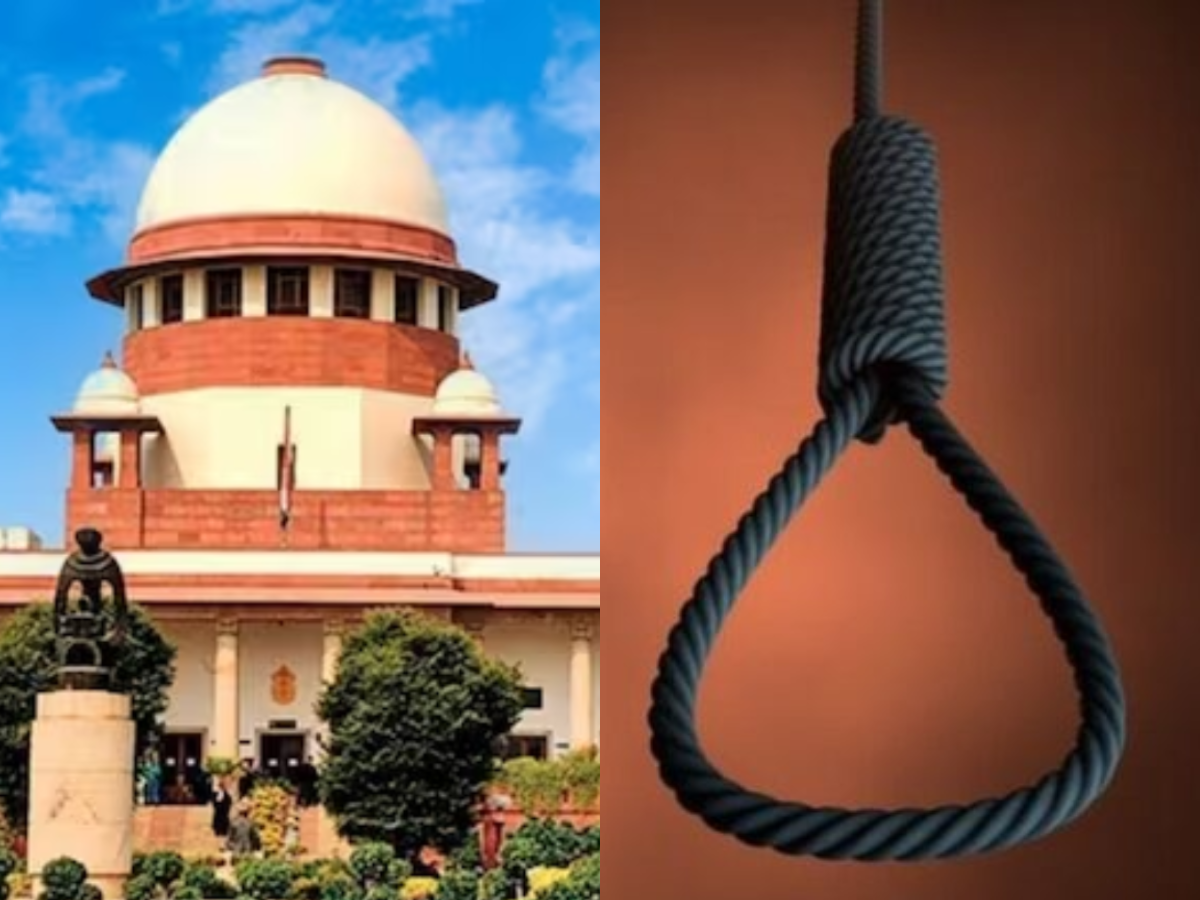
The Supreme Court on Monday made it clear that it can reconsider a death sentence under a writ petition made under Article 32 of the Constitution that gives the highest court the power to enforce fundamental rights. The landmark order creates a new window of hope for death row prisoners to appeal their sentence while making it clear that such petitions cannot be used to reargue whole cases.
Bench Details and Scope of Review
A three-member bench of Justices Vikram Nath, Sanjay Karol, and Sandeep Mehta ruled that Article 32 petitions could be aimed at considering the correctness of the sentence in view of extenuating circumstances. Such factors might encompass psychological and psychiatric assessments, among others.
The court observed, “In capital punishment cases, the corrective power can be exercised by this court under Article 32,” but said that this right could not be employed as a weapon to reopen settled issues.
Case Background: Vasant Sampat Dupare
The order was on the petition of Vasant Sampat Dupare, who was sentenced to death for raping and murdering a four-year-old girl in 2008. Dupare’s conviction and death sentence were confirmed by the Supreme Court in 2014 and a review petition was rejected in 2017. He also moved unsuccessful mercy petitions before the Maharashtra Governor and the President in 2022 and 2023.
In the petition, Dupare had requested reconsideration based on the 2022 Supreme Court ruling in Manoj v State of Rajasthan, which noted that psychiatric and psychological reports should be taken into account as mitigating circumstances while considering alternative punishment.
Court’s Observations on Sentencing
The bench explained that a writ petition under Article 32 is restricted only to the review of the sentence, and not the conviction. Dupare’s case will now be reheard on sentencing alone while the verdict on conviction stands.
The court also warned, “The exception cannot become a ground for reopening of concluded matters. It will be applicable only where there is breach of procedural safeguards.”
Significance of the Judgment
Historically, once a review petition is rejected, a convict’s sole remedy was a curative petition, which was heard in camera. This present ruling ensures that a death row convict can now approach for relief in open court, represented by lawyers, to review all the mitigating circumstances one last time. This is regarded as an important safeguard in the dispensing of capital punishment in India.
The Supreme Court suspended its May 2017 order rejecting Dupare’s review petition and instructed that the case be posted before the Chief Justice of India (CJI) for necessary directions on listing of the case.
Crime Details and Previous Court Findings
Dupare, 47 years old when he committed the offense, had brutally assaulted the minor girl using two heavy stones, which resulted in her death. The Supreme Court, in dismissing his review previously, had characterized his act as “depraved, calamitous, and menacing to society,” observing his failure to show remorse after the offense.
It is hoped that this ruling will be far-reaching, giving death row inmates another procedural protection without compromising the integrity of the legal process.