
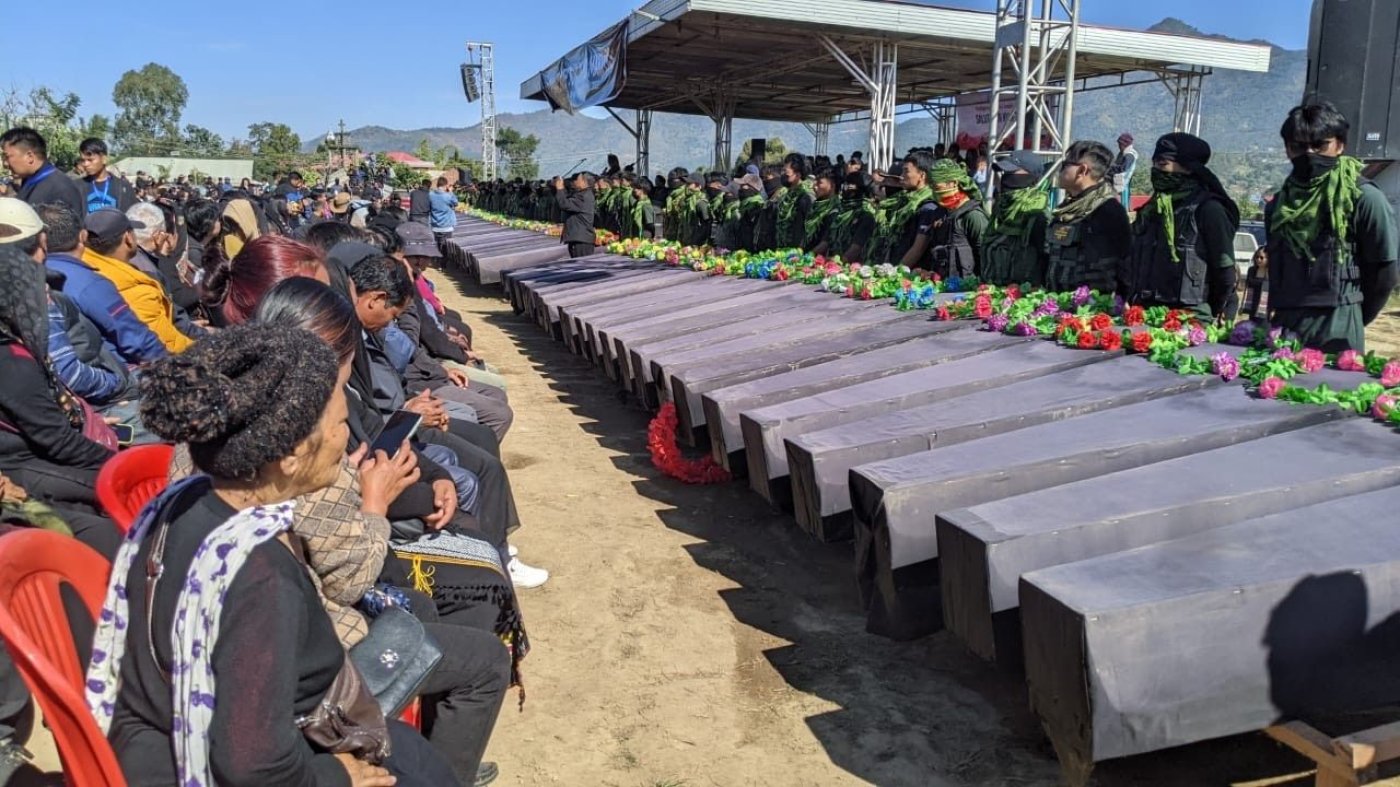
A joint team of the Manipur Police, the National Investigation Agency (NIA), and the Central Reserve Police Force (CRPF) arrested two suspects early Friday morning in connection with the killing of six Naga civilians in Leilon Vaiphei village in Manipur’s Kangpokpi district.
The arrests come nearly two months after the May 13 abduction and subsequent murder of the victims, an incident that intensified ethnic tensions in the northeastern state and triggered widespread outrage among Naga communities.
The operation was launched based on credible intelligence inputs and targeted Leilon Vaiphei village. During the raid, security forces arrested Pradip, son of Tomba, and his wife Ayingbi, who is also referred to as Ayinghi or Mangaih in some reports. Both are residents of the Kuki-Zo dominated village.
According to police, search and seizure operations were carried out during the raid, and the two accused have been taken into custody. Legal formalities are currently underway. Officials have not shared further details, saying the investigation is still in progress.
The involvement of the NIA highlights the seriousness of the case and indicates that investigators are examining possible links to militancy, arms proliferation, and cross-community violence in Manipur.
The case dates back to May 13, 2026, when 18 Naga civilians, including women and a child from Liangmai Naga communities, were allegedly abducted from Leilon Vaiphei village. The incident took place during a period of heightened tension following the ambush killing of three Kuki Baptist pastors in the same district.
According to reports, 12 of the abducted civilians were released earlier. However, the bodies of the remaining six were recovered on June 10 from a forested area near a Kuki-Zo village after an extensive search operation involving hundreds of security personnel, sniffer dogs, and forensic experts. The bodies reportedly showed signs of torture, mutilation, and dismemberment.
The Kuki-Zo Council later described the killings as a “big mistake” caused by emotion and issued an apology, acknowledging that the victims were innocent. However, Naga organisations viewed the incident as part of a larger pattern of targeted violence, displacement, and insecurity in Naga-inhabited areas.
The arrests came a day after the Naga Students’ Federation (NSF) intensified its demand for justice. On July 9, the federation organised a candlelight vigil in Kohima under the theme “Justice for Six Nagas” and submitted a memorandum to President Droupadi Murmu through Nagaland Governor Nand Kishore Yadav.
The memorandum was supported by a fact-finding report prepared after a reconnaissance mission conducted between June 4 and June 6 in southern Nagalim areas. The report documented violence, destruction of property, disruption of livelihoods, and restrictions on the movement of Naga communities.
NSF president Mteisuding described the vigil as “revolutionary solidarity” and alleged that the victims had been subjected to brutal torture and mutilation. He, along with Nagaland Tribal Hohos Coordination Committee convenor Thejao Vihienuo, urged Kuki leaders to stop violence and appealed to the Centre and state governments to address longstanding demands of the Naga people.
Among the key demands placed before the President were a time-bound and independent investigation into the killings and related incidents, a review of the Suspension of Operations (SoO) agreements with Kuki militant groups, inquiries into the conduct of security forces, better protection for Naga villages, action against illegal poppy cultivation, narcotics trafficking, and illegal arms, and safe passage along National Highway-202 and other important routes. The NSF also raised concerns over what it described as “armed narco-Kuki militant groups” contributing to instability.
Manipur has been affected by ethnic conflict involving the Meitei, Kuki-Zo, and Naga communities since 2023. Tensions between the Naga and Kuki communities date back to the 1990s and have been marked by repeated incidents of violence, displacement, and retaliation. The latest incident has increased concerns over further unrest in the hill districts, where disputes over land, resources, and political representation continue.
Naga organisations have welcomed the arrests as an important step towards accountability but have stressed the need for a swift and transparent investigation and the arrest of other alleged accomplices who are still believed to be at large. They have warned that any delay could weaken public confidence in the justice system.