
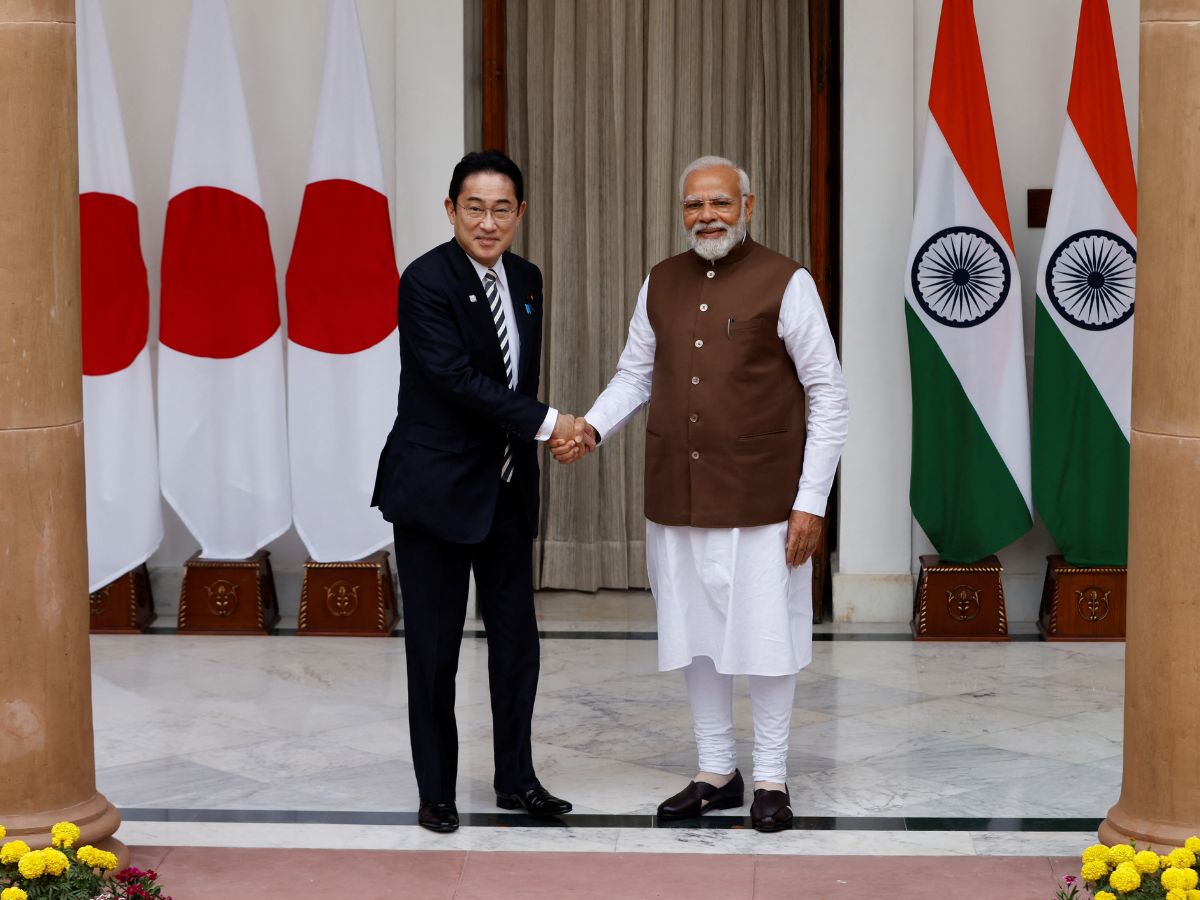
India and Japan on Friday took a decisive step towards reshaping their strategic and economic partnership. Prime Minister Narendra Modi and his Japanese counterpart Shigeru Ishiba finalised a 10-year roadmap in Tokyo, launching the Economic Security Initiative to deepen cooperation in technology, digitalisation, rare earths, and supply chain resilience. Central to the agreement is Tokyo’s ambitious target of 10 trillion yen ($68 billion) in private investments in India over the next decade, nearly doubling its earlier pledge.
The summit, held against the backdrop of global trade uncertainty created by U.S. policies under the Trump administration, placed economic security and innovation at the heart of bilateral relations. Both leaders underscored the need to safeguard national priorities while strengthening the rules-based international order.
“Strong Democracies Are Natural Partners”
At a joint media interaction, Prime Minister Modi described India and Japan as two vibrant democracies with shared responsibilities. “We both agree that as the world’s two largest economies and vibrant democracies, our partnership is extremely important not only for our two countries but also for global peace and stability. Strong democracies are natural partners in shaping a better world,” he said.
Echoing this, Ishiba noted that both nations must act decisively at a time of increasing uncertainty in international relations. “We share the responsibility to strengthen the international order. Japan and India need to bring their strengths together for the peace and stability of the region,” he remarked.
Investment Goals and Strategic Sectors
The Economic Security Initiative unveiled at the summit will focus on semiconductors, telecom, pharmaceuticals, space, and emerging technologies. Ishiba emphasised that Japan’s cooperation will extend to next-generation mobility, ports, aviation, shipbuilding, and the flagship Mumbai–Ahmedabad high-speed rail project. The target of 10 trillion yen builds on Japan’s earlier investment goal of 5 trillion yen between 2022 and 2026, which was achieved two years ahead of schedule.
The two sides also finalised a Joint Declaration on Security Cooperation, pledging to enhance coordination in defence, cybersecurity, and maritime security.
Technology, Talent, and Human Resource Exchange
High technology remains a central pillar of the new partnership. India and Japan agreed to expand cooperation under Digital Partnership 2.0 and launch a new AI Cooperation Initiative. At the same time, both leaders highlighted the importance of talent flows. Modi announced a plan for 500,000 human resource exchanges over five years, including 50,000 skilled Indians contributing directly to Japan’s economy.
Ishiba, however, expressed concern that fewer than 2,000 Indian students are currently in Japan despite the country’s growing need for skilled STEM professionals. He called for stronger mobility partnerships to bridge this gap and energise local communities in Japan.
Defence, Security and the Indo-Pacific Vision
Defence ties also took centre stage, with Modi and Ishiba vowing to deepen collaboration amid China’s assertive actions in the South China Sea and East China Sea. Both leaders reiterated their commitment to a free, open, peaceful, and rules-based Indo-Pacific, highlighting shared concerns over terrorism, cyber threats, and maritime security.
In a joint statement, the two prime ministers expressed “serious concern” over attempts to change the regional status quo by force or coercion. They opposed the militarisation of disputed features in the South China Sea, signalling a clear message to Beijing.
The Shinkansen Push and Infrastructure Cooperation
The Mumbai–Ahmedabad bullet train project remained a flagship element of discussions. Both sides agreed to work towards an early start of operations and the adoption of Japanese Shinkansen technology in India. Tokyo also offered the introduction of the E10 Shinkansen, equipped with advanced signalling systems, in India by the early 2030s. The joint plan includes immediate work on installing signalling infrastructure and introducing inspection and rolling stock technologies.
Also Read: India’s Economy Surges 7.8% In Q1 FY26 : Unexpected Boost Across Key Sectors Shocks Analysts
India and Japan as Global Partners
The summit concluded with both leaders framing the roadmap as a new chapter in the Special Strategic and Global Partnership that began in 2014. Modi said the decade-long vision will revolve around “investment, innovation, economic security, environment, technology, health, mobility, people-to-people exchanges and state-prefecture partnership.” Ishiba added that Japan’s technology and investments combined with India’s talent and market potential would deliver solutions not only for the two countries but also for global challenges.
As Modi put it, “We believe Japanese technology and Indian talent are a winning combination.” Ishiba agreed, emphasising that Japan and India must “take advantage of each other’s strengths to bring solutions to our challenges.”