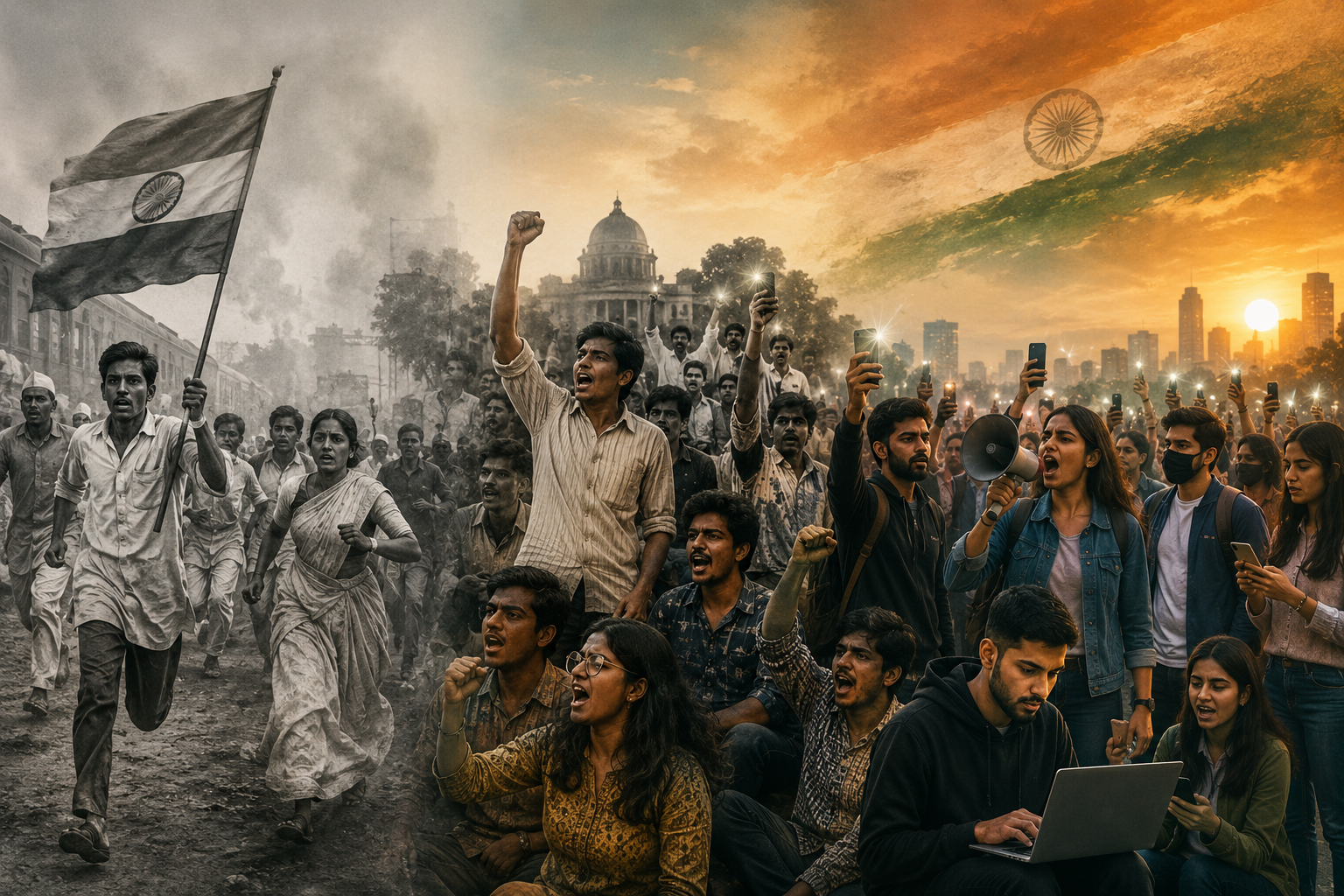
New Delhi: India’s history is often narrated through the actions of great leaders, political parties, and governments. Yet, behind many of the country’s most significant political transformations has stood another force—its youth. From the students who left classrooms to join the freedom struggle in the 1940s to the digitally connected generation expressing frustration through memes and satire in 2026, young Indians have repeatedly challenged authority, questioned existing systems, and sought to reshape the nation’s future.
The forms of dissent have changed dramatically over the decades. What began as physical resistance against colonial rule evolved into mass student agitations, anti-corruption campaigns, rights-based movements, and, more recently, digital activism. However, the underlying impulse remains remarkably similar: a refusal to accept what young people perceive as injustice, exclusion, or unresponsive governance.
The story of youth dissent in India is therefore not merely a history of protests. It is a chronicle of changing aspirations, technologies, and political cultures. Tracing this journey from the Quit India Movement of 1942 to the emergence of the Cockroach Janta Party in 2026 reveals how successive generations have reinvented the language of resistance while continuing a long tradition of challenging the status quo.
The Freedom Generation and the Quit India Movement
The modern history of youth dissent in India cannot begin anywhere other than the Quit India Movement of August 1942. Launched by Mahatma Gandhi at Bombay’s Gowalia Tank Maidan, the movement represented one of the most intense phases of India’s struggle against British colonial rule.
Young people were at the forefront. Students abandoned colleges, organised demonstrations, distributed underground literature, and participated in strikes. Many faced arrests, police brutality, and imprisonment. Unlike earlier phases of the national movement, the Quit India Movement witnessed widespread participation from ordinary citizens, particularly young men and women who viewed freedom as an urgent necessity rather than a distant aspiration.
The British administration responded with unprecedented repression. Top Congress leaders were arrested almost immediately after the movement began. Yet the crackdown only encouraged underground resistance. Young activists such as Usha Mehta operated clandestine radio stations, while leaders like Aruna Asaf Ali emerged as symbols of defiance.
For India’s youth, the movement was not simply about independence. It was also about agency. Young Indians discovered that they could become political actors capable of influencing national events. This belief would echo through future generations.
Independence and the New Republic
The achievement of independence in 1947 transformed the nature of youth activism. The enemy was no longer colonial rule. Instead, young Indians increasingly directed their energies toward nation-building.
Universities became centres of political debate. Student organisations affiliated with different ideological streams expanded rapidly. The early decades after independence saw young people engage with questions of language, regional identity, social justice, and economic development.
Yet dissatisfaction occasionally surfaced. As democratic institutions matured, students increasingly viewed themselves not merely as participants in politics but also as watchdogs capable of holding governments accountable.
This transition became particularly visible in the late 1960s and early 1970s, when inflation, unemployment, and corruption began generating widespread public frustration.
The Navnirman Movement and the Rise of Student Power
One of the most significant youth-led agitations after independence emerged in Gujarat in 1974. What began as a protest against rising hostel food charges soon developed into the Navnirman Andolan, a statewide movement against corruption and economic mismanagement.
The agitation quickly spread beyond university campuses. Students were joined by middle-class citizens, professionals, and sections of civil society. Demonstrations grew so large that they eventually forced the dissolution of the Gujarat Legislative Assembly.
The movement demonstrated the extraordinary power of student mobilisation. For the first time in independent India, a youth-led protest had directly contributed to the downfall of an elected government.
The significance of Navnirman extended beyond Gujarat. It inspired similar movements elsewhere, most notably the student-led agitations in Bihar supported by Jayaprakash Narayan. These developments eventually contributed to a broader political challenge to Prime Minister Indira Gandhi’s government.
The message was clear: youth could influence not only public opinion but also political outcomes.
Resistance During the Emergency
The declaration of the Emergency in 1975 marked another defining chapter in the history of youth dissent. Civil liberties were suspended, opposition leaders imprisoned, and press freedoms curtailed.
Many young activists found themselves confronting an unprecedented concentration of state power. Student organisations, underground networks, and civil society groups played crucial roles in resisting authoritarian measures.
Although dissent was severely restricted, the Emergency strengthened democratic consciousness among many young Indians. It reinforced the belief that vigilance was necessary to protect constitutional freedoms.
When the Emergency ended in 1977, youth participation contributed significantly to the broader democratic resurgence that followed.
Liberalisation and New Aspirations
The economic reforms of 1991 ushered in a different era. Liberalisation expanded educational opportunities, increased access to global culture, and created new aspirations among India’s youth.
Political dissent did not disappear, but its character changed. Economic mobility, employment opportunities, and professional advancement became central concerns. Student politics remained influential in many universities, yet large-scale youth movements became relatively less frequent compared to earlier decades.
However, beneath the surface, frustrations were accumulating. Rising competition, uneven development, and persistent corruption continued to shape public sentiment.
The arrival of the internet would soon provide young Indians with new tools for expressing these concerns.
The Digital Turn and the Anti-Corruption Movement
The first major youth mobilisation of the social media era emerged in 2011 during the India Against Corruption movement led by Anna Hazare.
For many young Indians, corruption had become symbolic of systemic failure. Social media platforms enabled rapid communication, mobilisation, and participation. Students and young professionals organised rallies, shared information online, and transformed anti-corruption activism into a national phenomenon.
The movement demonstrated how digital technologies could amplify political engagement. Unlike earlier protests that relied heavily on physical networks, online platforms enabled unprecedented speed and reach.
Although the movement eventually lost momentum, it marked a turning point in the relationship between youth and politics. A generation raised in the digital age had discovered its collective voice.
Nirbhaya and the Politics of Citizenship
The 2012 protests following the brutal gang rape and murder of a young woman in Delhi represented another watershed moment.
Thousands of young people gathered in public spaces demanding accountability, justice, and stronger protections for women. Unlike traditional political movements, the protests were largely spontaneous and issue-driven.
The demonstrations reflected changing expectations among India’s youth. They demanded not merely economic opportunities but also dignity, safety, and responsive governance.
The protests led to significant legal reforms and highlighted the growing influence of youth-led public pressure in shaping policy outcomes.
Campuses, Citizenship and Constitutional Values
The late 2010s witnessed renewed student activism across Indian universities. Debates over freedom of expression, campus autonomy, and citizenship increasingly occupied public discourse.
The protests against the Citizenship Amendment Act (CAA) and the proposed National Register of Citizens (NRC) became among the largest youth-led mobilisations in recent decades.
Students from institutions such as Jamia Millia Islamia and Aligarh Muslim University emerged at the forefront. Demonstrations soon spread across the country, drawing participation from diverse communities.
What distinguished these protests was their emphasis on constitutional values. Young protesters frequently invoked the Constitution, fundamental rights, and India’s pluralistic traditions. The movement revealed how contemporary youth dissent often combines digital communication with physical mobilisation.
The Generation of Anxiety
By the mid-2020s, a new set of concerns dominated youth discourse. Graduate unemployment remained high. Competitive examinations faced repeated allegations of paper leaks. Rising educational costs and economic uncertainty contributed to growing frustration.
Unlike previous generations, young Indians now lived in a hyperconnected environment. Every controversy, policy failure, or institutional breakdown could instantly become a national conversation.
This digital ecosystem transformed not only how dissent was expressed but also how it spread.
Humour, irony, memes, and satire increasingly became political tools.
The Cockroach Janta Party and the Age of Satirical Protest
The emergence of the Cockroach Janta Party in 2026 represents perhaps the most unusual chapter in India’s history of youth dissent.
The movement originated after remarks attributed to Chief Justice Surya Kant comparing certain unemployed youth to “cockroaches.” Although the remarks were later clarified, many young Indians viewed them as emblematic of official indifference toward their struggles.
Digital strategist Abhijeet Dipke responded by launching the Cockroach Janta Party as a satirical online movement. What began as a joke quickly evolved into a nationwide phenomenon.
Millions of young people embraced the symbol. The cockroach—traditionally associated with insignificance—was transformed into a metaphor for resilience and survival.
Unlike earlier protest movements organised through political parties, trade unions, or student organisations, the Cockroach Janta Party relied almost entirely on digital participation. Memes became manifestos. Satire became political commentary.
The movement’s popularity reflected deeper frustrations about unemployment, examination scandals, and perceived institutional failures. Its success demonstrated that in the digital age, humour can function as a powerful form of dissent.
From Streets to Screens—and Back Again
The evolution of youth dissent from the Quit India Movement to the Cockroach Janta Party reveals both continuity and change.
The students of 1942 confronted colonial rule through physical sacrifice and mass mobilisation. The activists of 1974 challenged corruption through organised protest. The youth of the 2010s harnessed social media to demand accountability and justice. Today’s generation employs memes, satire, and digital networks to articulate its concerns.
Yet the underlying thread remains remarkably consistent. Each generation has sought to challenge systems perceived as unjust, unresponsive, or exclusionary.
The methods have changed—from underground radio stations to Instagram reels—but the impulse remains the same.
India’s democratic journey has repeatedly been shaped by young citizens willing to question authority and imagine alternatives. Whether marching in the streets, occupying public squares, or mobilising online communities, they have continually expanded the boundaries of political participation.
The story of youth dissent in India is therefore not merely a historical narrative. It is an ongoing conversation between generations, each redefining what it means to raise one’s voice. And if history offers any lesson, it is that India’s youth will continue to find new languages of resistance long after today’s movements have passed into memory.