
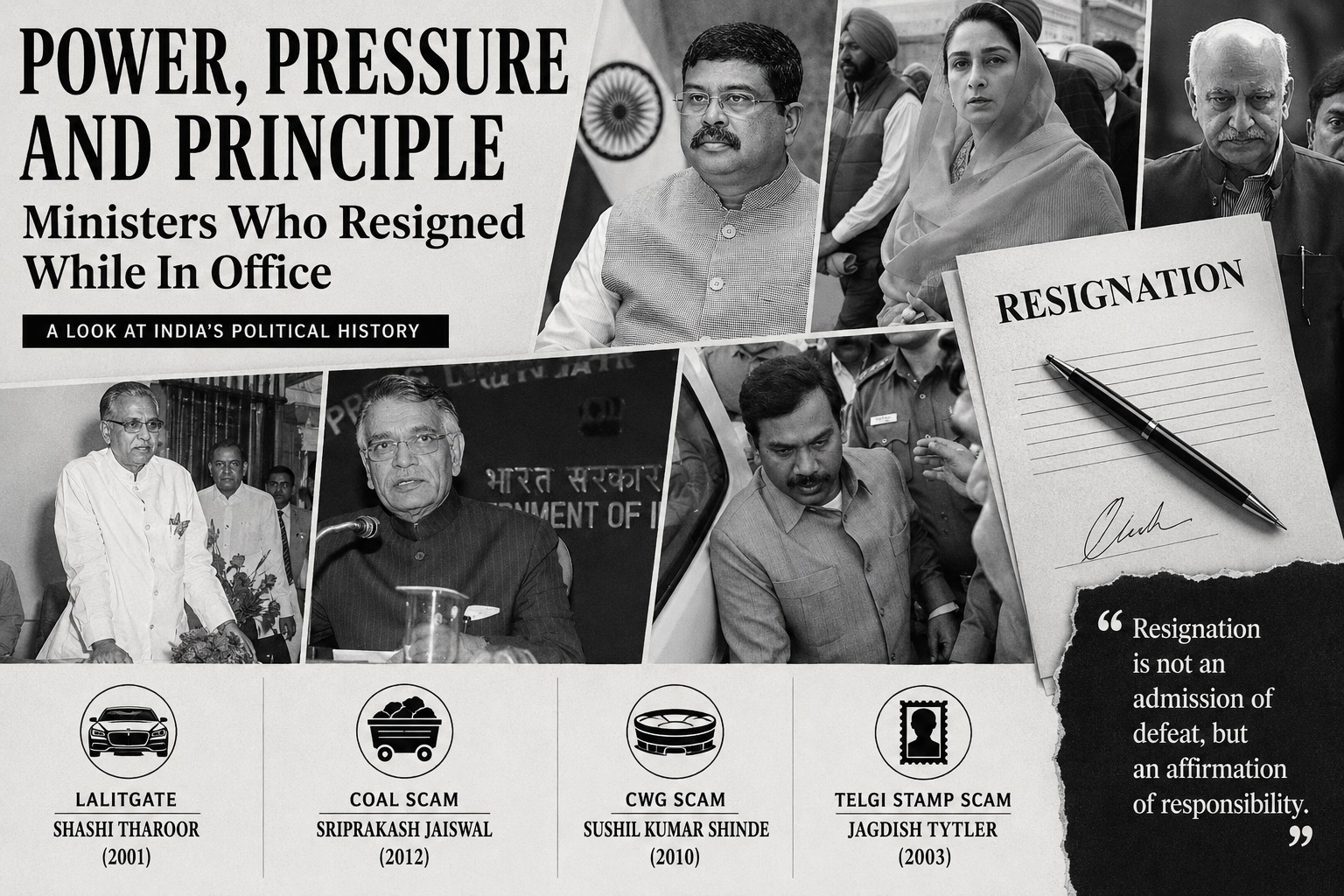
From Lal Bahadur Shastri to Dharmendra Pradhan, the history of ministerial resignations reflects how accountability, public pressure and political morality have shaped India’s democracy.
The resignation of Union Education Minister Dharmendra Pradhan on 25 July 2026, following weeks of nationwide student protests over the NEET-UG paper leak controversy, once again revived an old constitutional question: Should ministers resign when their departments fail, even if they are not personally guilty? His resignation came after sustained public demonstrations and mounting political pressure, with the government describing the move as an effort to restore confidence in the education system amid growing demands for greater accountability.
Although every resignation has its own political context, India has a long history of ministers stepping down over administrative failures, scandals, policy disagreements and questions of public morality. Some resigned voluntarily to uphold constitutional traditions, while others were compelled by public outrage, coalition pressures or judicial scrutiny.
The story of ministerial resignations is, therefore, also the story of India’s evolving democratic accountability.
The Westminster Legacy
India inherited the principle of ministerial responsibility from the Westminster parliamentary system. Under this doctrine, ministers are expected to accept responsibility not only for their personal actions but also for the functioning of their ministries.
In practice, however, resignations have never followed a fixed rule. Political calculations, public opinion and the strength of governments often determine whether a minister stays or goes. Yet some resignations have become defining moments in India’s democratic journey because they established standards of political ethics.
Lal Bahadur Shastri: Setting the Gold Standard
Perhaps the most celebrated example remains Lal Bahadur Shastri.
In November 1956, a devastating railway accident near Ariyalur in Tamil Nadu claimed over 140 lives. As Railway Minister in Jawaharlal Nehru’s Cabinet, Shastri resigned, accepting moral responsibility for the tragedy despite not being personally responsible for the accident.
Prime Minister Nehru initially tried to persuade him to stay. Nevertheless, Shastri insisted that a minister must accept responsibility for failures within his department.
The resignation earned him immense public respect and established a benchmark for ministerial accountability. Less than a decade later, he became India’s second Prime Minister.
Even today, Shastri’s resignation is widely cited whenever debates arise about political responsibility after administrative failures.
T.T. Krishnamachari and the Mundhra Scandal
In 1958, Finance Minister T.T. Krishnamachari resigned after the LIC-Mundhra scandal, one of independent India’s earliest financial controversies.
A judicial inquiry headed by Justice M.C. Chagla criticised the role of the Finance Ministry after the Life Insurance Corporation invested heavily in companies linked to businessman Haridas Mundhra.
Although Krishnamachari denied direct wrongdoing, the inquiry’s findings made his position politically untenable. His resignation demonstrated that parliamentary scrutiny and independent investigations could compel accountability even in the early years of the Republic.
Krishna Menon After the 1962 War
Another landmark resignation came in 1962.
Defence Minister V.K. Krishna Menon, one of Prime Minister Nehru’s closest associates, faced intense criticism following India’s military defeat in the Sino-Indian War.
Questions over defence preparedness, intelligence failures and military leadership generated enormous public anger. Under growing pressure from Parliament, the media and within the Congress itself, Menon resigned.
Although historians continue to debate the extent of his personal responsibility, the resignation reflected the expectation that ministers must bear political responsibility for national setbacks.
The Coalition Era and Political Pressures
From the late 1980s onwards, coalition governments transformed the nature of resignations.
Political survival often depended on maintaining alliances, meaning ministers sometimes resigned to reduce pressure on governments rather than purely on moral grounds.
One notable example was Nitish Kumar, who resigned as Railway Minister after the 1999 Gaisal train disaster. The collision killed hundreds of passengers and revived comparisons with Lal Bahadur Shastri’s earlier resignation.
Although Kumar later returned to government, the episode reinforced the tradition that railway accidents often triggered ministerial accountability.
Security Failures and Shivraj Patil
The 26/11 Mumbai terror attacks in 2008 marked another turning point.
Following criticism of the government’s handling of internal security and intelligence coordination, Union Home Minister Shivraj Patil resigned.
His resignation came amid widespread public outrage over the terrorist attacks that killed more than 160 people. While the attacks exposed multiple institutional failures across agencies, political accountability focused on the Home Ministry.
The resignation was widely viewed as an attempt to restore public confidence during one of India’s gravest national security crises.
Corruption and the UPA Years
The United Progressive Alliance (UPA) years witnessed a series of high-profile resignations linked to corruption allegations.
Telecommunications Minister A. Raja resigned in 2010 after allegations relating to the allocation of 2G spectrum licences. Investigations, parliamentary debates and sustained public criticism made the controversy one of India’s biggest political scandals.
In 2011, Dayanidhi Maran stepped down following allegations connected to telecom licensing decisions.
The following years saw more resignations.
Law Minister Ashwani Kumar resigned in 2013 after controversy surrounding the alleged vetting of a CBI report.
Railway Minister Pawan Kumar Bansal also resigned in 2013 following corruption allegations involving a railway appointments scandal.
These resignations reflected increasing judicial activism, media scrutiny and public intolerance towards corruption during the period.
Resignation and Personal Conduct
Not every resignation has involved administrative failure.
In 2018, Minister of State for External Affairs M.J. Akbar resigned following multiple allegations of sexual harassment during India’s #MeToo movement.
Although the allegations related largely to events before he entered government, the growing public debate over workplace conduct and gender justice created intense political pressure.
His resignation illustrated how standards of public office had expanded beyond administrative performance to include personal conduct and ethical credibility.
Policy Differences
Ministers have also resigned over ideological disagreements.
In 2012, Railway Minister Dinesh Trivedi resigned after proposing an increase in railway fares that was opposed by his own party, the Trinamool Congress.
Similarly, in 2020, Food Processing Industries Minister Harsimrat Kaur Badal resigned from the Union Cabinet in protest against the three farm laws.
Unlike resignations triggered by scandals, these reflected political principles and policy differences within coalition politics.
Dharmendra Pradhan and the Politics of Accountability
The latest addition to this history is the resignation of Dharmendra Pradhan.
The immediate trigger was the controversy surrounding the NEET-UG 2026 paper leak, which affected millions of aspirants and reignited concerns over the integrity of public examinations. The issue quickly evolved into a broader youth movement demanding accountability, examination reforms and greater transparency in recruitment systems. Weeks of nationwide demonstrations, particularly led by students, increased pressure on the government before Pradhan announced his resignation.
In his resignation letter, Pradhan said he was stepping down in the interest of students and to prevent further unrest, while reiterating his commitment to educational reform. The government has also indicated plans for stronger anti-paper leak legislation and structural reforms to examination systems.
Whether history ultimately judges his resignation as an act of moral responsibility or a political necessity will depend on the long-term success of those reforms. Nevertheless, it has reopened an important national conversation about accountability in public office.
Has the Meaning of Resignation Changed?
Over seven decades, the reasons behind ministerial resignations have changed significantly.
In the 1950s and 1960s, resignations often symbolised moral responsibility.
By the coalition era, political arithmetic became equally important.
In the 2000s, judicial scrutiny, investigative agencies and 24-hour news coverage increased pressure on ministers.
Today, social media, digital activism and citizen mobilisation have emerged as equally powerful forces capable of influencing political outcomes.
The expectations of citizens have also evolved. Public accountability now extends beyond administrative competence to include transparency, ethical conduct and responsiveness during crises.
A Democratic Safety Valve
Resignation should not automatically be interpreted as an admission of guilt.
In parliamentary democracies, it frequently serves as a constitutional mechanism to preserve public confidence while investigations continue or governments reset their political course.
India’s history demonstrates that resignations have occurred for many reasons—railway accidents, military defeats, financial scandals, corruption allegations, personal misconduct, policy disagreements and public protests. Yet each has contributed to the broader democratic principle that those entrusted with public office must remain answerable to Parliament and the people.
From Lal Bahadur Shastri’s resignation after the Ariyalur rail disaster to Dharmendra Pradhan’s exit amid nationwide student protests, these episodes trace the evolution of ministerial accountability in India. They remind us that while governments change and political circumstances differ, the expectation that those in power must answer for the functioning of their ministries remains one of the enduring foundations of parliamentary democracy.