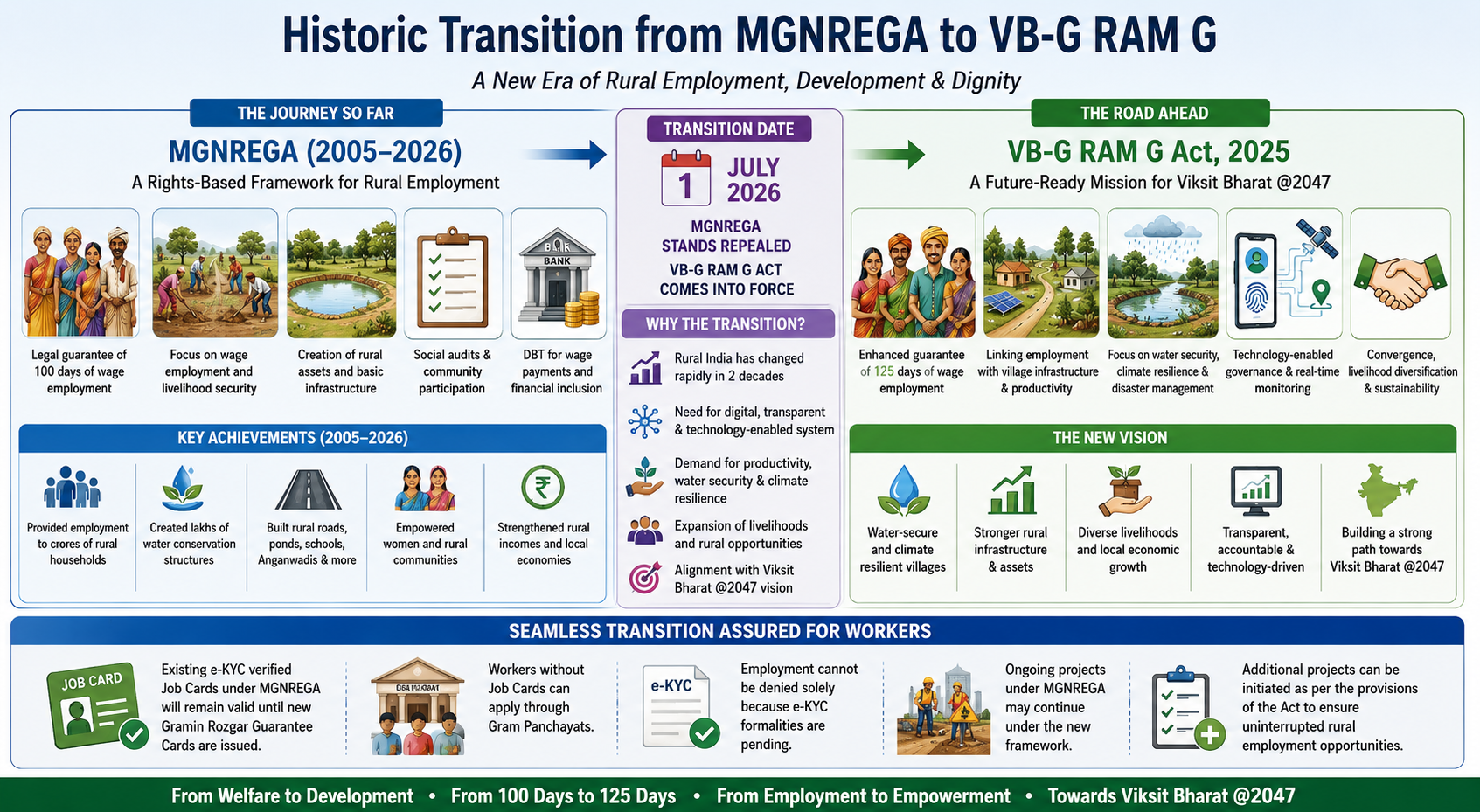
India’s rural development framework entered a historic new phase with the introduction of the Viksit Bharat – Guarantee for Rozgar and Ajeevika Mission (Gramin) Act, 2025, popularly called the VB-G RAM G (विकसित भारत–जी राम जी) Act. Operational across all rural areas of the country from July 1, 2026, the legislation replaces the two-decade-old Mahatma Gandhi National Rural Employment Guarantee Act and marks a significant transformation in the way rural employment and village development are envisioned in India.
The Act has been designed as a future-ready rural development architecture aligned with the national vision of Viksit Bharat @2047. While MGNREGA focused primarily on wage employment generation, the new framework seeks to combine livelihood security with durable infrastructure creation, climate resilience, technological governance, and long-term economic growth. It attempts to reposition rural employment from a welfare-oriented intervention to a productive and developmental instrument capable of transforming villages into engines of sustainable growth.
At the heart of the legislation lies the idea of “Rozgar Bhi, Samman Bhi” — employment with dignity. The Government has emphasized that rural workers should not merely be recipients of temporary wages, but active participants in building productive public assets that strengthen local economies and improve quality of life.
Historic Transition from MGNREGA to VB-G RAM G
The implementation of the VB-G RAM G Act across all rural areas of the country is being described as one of the most significant rural policy transitions in independent India. With the commencement of the Act, MGNREGA stands repealed from July 1, 2026.
The transition signifies more than just a change in legislation. It reflects a complete restructuring of India’s rural employment philosophy. Over the past two decades, India’s villages have undergone rapid changes due to improved roads, digital connectivity, social welfare schemes, banking penetration, mobile technology, and expanding livelihood opportunities. Policymakers argued that the earlier framework required modernization to match contemporary rural realities and future aspirations.
The new Act therefore introduces a broader developmental vision where rural employment is linked directly with village infrastructure, productivity enhancement, water conservation, disaster management, livelihood diversification, and climate adaptation.
Importantly, the Government has assured a seamless transition for workers. Existing e-KYC verified Job Cards under MGNREGA will remain valid until new Gramin Rozgar Guarantee Cards are issued. Workers without Job Cards can apply through Gram Panchayats, and employment cannot be denied solely because e-KYC formalities are pending.
Ongoing projects under MGNREGA may continue under the new framework, while additional projects can be initiated according to the provisions of the Act. This continuity is aimed at ensuring that rural employment opportunities remain uninterrupted during the transition period.
Enhanced Employment Guarantee: From 100 to 125 Days
One of the most notable features of the VB-G RAM G Act is the enhancement of the statutory employment guarantee from 100 days to 125 days in every financial year.
This increase reflects the Government’s recognition that rural households continue to require livelihood support amid economic uncertainty, climate-related disruptions, and changing agricultural patterns. The additional 25 days are expected to strengthen rural incomes, increase purchasing power, and provide greater economic resilience to vulnerable communities.
The enhanced guarantee applies to every rural household whose adult members volunteer to undertake unskilled manual work. Workers can continue demanding employment orally, through written applications, or via digital platforms.
The Act also strengthens unemployment allowance provisions. If employment is not provided within the stipulated period, workers remain legally entitled to unemployment allowance. For the first thirty days, the allowance will be at least one-fourth of the notified wage rate, increasing to one-half of the wage rate for the remaining period.
These provisions aim to reinforce accountability within the implementation system and ensure that the employment guarantee remains legally enforceable rather than symbolic.
Rural Employment Linked with Productive Development
Unlike earlier wage-employment programmes that were often criticized for creating temporary or low-impact assets, the VB-G RAM G framework strongly emphasizes durable and productive infrastructure creation.
The Act categorizes permissible works into four major thematic areas:
1. Water Security
Water-related projects form one of the central pillars of the new framework. These include groundwater recharge structures, irrigation support systems, rainwater harvesting, watershed development, rejuvenation of ponds and lakes, and afforestation activities.
Given the increasing challenges posed by droughts, erratic monsoons, and groundwater depletion, these works are intended to improve long-term water resilience in rural India.
2. Core Rural Infrastructure
The Act expands the scope of rural infrastructure works to include roads, public buildings, school infrastructure, sanitation systems, Anganwadi centres, renewable energy infrastructure, and housing-related works.
This approach integrates employment generation with the improvement of essential civic amenities and public services.
3. Livelihood-Oriented Infrastructure
The framework also supports infrastructure related to agriculture, fisheries, livestock, storage facilities, cold chains, food processing units, compost units, rural markets, and skill development centres.
The objective is to diversify rural livelihoods, strengthen agro-based industries, and create sustainable economic opportunities within villages.
4. Climate Resilience and Disaster Mitigation
Recognizing the growing impact of climate change, the Act prioritizes works related to flood management, embankments, cyclone shelters, post-disaster rehabilitation, and forest fire management.
These initiatives seek to make rural communities more resilient against natural disasters and extreme weather events.
By integrating employment generation with infrastructure development, the Act attempts to ensure that each day of labour contributes meaningfully to long-term village transformation.
Technology-Enabled Governance and Transparency
A major departure from the earlier framework is the strong emphasis on technology-enabled governance.
The Act introduces a digitally integrated monitoring system aimed at improving transparency, accountability, and efficiency in implementation. Attendance at worksites will be captured through NMMS-enabled systems and face authentication-based attendance mechanisms.
Additionally, the framework incorporates:
· Geo-tagging of assets
· Mobile-based monitoring
· Real-time dashboards
· AI-enabled analytics
· Digital public disclosure systems
· GIS-based planning
· Integration with PM Gati Shakti
These measures are expected to reduce leakages, prevent duplication, and improve quality control.
At the same time, the Government has stated that suitable exception-handling mechanisms will be available to ensure workers are not unfairly excluded because of technical glitches or connectivity issues.
Timely Wage Payments and Worker Protection
The Act gives significant importance to timely wage disbursement.
Wages will continue to be transferred directly into workers’ bank or post office accounts through Direct Benefit Transfer (DBT). Payments are to be made weekly or within fifteen days from the closure of the muster roll.
In cases where wage payments are delayed beyond the stipulated period, workers will receive compensation at the rate of 0.05 percent of unpaid wages for every day of delay after the sixteenth day.
The legislation also introduces several worker-centric welfare measures at worksites. These include:
· Clean drinking water
· Shade and rest areas
· First-aid kits
· Childcare support at worksites
· Free medical treatment in case of accidents
· Ex-gratia assistance for death or permanent disability
A particularly significant provision is the appointment of a woman worker to care for children below the age of five at worksites where five or more children are present. This measure aims to increase women’s participation in rural employment programmes.
Strengthening Gram Panchayats through Decentralized Planning
The Act places Gram Panchayats at the centre of rural development planning through the concept of the Viksit Gram Panchayat Plan (VGPP).
Under this framework, Gram Sabhas and Panchayats identify local developmental priorities through a bottom-up planning process. Plans are then consolidated at block, district, and state levels.
This decentralized approach seeks to empower local governance institutions and ensure that projects are tailored to local needs rather than imposed through centralized planning.
Integration with digital mapping systems and PM Gati Shakti is expected to make rural planning more scientific and data-driven.
Balancing Agriculture and Rural Employment
An innovative provision in the Act allows States to notify a cumulative pause period of up to sixty days during peak sowing and harvesting seasons.
The objective is to ensure adequate labour availability for agriculture during critical periods while preserving the full 125-day employment guarantee during the remainder of the year.
This provision attempts to address longstanding concerns from farmers regarding labour shortages during agricultural seasons.
Historic Budgetary Commitment
The Government has made a record financial allocation for the implementation of the programme.
For FY 2026-27, a Central allocation of ₹95,692.31 crore has been made under the scheme, the largest-ever Budget Estimate allocation for a rural employment programme in India.
Including estimated State contributions, the total programme outlay is expected to exceed ₹1.51 lakh crore.
The massive financial commitment demonstrates the Government’s intention to use the programme as a major driver of rural infrastructure creation, employment generation, and economic growth.
Capacity Building and Administrative Strengthening
The Act also recognizes the importance of strengthening grassroots implementation machinery.
Administrative expenditure has been increased from 6 percent to 9 percent, enabling better training, remuneration, and capacity building for field-level functionaries such as:
· Gram Rozgar Sevaks
· Programme Officers
· Mates
· Panchayat-level staff
This investment is expected to improve monitoring, implementation efficiency, and accountability.
Convergence-Based Rural Development Model
Another major feature of the Act is its convergence-based approach.
Instead of operating as an isolated scheme, VB-G RAM G seeks to integrate multiple government programmes into a unified rural development framework. Housing schemes, sanitation initiatives, renewable energy projects, irrigation works, and livelihood missions are expected to function in coordination.
This “saturation approach” aims to systematically close infrastructure gaps within villages and ensure comprehensive rural transformation.
Institutional Oversight and Social Audits
To maintain accountability, the Act establishes multiple oversight mechanisms.
These include:
· Central Gramin Rozgar Guarantee Council
· State Gramin Rozgar Guarantee Councils
· Central and State Steering Committees
· Strengthened Social Audit systems
Mandatory social audits and Janata Boards displaying work details at worksites are expected to improve community participation and transparency.
Public disclosure systems, geo-tagging, and real-time monitoring are designed to strengthen public oversight at the grassroots level.
Climate Resilience and Future-Oriented Vision
One of the defining aspects of the VB-G RAM G framework is its emphasis on climate resilience.
Rural India is increasingly vulnerable to floods, droughts, heatwaves, and changing rainfall patterns. By integrating climate adaptation measures into public works, the Act seeks to build resilient rural infrastructure capable of withstanding environmental challenges.
The framework aligns employment generation with sustainability goals, reflecting a broader policy shift toward environmentally conscious development.
Criticism and Challenges
Despite its ambitious vision, the Act is likely to face several implementation challenges.
Critics may raise concerns regarding:
· Dependence on digital systems in regions with poor connectivity
· Biometric authentication failures
· Administrative capacity at the Panchayat level
· Delays in wage payments despite legal guarantees
· Adequacy of funding for expanded employment guarantees
· Potential exclusion of vulnerable groups during digital transition
There may also be debates over whether replacing MGNREGA could weaken the rights-based nature of rural employment if implementation becomes overly centralized or technology-dependent.
Ensuring effective grievance redressal and maintaining transparency will therefore be crucial to the programme’s success.
The VB-G RAM G Act, 2025 represents one of the most ambitious rural policy reforms undertaken in India in recent decades. By expanding the employment guarantee, strengthening infrastructure creation, embracing technology-enabled governance, and integrating climate resilience into rural planning, the legislation seeks to redefine the relationship between employment and development in rural India.
The transition from MGNREGA to VB-G RAM G reflects the Government’s attempt to align rural development with the long-term vision of Viksit Bharat @2047. The framework aims not only to provide wages but also to create productive villages, stronger livelihoods, sustainable infrastructure, and empowered Panchayats.
Whether the programme succeeds will depend largely on effective implementation, timely payments, robust accountability mechanisms, and inclusive governance. If executed efficiently, the Act has the potential to transform rural employment from a safety-net programme into a catalyst for sustainable and future-ready rural development across India.