How a judicial reform launched in 2000 continues to evolve—from delivering speedy justice in criminal cases to tackling new-age crimes like examination paper leaks.
“Justice delayed is justice denied.” The words of British statesman William E. Gladstone have echoed through courtrooms across the world for more than a century. In India, where judicial delays have often tested the patience of litigants, this principle became the driving force behind one of the country’s most significant legal reforms—the establishment of Fast-Track Courts (FTCs) in 2000.
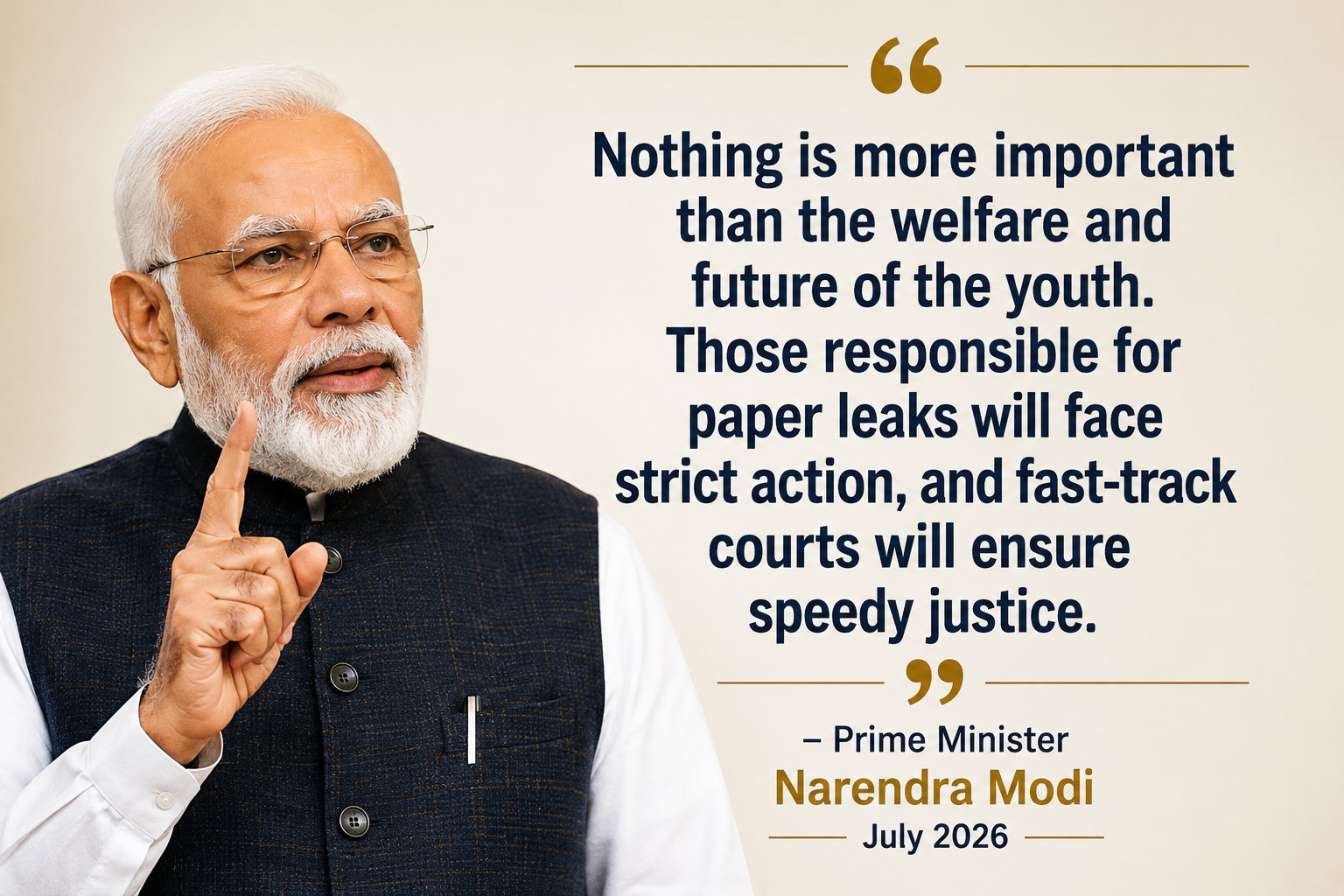
Twenty-five years later, the idea of speedy justice is once again making headlines. Addressing the nation during the Monsoon Session of Parliament, Prime Minister Narendra Modi announced that the Centre would establish Fast-Track Courts for paper leak cases, ensuring that those who jeopardise the future of millions of students are brought to justice swiftly.
The announcement is more than a response to a contemporary challenge. It reflects the remarkable journey of Fast-Track Courts—from reducing decades-old judicial backlogs to becoming a trusted instrument for addressing crimes that deeply affect public confidence. Their evolution mirrors India’s changing priorities, proving that while crimes may change with time, the need for timely justice remains constant.
When Justice Took Too Long
The story of Fast-Track Courts begins long before they were officially created.
After Independence, India’s judiciary gradually became burdened with an ever-growing number of civil and criminal cases. By the 1980s and 1990s, delays had become one of the biggest challenges facing the justice delivery system. Courtrooms struggled with mounting pendency, vacancies among judges, and procedural bottlenecks. Criminal trials often continued for years, sometimes even decades.
Delayed justice had serious consequences. Victims waited endlessly for closure, accused persons remained under prolonged legal uncertainty, witnesses became unavailable, and public trust in institutions weakened.
Legal experts, judges and the Law Commission of India repeatedly emphasised that unless the backlog was reduced, the constitutional promise of equal access to justice would remain incomplete.
The Birth of Fast-Track Courts
A major breakthrough came in 2000, when the Government of India accepted the recommendation of the Eleventh Finance Commission to establish Fast-Track Courts across the country.
Initially conceived as a temporary measure, these courts had one primary objective—to dispose of long-pending sessions cases as quickly as possible.
More than 1,700 Fast-Track Courts were sanctioned in different states with financial assistance from the Union Government. They functioned using retired judges, ad hoc judicial officers and existing court infrastructure.
Their creation marked India’s first large-scale attempt to tackle judicial pendency through specialised courts dedicated to speedier disposal.
Within a few years, Fast-Track Courts disposed of hundreds of thousands of pending criminal cases, demonstrating that focused judicial mechanisms could significantly improve efficiency.
The First Phase: Reducing Backlogs
During their initial years, Fast-Track Courts primarily handled serious criminal matters such as:
· Murder
· Dacoity
· Robbery
· Attempt to murder
· Long-pending Sessions Court cases
Unlike ordinary courts, these courts followed continuous hearing schedules, minimising unnecessary adjournments while ensuring that due process was followed.
Although implementation differed from state to state, the experiment showed that judicial delays were not inevitable. Better planning, dedicated judges and focused case management could dramatically improve disposal rates.
The Nirbhaya Moment That Changed Everything
If the year 2000 marked the birth of Fast-Track Courts, 2012 marked their transformation.
The horrific gang rape and murder of a young physiotherapy student in Delhi—remembered across the country as the Nirbhaya case—triggered one of the largest public movements for judicial reform in independent India.
The nation demanded two things:
· Stronger laws.
· Faster justice.
The Government constituted the Justice J. S. Verma Committee, whose recommendations became the foundation for the Criminal Law (Amendment) Act, 2013.
Following these reforms, Fast-Track Courts acquired a new identity.
Instead of merely reducing pendency, they increasingly became specialised courts dealing with:
· Sexual offences
· Crimes against women
· Child abuse
· Cases under the Protection of Children from Sexual Offences (POCSO) Act
The emphasis shifted from administrative efficiency to victim-centred justice.
Fast Track Special Courts: Protecting the Vulnerable
Recognising the need for specialised handling of sensitive offences, the Government later introduced Fast Track Special Courts (FTSCs).
These courts were established specifically for:
· Rape cases
· POCSO cases
· Crimes involving women and children
Special child-friendly courtrooms, separate waiting areas, video-recorded testimonies and victim-sensitive procedures became increasingly common.
The objective was clear—not only should justice be delivered quickly, but survivors should also be spared prolonged legal trauma.
Today, FTSCs operate in many states under a Centrally Sponsored Scheme funded through the Nirbhaya Fund, reflecting the country’s commitment to strengthening access to justice for vulnerable groups.
Technology Brings a New Dimension
The evolution of Fast-Track Courts has also coincided with India’s digital transformation.
The e-Courts Mission Mode Project, launched to modernise the judiciary, introduced:
· Electronic filing of cases
· Digital case records
· Online cause lists
· Video conferencing
· Virtual hearings
The COVID-19 pandemic accelerated the adoption of technology, allowing courts to continue functioning even during lockdowns.
Today, technology complements Fast-Track Courts by reducing administrative delays and improving case management, making speedy justice more achievable than ever before.
A New Chapter: Fast-Track Courts for Paper Leak Cases
Twenty-five years after their creation, Fast-Track Courts are entering yet another phase.
In July 2026, amid growing concern over repeated examination paper leaks affecting recruitment and competitive examinations, Prime Minister Narendra Modi announced that the Government would establish Fast-Track Courts for paper leak cases.
The decision reflects changing societal priorities.
Earlier, Fast-Track Courts primarily dealt with violent crimes. Today, they are also seen as instruments to combat organised fraud that threatens public trust, meritocracy and the aspirations of millions of young Indians.
Examination paper leaks not only undermine fair competition but also erode confidence in public institutions. By proposing specialised courts for such offences, the Government has signalled that crimes affecting the future of students deserve the same urgency as other serious offences.
The announcement marks another milestone in the continuing evolution of India’s judicial reforms.
Achievements Over Twenty-Five Years
The success of Fast-Track Courts cannot be measured only by statistics.
They have:
· Reduced pendency in thousands of criminal cases.
· Improved public confidence in the justice delivery system.
· Encouraged specialised handling of sensitive offences.
· Strengthened victim-centric judicial processes.
· Demonstrated that institutional innovation can improve access to justice.
Most importantly, they have reinforced the constitutional promise that justice should be accessible within a reasonable time.
Challenges That Remain
Despite their achievements, Fast-Track Courts continue to face several challenges.
Many sanctioned courts still function without adequate infrastructure or dedicated staff. Judicial vacancies continue to affect efficiency. Police investigations and forensic examinations often take longer than expected, limiting the benefits of speedy trials.
Witness protection remains another concern, as prolonged investigations sometimes discourage witnesses from participating fully in trials.
Legal experts therefore argue that Fast-Track Courts should work alongside broader reforms, including:
· Filling judicial vacancies.
· Increasing the number of judges.
· Strengthening forensic laboratories.
· Modernising police investigations.
· Expanding digital infrastructure.
· Improving legal aid services.
The Road Ahead
The future of Fast-Track Courts is likely to extend beyond traditional criminal trials.
With cybercrime, financial fraud, examination scams and technology-enabled offences increasing rapidly, specialised judicial mechanisms will become even more important.
Artificial intelligence-assisted case management, digital evidence platforms, virtual hearings and integrated criminal justice systems are expected to further reduce delays while preserving due process.
Fast-Track Courts are therefore no longer viewed as temporary solutions but as an essential component of a modern justice delivery system.
Justice That Evolves With Society
The history of Fast-Track Courts is, in many ways, the history of India’s changing understanding of justice.
What began in 2000 as an administrative experiment to reduce judicial backlogs has evolved into a dynamic institution responding to the nation’s most pressing concerns—from violent crimes against women and children to examination fraud affecting millions of young citizens.
As India marks 25 years of Fast-Track Courts, the institution stands as a reminder that justice systems must evolve alongside society. Laws may change, crimes may take new forms, and technology may reshape courtrooms, but one principle remains timeless: justice must be fair, accessible and timely.
In extending the Fast-Track Court model to paper leak cases, India is not merely responding to a present crisis—it is carrying forward a judicial reform that has continually adapted to the needs of its people. After a quarter century, the message is clear: speedy justice is no longer an aspiration; it is an expectation central to a modern democracy.