
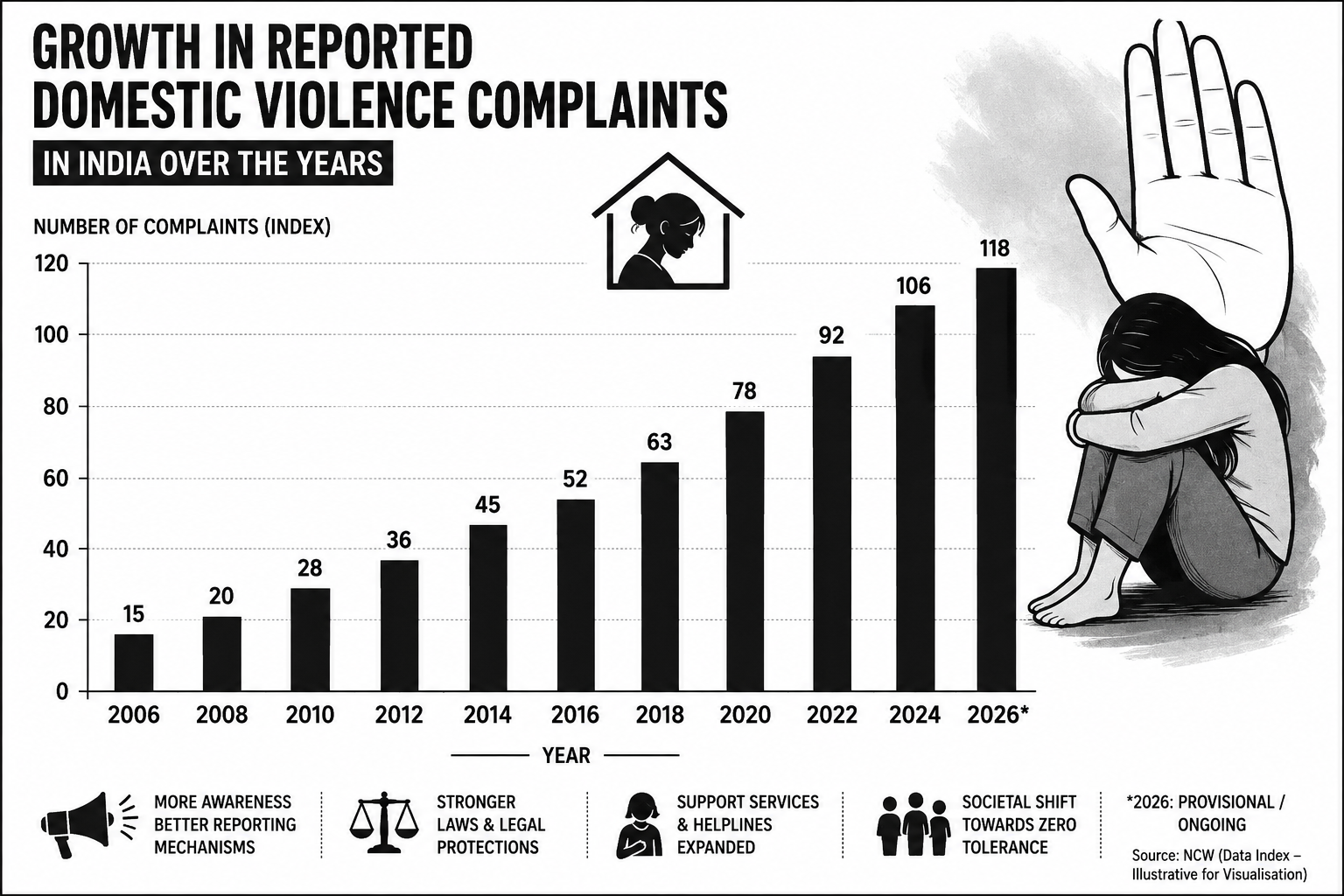
The recent domestic violence complaint filed by television actor Aditi Sharma against her husband and in-laws has once again brought the issue of abuse within the home into public discussion. While the allegations are under investigation and will be determined through the legal process, the case serves as a reminder that domestic violence cuts across social, economic and professional boundaries. It also raises an important historical question: How did India move from treating domestic violence as a private family matter to recognising it as a violation of human rights and a punishable offence?
The answer lies in a long journey of legal reform, social activism and judicial intervention. For much of India’s history, violence within marriage was rarely acknowledged by the law. Women often faced immense social pressure to remain silent, and legal remedies were limited. Over the decades, however, sustained campaigns by women’s organisations, landmark court judgments and parliamentary reforms transformed the legal landscape. Today, India has a comprehensive legal framework that provides both civil and criminal remedies to survivors of domestic violence.
A Time When the Law Looked Away
During the colonial period, the Indian Penal Code (IPC), 1860 criminalised offences such as assault, hurt and grievous hurt. However, these provisions were general in nature and did not specifically address violence committed within the household. Domestic abuse was largely viewed as a personal or family matter rather than a public concern requiring state intervention.
Social norms further discouraged women from reporting abuse. Marriage was considered a lifelong institution, and preserving family honour often took precedence over the safety and well-being of women. Financial dependence, limited education and the absence of support systems made it even more difficult for survivors to seek justice.
As a result, countless cases of domestic abuse went unreported, and those who did approach authorities often found little legal protection.
The Dowry Crisis and the Beginning of Reform
Independent India witnessed rapid social changes, but violence against women remained widespread. One of the most alarming manifestations was the growing number of dowry-related deaths and harassment during the 1970s and early 1980s.
Women’s rights groups organised protests across major cities, demanding stricter laws to protect married women. Media reports documenting cases of young brides dying under suspicious circumstances shocked the nation and exposed the inadequacy of existing laws.
Responding to mounting public pressure, Parliament strengthened legal protections through a series of reforms.
The Dowry Prohibition Act, 1961, had already outlawed the giving and taking of dowry. However, enforcement remained weak, and the law did little to prevent cruelty within marriage.
Section 498A: Recognising Cruelty Within Marriage
A significant turning point came in 1983, when Parliament introduced Section 498A into the Indian Penal Code.
For the first time, cruelty by a husband or his relatives became a specific criminal offence. The law defined cruelty broadly to include both physical and mental harassment, particularly where it was linked to unlawful demands for dowry or conduct that could drive a woman to suicide or cause grave injury.
Section 498A represented a historic shift. It acknowledged that violence inside the home was not merely a domestic dispute but a criminal act deserving legal intervention.
The provision also reflected changing public attitudes. Society had begun recognising that marriage could not be used as a shield for abuse.
Over time, courts issued guidelines to prevent misuse while reaffirming that genuine victims must continue to receive legal protection.
Tackling Dowry Deaths
In 1986, Parliament introduced Section 304B of the IPC, dealing specifically with dowry deaths.
The provision established that if a woman died under unnatural circumstances within seven years of marriage after experiencing dowry-related cruelty or harassment, the law could presume a connection between the abuse and the death.
The legislation strengthened prosecution in cases where proving direct evidence was often difficult.
Together, Sections 498A and 304B marked an important phase in India’s legal response to violence against married women.
The Global Influence
The 1990s saw increasing international attention on violence against women as a human rights issue.
The United Nations Declaration on the Elimination of Violence Against Women (1993) encouraged governments worldwide to strengthen laws protecting women from abuse.
India’s participation in global forums on women’s rights reinforced domestic demands for comprehensive legislation. Activists argued that criminal punishment alone was insufficient because survivors also needed immediate protection, financial assistance and safe housing.
These discussions laid the foundation for one of the most significant reforms in Indian legal history.
The Landmark Law of 2005
The Protection of Women from Domestic Violence Act (PWDVA), 2005, fundamentally changed how India addressed domestic abuse.
Unlike earlier laws that focused primarily on criminal punishment, the Act adopted a rights-based approach by recognising domestic violence as both a legal and social issue.
The law expanded the definition of domestic violence to include:
· Physical abuse
· Emotional abuse
· Verbal abuse
· Sexual abuse
· Economic abuse
This broader definition acknowledged that violence is not limited to physical injuries. Constant humiliation, financial deprivation, threats, intimidation and controlling behaviour can also have devastating consequences.
The Act came into force in 2006 and introduced several important protections.
A New Set of Rights
One of the most revolutionary aspects of the Domestic Violence Act was the recognition of a woman’s right to reside in the shared household, regardless of whether she owned the property.
The Act also empowered courts to issue:
· Protection orders preventing further abuse.
· Residence orders safeguarding housing rights.
· Monetary relief for medical expenses and maintenance.
· Custody orders concerning children.
· Compensation orders for injuries and emotional distress.
The law appointed Protection Officers to assist survivors in accessing legal remedies, medical care, counselling and shelter homes.
This marked a transition from a punishment-centred approach to one focused on survivor protection and rehabilitation.
Expanding Judicial Interpretation
Since the Act came into force, Indian courts have played an important role in interpreting its provisions.
Judicial decisions have clarified that domestic violence extends beyond physical assault and includes psychological, emotional and economic abuse.
Courts have also broadened the understanding of domestic relationships covered by the Act and reinforced the importance of providing timely protection to survivors.
These interpretations have ensured that the legislation remains responsive to changing social realities.
The Changing Nature of Domestic Violence
While early public discussions largely focused on dowry harassment, contemporary understanding of domestic violence has expanded considerably.
Today, experts recognise that abuse may involve:
· Isolation from family and friends.
· Financial control.
· Verbal humiliation.
· Digital surveillance.
· Threats and intimidation.
· Restricting employment or education.
· Emotional manipulation.
The law has gradually evolved to acknowledge these forms of coercive behaviour, reflecting changing societal awareness.
The Role of Civil Society
Legal reforms did not emerge in isolation.
Women’s organisations, lawyers, academics, journalists and social workers played a crucial role in documenting abuse, supporting survivors and advocating legislative change.
Public campaigns helped shift the narrative from blaming victims to recognising domestic violence as a systemic issue requiring legal and institutional intervention.
Shelter homes, legal aid services, counselling centres and helplines also expanded over the years, providing practical support beyond the courtroom.
Continuing Challenges
Despite stronger laws, significant challenges remain.
Many survivors continue to hesitate before reporting abuse due to fear of social stigma, financial dependence or concern for children.
Lengthy legal proceedings, limited awareness of rights and uneven implementation of protective measures can also discourage complaints.
Rural areas often face shortages of trained personnel and support services, while urban survivors may encounter emotional and economic barriers that delay legal action.
Experts argue that legislation alone cannot eliminate domestic violence. Long-term progress also requires education, gender equality, economic empowerment and community awareness.
The Debate Around Section 498A
Section 498A has periodically been at the centre of public debate over allegations of misuse.
The Supreme Court has acknowledged concerns regarding arbitrary arrests while simultaneously emphasising that isolated instances of misuse cannot undermine the need to protect genuine victims.
Accordingly, judicial guidelines have sought to balance safeguards for the accused with effective remedies for women experiencing cruelty.
This ongoing debate reflects the complexity of designing laws that are both fair and effective.
Why History Matters Today
Every contemporary domestic violence case is part of a much larger historical story.
The legal protections available today did not appear overnight. They were built through decades of activism, parliamentary debate, judicial interpretation and public demand for reform.
Cases that attract public attention often encourage renewed conversations about awareness, implementation and access to justice. They remind society that while laws have progressed significantly, ensuring their effective implementation remains equally important.
Understanding this history also highlights how legal systems evolve alongside social values. What was once dismissed as a private household matter is now recognised as an issue affecting fundamental rights, dignity and equality.
Looking Ahead
India’s domestic violence laws continue to evolve through legislative amendments and judicial interpretation. Greater emphasis is now being placed on survivor-centred approaches, improved coordination among law enforcement agencies, faster access to legal remedies and wider public awareness.
Technology has also begun playing a role, with online complaint mechanisms, digital legal services and awareness campaigns making it easier for some survivors to seek help.
However, the success of any law ultimately depends on implementation. Strong institutions, accessible legal aid, effective policing and social support systems remain essential.
Conclusion
The journey of domestic violence legislation in India reflects one of the country’s most significant social and legal transformations. From the limited protections available under the colonial-era penal code to the comprehensive framework established by the Protection of Women from Domestic Violence Act, the law has steadily expanded to recognise the many forms that abuse can take.
Today’s legal framework acknowledges that domestic violence is not confined to physical assault. Emotional, verbal, sexual and economic abuse are equally capable of violating an individual’s dignity and security.
The recent complaint involving Aditi Sharma has once again placed the issue in the public eye. While the allegations in that case will be examined through the judicial process, it also serves as a reminder of the historical progress India has made in recognising and addressing violence within the home. The country’s legal journey demonstrates that protecting individuals from abuse is not only a matter of criminal justice but also of safeguarding equality, dignity and human rights within one of society’s most fundamental institutions—the family.