New Delhi:
Its history, however, is not merely the story of roads and concrete. It is also a story of political vision, administrative innovation, technological advancement, and the changing relationship between geography and economic opportunity. The project reshaped patterns of industrial growth, facilitated the movement of people and goods, stimulated regional economies, and laid the foundation for India’s future transport corridors.
India’s Roads Before the Golden Quadrilateral
At Independence in 1947, India inherited a fragmented and inadequate road network. The colonial administration had prioritised railways over highways, leaving roads largely underdeveloped. For decades after Independence, the expansion of road infrastructure failed to keep pace with population growth and economic needs.
National Highways constituted only a tiny fraction of India’s road network, yet they carried a disproportionately large share of traffic. By the late twentieth century, economic reforms initiated in 1991 had accelerated industrial activity, increased freight movement, and expanded domestic markets. However, the country’s transport infrastructure remained a major bottleneck.
Travel between major cities often involved narrow two-lane roads, poor maintenance, frequent bottlenecks, railway crossings, and unpredictable travel times. The inefficiency translated into higher transportation costs, increased fuel consumption, delays in supply chains, and reduced competitiveness for Indian industry.
The need for a modern highway system had become increasingly evident.
The Vajpayee Vision
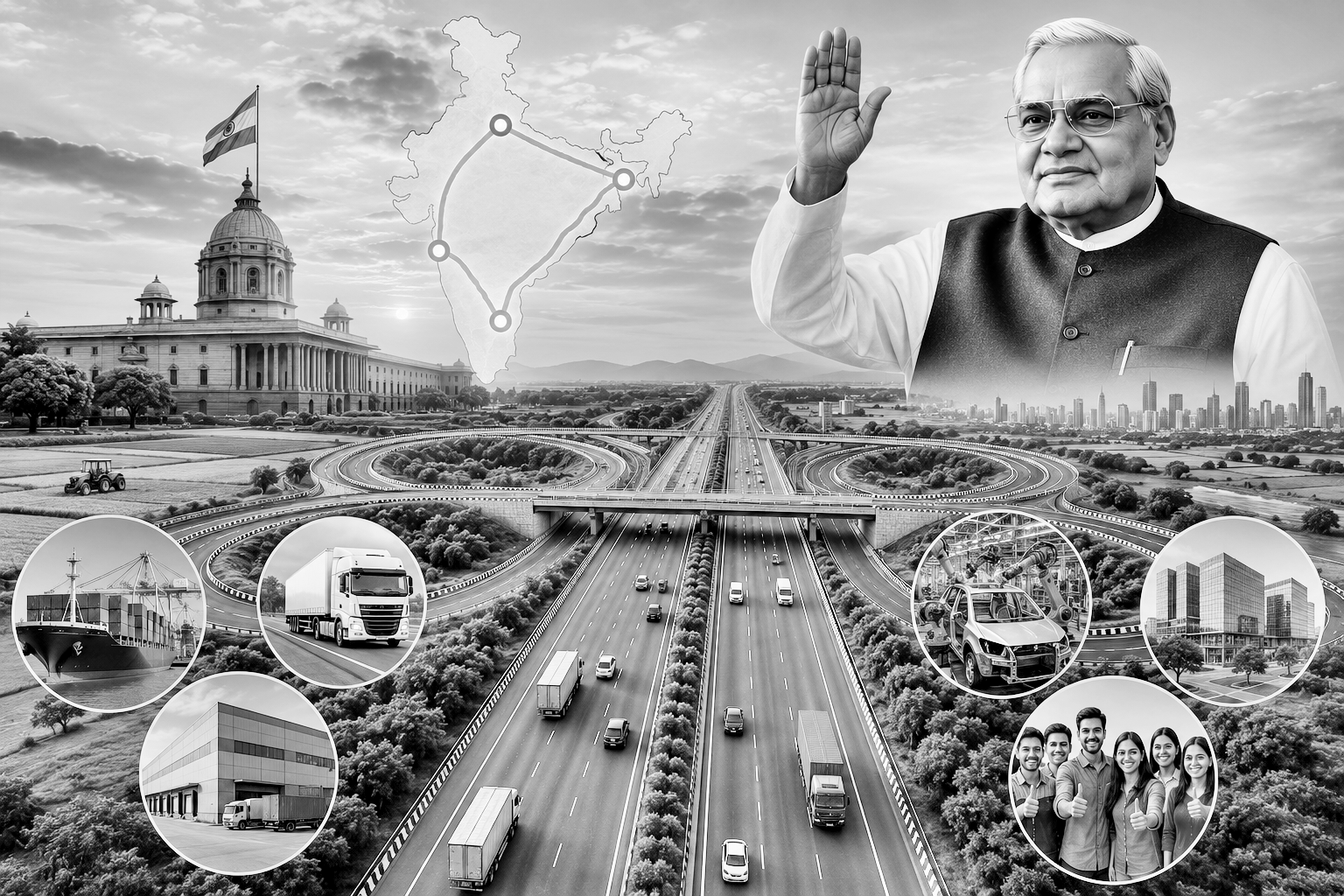
The idea of a comprehensive highway network took concrete shape under Prime Minister Atal Bihari Vajpayee. Recognising that roads could serve as engines of development, his government launched the National Highways Development Project (NHDP) in 1998.
The NHDP was envisioned as a transformative initiative to upgrade India’s highway infrastructure through four-laning and six-laning of critical routes. The centrepiece of Phase I was the Golden Quadrilateral.
Speaking about the project, Vajpayee described it as “a highway to prosperity” that would place India on the fast lane of socio-economic development.
The vision extended beyond transportation efficiency. It sought to integrate markets, strengthen national unity, generate employment, and improve the quality of life.
Birth of the Golden Quadrilateral
Officially launched in 2001, the Golden Quadrilateral connected India’s four largest metropolitan cities:
● Delhi
● Mumbai
● Chennai
● Kolkata
The network formed a giant quadrilateral across the Indian subcontinent.
The four corridors included:
Delhi–Kolkata Corridor
Passing through Kanpur, Varanasi and Dhanbad, this route connected the political capital with eastern India’s major commercial centre.
Approximate length: 1,450 km.
Kolkata–Chennai Corridor
Traversing Bhubaneswar and Visakhapatnam, this corridor strengthened connectivity along the eastern coast.
Approximate length: 1,680 km.
Chennai–Mumbai Corridor
Passing through Bengaluru and Pune, it linked southern India’s industrial clusters with western India’s financial capital.
Approximate length: 1,290 km.
Mumbai–Delhi Corridor
Connecting Ahmedabad, Udaipur and Jaipur, this corridor facilitated movement between India’s two most important economic centres.
Approximate length: 1,400 km.
Together, these routes covered 5,846 kilometres, making the Golden Quadrilateral one of the world’s largest highway projects.
Financing and Implementation
The project was implemented by the National Highways Authority of India (NHAI) under the Ministry of Road Transport and Highways.
Financing came through a combination of sources:
● Budgetary support from the Government of India;
● Fuel cess collected under the Central Road Fund;
● Multilateral loans from institutions such as the World Bank and Asian Development Bank;
● Private sector participation under Build-Operate-Transfer (BOT) arrangements;
● Market borrowings through NHAI bonds.
This diversified financing model marked a departure from earlier dependence solely on government expenditure.
The introduction of a dedicated fuel cess created a stable funding mechanism, ensuring continuity of projects despite fiscal constraints.
Engineering Features
The Golden Quadrilateral represented a significant leap in engineering standards.
Key features included:
● Four and six-lane divided carriageways;
● Service roads in urban stretches;
● Grade separators and flyovers;
● Railway overbridges;
● Underpasses;
● Bypasses around congested towns;
● Improved road geometry;
● Enhanced signage and lane markings;
● Crash barriers and safety measures;
● Wayside amenities.
Unlike earlier highways, these roads were designed to support uninterrupted movement and higher speeds.
The elimination of railway level crossings on major stretches significantly improved efficiency.
Construction Challenges
The project’s execution was not without difficulties.
Land Acquisition
Acquiring land across multiple states proved complex. Compensation disputes, litigation, and administrative delays frequently slowed progress.
Environmental Concerns
Construction required diversion of forest land in some areas and raised concerns regarding ecological impacts, tree felling, and wildlife movement.
Coordination Across States
Highway construction involved coordination between central agencies, state governments, contractors, and local administrations.
Contractor Capacity
India’s construction sector initially lacked experience with projects of such scale. However, the GQ eventually helped domestic firms acquire technical expertise.
Delays
Although substantial completion was originally expected by 2004, many stretches required additional time. Most of the network became operational by around 2012, followed by continuing improvements and expansions.
Economic Transformation
The Golden Quadrilateral’s most enduring legacy lies in its economic impact.
By reducing travel time and transportation costs, the network improved market efficiency.
Manufacturers gained access to wider markets.
Retailers expanded distribution systems.
Logistics operations became more predictable.
Perishable agricultural products could reach consumers faster.
Industrial supply chains became increasingly integrated.
Studies suggest that improved highways reduced inventory costs and enabled firms to adopt more efficient production strategies.
The highway network thus emerged as a catalyst for economic integration.
Manufacturing and Industrial Growth
Research examining districts located near the Golden Quadrilateral found significant changes in manufacturing activity.
Districts situated within ten kilometres of the highway experienced:
● Increased entry of new manufacturing establishments;
● Higher employment generation;
● Greater industrial output;
● Improved labour productivity;
● Enhanced total factor productivity.
These benefits were particularly visible among newly established firms.
Improved connectivity allowed businesses to optimise location choices rather than remaining concentrated in traditional industrial centres.
Decentralisation of Industry
One of the most important consequences of the GQ was the redistribution of industrial activity.
Historically, industries clustered within major metropolitan regions despite high land costs and congestion.
The Golden Quadrilateral altered this pattern.
Land-intensive industries increasingly shifted towards peripheral and intermediate cities located along the highway.
Examples include moderate-density cities such as Surat and Srikakulam, which witnessed remarkable increases in manufacturing activity.
This decentralisation promoted more efficient use of land and reduced pressure on congested urban centres.
It also created new growth poles beyond metropolitan India.
Impact on Agriculture
Agriculture benefited significantly from improved road connectivity.
Farmers gained quicker access to urban markets.
Reduced transportation time helped minimise spoilage of perishable commodities.
Expanded market access improved price realisation.
Export-oriented agricultural products reached ports more efficiently.
Rural producers increasingly integrated into broader value chains.
For many regions, the highway functioned as a bridge between agricultural production zones and consumer markets.
Employment Generation
Construction activities generated substantial employment.
The project created direct jobs for:
● Engineers;
● Construction workers;
● Equipment operators;
● Supervisors;
● Skilled technicians.
Indirect employment emerged through increased demand for:
● Cement;
● Steel;
● Machinery;
● Hospitality services;
● Logistics operations.
Economic activity along highway corridors subsequently supported additional employment in manufacturing, trade, warehousing, and transport services.
Growth of the Logistics Sector
India’s logistics industry underwent major transformation.
Prior to GQ, freight transport was characterised by uncertainty and delays.
The upgraded highways improved reliability.
Truck turnaround times declined.
Fleet productivity improved.
Businesses increasingly adopted hub-and-spoke distribution models.
Logistics parks, warehouses, and industrial clusters emerged near highway intersections.
The GQ thereby contributed to the professionalisation of India’s logistics ecosystem.
Road Safety and Regulatory Measures
Improved infrastructure was accompanied by efforts to enhance safety.
Government initiatives included:
● Better road engineering;
● Refresher training for heavy vehicle drivers;
● Road safety awareness campaigns;
● Mandatory seat belt provisions;
● Strengthened vehicle fitness norms;
● Improved traffic regulation.
Emission norms also became stricter.
Bharat Stage standards were progressively introduced across the country, reflecting growing attention towards environmental concerns.
Criticisms and Controversies
Despite its achievements, the Golden Quadrilateral has attracted criticism.
Toll and PPP Concerns
Questions have periodically arisen regarding transparency in toll collection and public-private partnerships.
Cost Escalation
Delays contributed to rising project costs.
Uneven Benefits
Some regions benefited more than others, particularly districts directly adjoining the corridor.
Six-Laning Controversies
Subsequent expansion initiatives during later governments became subjects of political debate.
Reports alleged that norms governing viability gap funding and project approvals had been modified to facilitate faster implementation of certain stretches.
These controversies illustrate the complexities inherent in large-scale infrastructure governance.
The Golden Quadrilateral in Comparative Perspective
Globally, highway systems have often reshaped national economies.
The United States experienced transformation through the Interstate Highway System.
China leveraged expressways to decentralise manufacturing.
South Korea’s transport investments facilitated industrial expansion.
India’s Golden Quadrilateral belongs within this global tradition of infrastructure-led development.
Its significance extends beyond transport.
It represents state capacity, economic ambition, and nation-building.
Integration with Future Projects
The GQ has evolved from a standalone initiative into the backbone of a larger transport network.
It now interfaces with:
● Bharatmala Pariyojana;
● Sagarmala Programme;
● Dedicated Freight Corridors;
● Industrial Corridors;
● Smart City initiatives;
● Multimodal logistics hubs.
Many stretches continue to undergo widening from four to six or eight lanes.
Digital technologies such as FASTag have further improved efficiency.
The highway remains central to India’s long-term infrastructure strategy.
National Integration and Social Impact
Beyond economics, the Golden Quadrilateral carries symbolic significance.
It physically connected regions with distinct languages, cultures, and histories.
Distance became less intimidating.
Migration became easier.
Tourism expanded.
Families separated by geography found travel more accessible.
Students, workers, traders, and pilgrims all benefited from improved mobility.
In a country defined by diversity and scale, roads became instruments of integration.
Conclusion
The Golden Quadrilateral stands as one of independent India’s most consequential infrastructure achievements. Conceived during a period of economic transition, it sought to address longstanding deficiencies in connectivity and unleash the country’s productive potential. By linking Delhi, Mumbai, Chennai, and Kolkata through modern highways, it transformed patterns of trade, manufacturing, agriculture, and mobility.
Its impact has been multidimensional. It lowered transportation costs, stimulated industrial decentralisation, generated employment, enhanced rural access to markets, and strengthened national integration. The project also demonstrated India’s ability to execute infrastructure initiatives of unprecedented scale, while revealing the governance challenges that accompany such undertakings.
More than two decades after its launch, the Golden Quadrilateral continues to shape India’s development trajectory. It is not merely a network of roads connecting four cities. It is a physical manifestation of a broader national aspiration—to build an India that is faster, more connected, more competitive, and more integrated. Every truck transporting goods, every family embarking on a road journey, and every entrepreneur establishing a business along its route contributes to the continuing story of a project that fundamentally reimagined the geography of opportunity in modern India.