
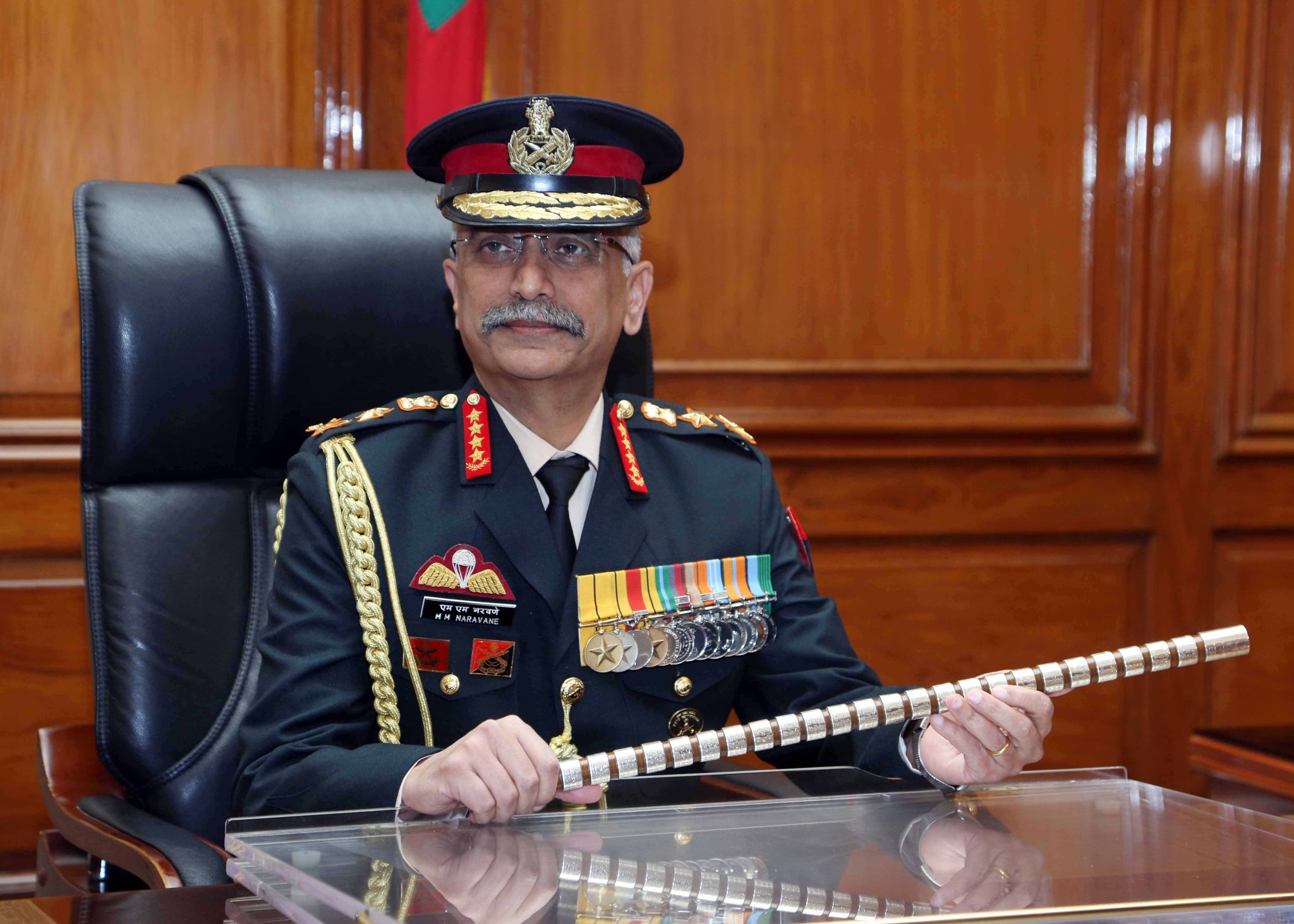
NEW DELHI: When former Army chief General Manoj Mukund Naravane’s unpublished memoir Four Stars of Destiny resurfaced in Parliament this week, it triggered a political storm, disrupted Lok Sabha proceedings, and reignited old questions about India’s fraught relationship with China. What began as a procedural clash over parliamentary rules quickly turned into a broader debate on national security, civil-military relations, and historical accountability.
At the centre of the controversy is a soldier who led the Indian Army during one of its most challenging periods since the 1962 war—the violent standoff with China in eastern Ladakh that culminated in the deadly Galwan Valley clash of June 2020.
WHO IS GENERAL M.M. NARAVANE?
General Manoj Mukund Naravane, born on April 22, 1960, served as the 28th Chief of the Army Staff (COAS) from December 31, 2019, to April 30, 2022. Commissioned into the Sikh Light Infantry in 1980, Naravane rose through the ranks with extensive experience in counter-insurgency operations in Jammu and Kashmir and the Northeast, as well as overseas service during Operation Pawan in Sri Lanka.
An alumnus of the National Defence Academy and Indian Military Academy, Naravane holds advanced degrees in defence and strategic studies and has attended premier military institutions, including the Defence Services Staff College and the Army War College. Before becoming COAS, he served as Vice Chief of Army Staff, GOC-in-C Eastern Command, and headed the Army Training Command.
Known for his measured public demeanour, Naravane assumed office just weeks before the India-China border situation sharply deteriorated.
WHY IS NARAVANE IN THE NEWS NOW?
Naravane’s memoir, Four Stars of Destiny, written after his retirement, has been under review by the Ministry of Defence for over a year. While the book has not yet been formally published, excerpts and references surfaced in a recent cover story by The Caravan magazine.
Leader of the Opposition Rahul Gandhi attempted to cite the article in Parliament, arguing that it raised serious national security concerns related to decision-making during the China standoff. The Treasury benches objected, stating that unpublished material could not be quoted in the House, leading to repeated adjournments.
The controversy has raised questions about why the book remains under review and whether candid military assessments are being withheld from the public domain.
WHAT DOES NARAVANE’S BOOK REPORTEDLY SAY?
According to reports, the memoir discusses sensitive moments during the 2020 Ladakh crisis, including interactions between military leadership and the political executive. In one widely quoted passage, Naravane recounts being told that operational decisions were left entirely to the military, placing full responsibility on the Army chief during a volatile situation.
Supporters argue that such accounts offer valuable insight into civil-military dynamics, while critics contend that discussing operational matters risks undermining national security.
THE GALWAN VALLEY CLASH: WHAT HAPPENED?
On the night of June 15-16, 2020, Indian and Chinese troops engaged in a violent confrontation in Galwan Valley, a high-altitude area in eastern Ladakh. In the brutal hand-to-hand fight—fought without firearms under existing border protocols—20 Indian soldiers, including a commanding officer, lost their lives. China never officially disclosed its casualties.
The clash marked the first combat deaths along the Line of Actual Control (LAC) in over four decades and fundamentally altered bilateral ties. It shattered long-held assumptions that peace agreements had stabilized the border and led to a massive military build-up on both sides.
INDIA-CHINA CLASHES: A LONG AND TROUBLED HISTORY
The roots of the India-China boundary dispute stretch back to the colonial era. The border was never mutually demarcated, particularly in Aksai Chin in the west and Arunachal Pradesh (which China calls “South Tibet”) in the east.
Tensions escalated in the late 1950s, culminating in the 1962 war, in which India suffered a humiliating defeat. The conflict exposed severe military unpreparedness and flawed political assessments of Chinese intentions.
After 1962, while full-scale war was avoided, clashes and standoffs continued—Nathu La (1967), Sumdorong Chu (1986), Doklam (2017), and finally Ladakh (2020). Each episode reflected unresolved territorial claims and competing strategic interests.
DISPUTED TERRITORY: CHINA’S POSITION
China claims approximately 90,000 square kilometres in Arunachal Pradesh and about 38,000 square kilometres in Aksai Chin, which it controls. Beijing argues that these areas historically belonged to Tibet and were wrongfully incorporated into India.
India, meanwhile, asserts sovereignty over Arunachal Pradesh and claims Aksai Chin as part of Ladakh. The Line of Actual Control, unlike a formal border, remains undefined in several stretches, allowing differing perceptions to trigger confrontations.
THE NEHRU YEARS AND LINGERING BLAME
Much of the debate around India-China relations inevitably circles back to the Jawaharlal Nehru era. Critics argue that Nehru’s idealistic belief in Hindi-Chini Bhai-Bhai and his acceptance of Chinese control over Aksai Chin without adequate military preparation proved costly.
Decisions such as India’s “Forward Policy” without sufficient force backing, intelligence failures, and diplomatic miscalculations are often cited as contributing factors to the 1962 debacle. Government supporters today frequently invoke these historical errors to counter opposition criticism on China.
WHY THE NARAVANE EPISODE MATTERS
Beyond partisan sparring, the Naravane controversy highlights deeper issues: the transparency of national security decision-making, the space for retired military leaders to speak freely, and Parliament’s role in scrutinising strategic challenges.
As India faces an assertive China along its borders, questions about past decisions—from Nehru to the present—continue to shape political discourse. Naravane’s unpublished memoir has become a flashpoint not just because of what it may reveal, but because it underscores the enduring sensitivity surrounding India’s most complex external challenge.
Whether Four Stars of Destiny eventually reaches readers or remains under official review, its impact has already been felt—reopening old wounds, sharpening political divides, and reminding the nation that the China question is far from settled.