
From carrying rocket parts on bicycles to launching private orbital rockets, India’s space programme reflects six decades of scientific ambition, self-reliance and innovation.
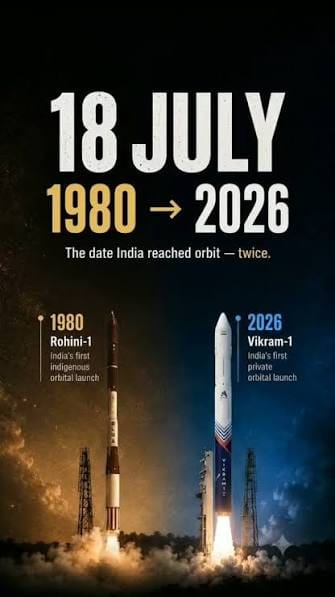
When the Satellite Launch Vehicle-3 (SLV-3) lifted off from Sriharikota on 18 July 1980, it carried more than the Rohini satellite into orbit. It carried the aspirations of a young nation determined to master one of the world’s most complex technologies. That launch made India the sixth country capable of launching satellites using an indigenously developed launch vehicle, marking the beginning of a remarkable journey in space transportation.
Forty-six years later, another July launch has entered the history books. Vikram-1, developed by Skyroot Aerospace, became India’s first privately developed orbital launch vehicle to lift off from the Satish Dhawan Space Centre. While separated by decades, SLV-3 and Vikram-1 represent two defining moments in India’s space story—the first proving that India could build rockets, and the second demonstrating that an ecosystem nurtured by ISRO has matured enough for private enterprise to reach orbit.
The Humble Beginnings
India’s space programme began long before powerful launch vehicles and lunar missions. In 1962, the Indian National Committee for Space Research (INCOSPAR), led by Dr. Vikram Sarabhai, established the foundation for peaceful space exploration. The first sounding rocket was launched from Thumba in Kerala in 1963. Those early years became legendary for images of rocket components transported on bicycles and bullock carts—not because of symbolism, but because resources were limited and scientific determination was immense.
Recognising the strategic importance of space technology, the government established the Indian Space Research Organisation (ISRO) in 1969. The vision was not military dominance but national development through communication, weather forecasting, education and resource management.
The SLV-3 Breakthrough
The road to SLV-3 was filled with setbacks. The first experimental launch in August 1979 failed to achieve orbit. Instead of abandoning the programme, ISRO scientists analysed every detail and returned stronger.
On 18 July 1980, the four-stage solid-fuel SLV-3 successfully placed the Rohini RS-1 satellite into Low Earth Orbit. Project Director Dr. A.P.J. Abdul Kalam later described the achievement as the result of teamwork, perseverance and faith in indigenous technology.
Although SLV-3 could carry only about 40 kilograms to Low Earth Orbit, its significance extended far beyond payload capacity. It established India’s capability to independently design, build and operate orbital launch vehicles—a foundation upon which every subsequent rocket would be built.
Learning Through ASLV
Rather than immediately pursuing larger rockets, ISRO developed the Augmented Satellite Launch Vehicle (ASLV) during the late 1980s. Several early missions faced failures, yet the programme proved invaluable in mastering stage separation, guidance systems, aerodynamics and stability.
These lessons became essential for developing India’s most reliable launch vehicle.
PSLV: The Workhorse That Changed Everything
The Polar Satellite Launch Vehicle (PSLV) transformed India’s position in global spaceflight.
Following initial development challenges, PSLV became one of the world’s most dependable launch vehicles. Its versatility allowed it to place satellites into polar, sun-synchronous and interplanetary trajectories. It carried landmark missions such as Chandrayaan-1, Mars Orbiter Mission (Mangalyaan), AstroSat, Aditya-L1, and numerous Earth observation satellites.
In 2017, PSLV achieved another global milestone by launching 104 satellites in a single mission, setting a world record at the time and demonstrating India’s capability in commercial satellite launches.
The PSLV era also marked India’s emergence as an affordable and reliable launch service provider for international customers.
Entering the Heavy-Lift Era
As India’s communication and strategic requirements expanded, ISRO required more powerful launch vehicles.
The Geosynchronous Satellite Launch Vehicle (GSLV) introduced cryogenic engine technology, one of the most challenging achievements in rocket engineering. After years of research and technological hurdles, India successfully developed an indigenous cryogenic engine, reducing dependence on foreign suppliers.
This success paved the way for LVM3 (formerly GSLV Mk III), India’s heaviest operational launch vehicle. Designed to carry heavier communication satellites, LVM3 also became the vehicle for Chandrayaan-2, Chandrayaan-3, commercial OneWeb satellite launches and the upcoming Gaganyaan human spaceflight programme.
Building an Independent Launch Ecosystem
Today’s India possesses launch vehicles capable of placing up to 10 tonnes into Low Earth Orbit and about 4.2 tonnes into Geosynchronous Transfer Orbit. This capability supports communication, navigation, Earth observation and scientific exploration without relying on foreign launch providers.
At the same time, ISRO is preparing for the future. Development is underway on the Next Generation Launch Vehicle (NGLV), designed to place up to 30 tonnes into Low Earth Orbit, while reusable launch vehicle technologies promise to significantly reduce launch costs. The government has also approved a Third Launch Pad at Sriharikota, and a second spaceport is being developed at Kulasekarapattinam, Tamil Nadu, reflecting India’s expanding launch ambitions.
Opening the Doors to Private Enterprise
For decades, India’s space programme was almost entirely driven by ISRO. The organisation designed rockets, built satellites, conducted launches, and managed scientific missions. This government-led model helped establish India as a trusted spacefaring nation, but it also meant that commercial participation remained limited.
A major shift began in 2020, when the Government of India announced sweeping reforms to open the space sector to private companies. The creation of the Indian National Space Promotion and Authorisation Centre (IN-SPACe) provided a regulatory framework for non-government entities to access ISRO’s launch facilities, testing infrastructure, and technical expertise. Around the same time, NewSpace India Limited (NSIL) expanded the commercialisation of ISRO’s technologies and launch services.
These reforms fundamentally changed the Indian space ecosystem. Instead of competing with private companies, ISRO began acting as a mentor and enabler, allowing startups to innovate while benefiting from decades of institutional knowledge.
The Rise of India’s Space Startups
The policy changes triggered a surge of entrepreneurial activity. Within a few years, India witnessed the emergence of hundreds of space startups working on launch vehicles, satellites, propulsion systems, Earth observation, and downstream applications.
Companies such as Skyroot Aerospace, Agnikul Cosmos, Pixxel, Bellatrix Aerospace, and Digantara became symbols of this new era. Each focused on a different segment of the rapidly expanding global space economy, from launch services and satellite manufacturing to space situational awareness and in-orbit propulsion.
Among these, Skyroot Aerospace achieved an important milestone in 2022 when it launched Vikram-S, India’s first privately developed sub-orbital rocket. Though it did not reach orbit, the mission demonstrated that Indian startups could independently design, manufacture, and operate launch vehicles.
It was a preview of a much bigger achievement that would follow.
Vikram-1: A New Chapter in Indian Space History
The successful launch of Vikram-1 represents far more than a technological accomplishment. It signifies the arrival of India’s private sector as an active participant in orbital spaceflight.
Developed by Skyroot Aerospace and launched from the Satish Dhawan Space Centre, Vikram-1 became the first privately developed Indian rocket to place payloads into orbit. The mission also showcased how government infrastructure and private innovation can work together to expand national capabilities.
Just as SLV-3 proved India’s indigenous launch capability in 1980, Vikram-1 demonstrates that India now possesses a mature ecosystem where private industry can contribute meaningfully to space transportation.
This transition mirrors developments seen in countries such as the United States, where government agencies increasingly collaborate with commercial launch providers to reduce costs and accelerate innovation.
Beyond Government Missions
The growth of private launch capability has implications far beyond scientific research.
The global space economy is projected to grow rapidly over the coming decades, driven by satellite communications, navigation, climate monitoring, broadband connectivity, and commercial Earth observation. Small satellites, in particular, have created demand for flexible and affordable launch services.
India’s combination of engineering talent, competitive costs, and proven launch infrastructure positions it to capture a larger share of this expanding market.
Private launch vehicles can complement ISRO’s scientific missions by serving commercial customers, universities, research institutions, and international satellite operators, allowing ISRO to focus increasingly on ambitious exploration programmes.
Preparing for the Future
India’s launch vehicle programme continues to evolve.
ISRO is currently developing the Next Generation Launch Vehicle (NGLV), which is expected to significantly increase payload capacity while incorporating reusable technologies. The organisation is also investing in Reusable Launch Vehicle (RLV) technologies aimed at reducing the cost of access to space.
Meanwhile, infrastructure is expanding. Alongside the existing launch complexes at Sriharikota, the government has approved a Third Launch Pad and is establishing a second spaceport at Kulasekarapattinam in Tamil Nadu to support future commercial and small satellite launches.
These developments indicate that India’s ambitions now extend beyond achieving self-reliance. The objective is to become a major global launch hub.
History in Perspective
When historians examine India’s space programme decades from now, they are likely to identify two transformative milestones.
The first came on 18 July 1980, when SLV-3 successfully placed the Rohini satellite into orbit, proving that India could independently build and launch rockets.
The second is likely to be remembered as the successful launch of Vikram-1, which demonstrated that India’s space capabilities had expanded beyond a single government agency into a collaborative national ecosystem powered by public institutions and private enterprise.
From the modest sounding rockets of Thumba to sophisticated launch vehicles carrying satellites to the Moon, Mars, the Sun, and now through privately developed orbital rockets, India’s space journey has been defined by persistence, innovation, and a willingness to learn from failure.
The story is no longer just about reaching space. It is about creating an ecosystem capable of shaping the future of global space exploration and commerce.