As protests once again converge on Parliament during the Monsoon Session, a look back at how generations of Indians have marched to the nation’s highest law-making institution to demand change.
As Parliament convenes for another Monsoon Session, the streets of New Delhi have once again become the backdrop for demonstrations. Political parties, student groups, farmers’ organisations and civil society activists have gathered under the familiar slogan of “Sansad Chalo”—March to Parliament. Barricades have been erected, security has been tightened, traffic diverted and large sections of central Delhi placed under close watch. While the issues dominating today’s protests range from unemployment and examination reforms to inflation, governance and federal concerns, the image itself is unmistakably familiar. Citizens marching towards Parliament has become one of the defining symbols of Indian democracy.
For nearly eight decades, Parliament has represented more than the place where laws are debated and enacted. It has also served as the destination where citizens seek to influence those laws. Every generation has walked this road with its own demands. Farmers have marched for fair crop prices, students for educational reforms, women for equal political representation, workers for labour rights and political parties against government policies. Some demonstrations ended in compromise, others triggered landmark legislation, while a few fundamentally altered the course of Indian politics.
The history of Parliament marches is therefore the history of India’s democracy in motion.
Parliament: More Than a Building
When India adopted its Constitution in 1950, Parliament became the supreme legislative institution of the Republic. Yet it quickly acquired another identity—that of a national symbol where citizens could directly appeal to their elected representatives.
This idea was deeply rooted in India’s freedom movement. Mahatma Gandhi had shown that peaceful marches and public mobilisation could influence governments. Although his famous Dandi March was directed against British rule, independent India inherited the same democratic tradition of non-violent protest.
Instead of confronting colonial rulers, citizens now marched to Parliament, expecting democratic governments to hear their concerns.
The First Decade: Nation-Building and Public Participation
During the 1950s, India’s democracy was still finding its rhythm. Trade unions, teachers, government employees and social organisations regularly organised demonstrations in Delhi. These were not merely protests but expressions of a newly independent population discovering its constitutional right to peaceful assembly.
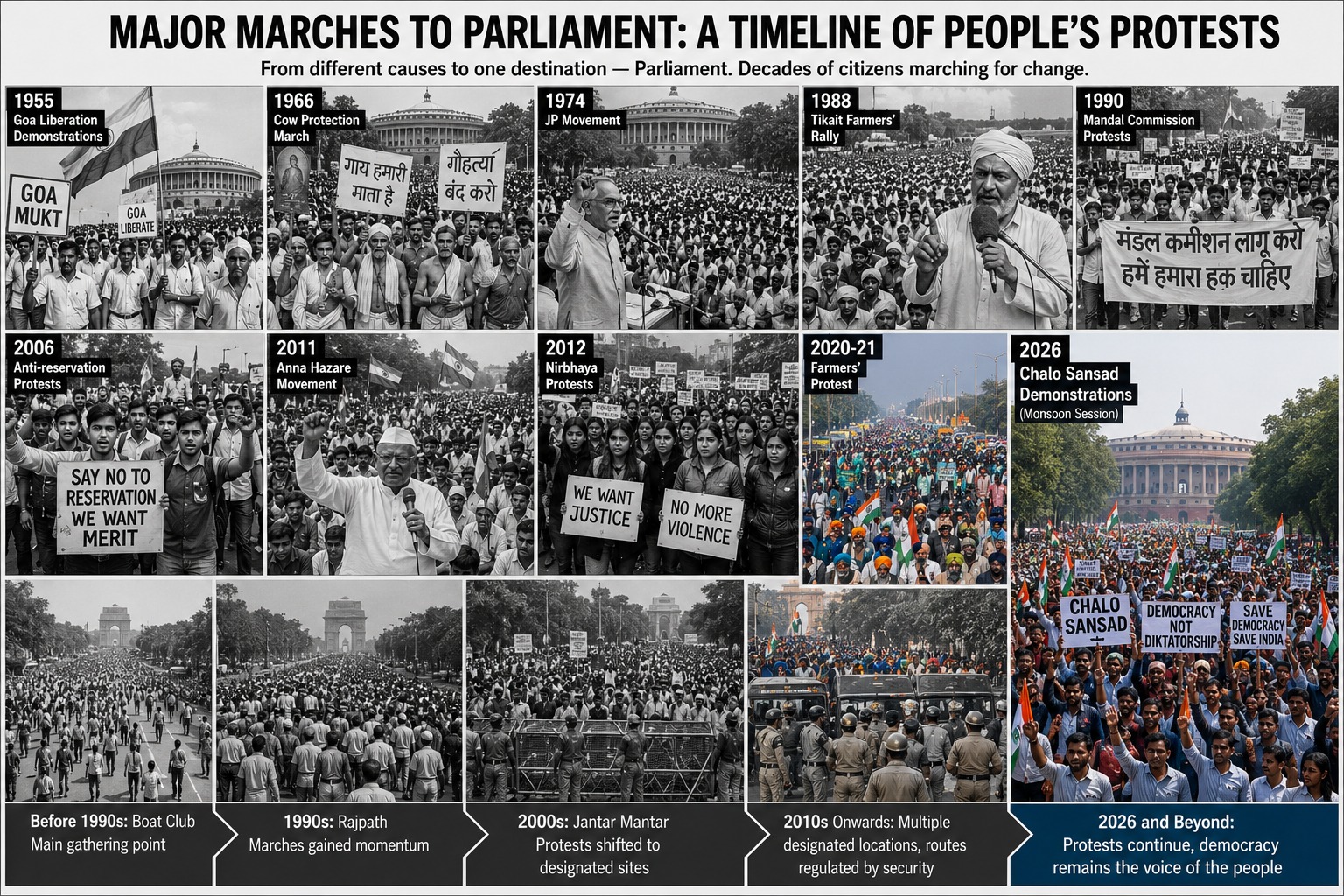
One of the earliest national campaigns centred on Goa, which remained under Portuguese control even after India’s Independence. Activists travelled to Delhi and demonstrated before the Central Government, demanding military and diplomatic action. Their sustained efforts kept the issue alive until Goa’s liberation in 1961.
These early demonstrations established an important precedent: Parliament was not isolated from public opinion but closely connected to it.
1966: When Protest Turned Violent
A defining moment came on 7 November 1966, when nearly one lakh sadhus and supporters assembled in Delhi demanding a nationwide ban on cow slaughter.
The march towards Parliament escalated into clashes with police, resulting in deaths, injuries and widespread unrest. The incident exposed the challenges of balancing the constitutional right to protest with public order.
It also permanently changed Parliament’s security architecture. Authorities strengthened barricading, crowd management and policing around the Parliament complex—measures that continue to evolve even today.
The JP Movement: Democracy’s Turning Point
If one Parliament march changed Indian politics forever, it was the movement led by Jayaprakash Narayan in 1974.
What began as a student protest against corruption and inflation in Bihar soon transformed into a nationwide campaign demanding accountability and electoral reforms. JP’s call for “Sampoorna Kranti” (Total Revolution) resonated with millions.
Large demonstrations in Delhi placed enormous pressure on the government. Although the movement eventually led to the declaration of the Emergency in 1975, it also united opposition parties and energised democratic participation across the country.
When the Emergency ended and elections were held in 1977, the Congress Party lost power at the Centre for the first time. The JP Movement proved that sustained public mobilisation could reshape India’s political future.
Farmers Discover Their Collective Voice
The 1980s witnessed the rise of farmers as one of India’s most influential political constituencies.
In 1988, Bharatiya Kisan Union leader Mahendra Singh Tikait brought hundreds of thousands of farmers to Delhi. Their demands focused on better sugarcane prices, electricity subsidies, irrigation and debt relief.
The scale of the mobilisation forced policymakers to acknowledge agriculture as a central political issue. It also demonstrated that Parliament was not only a forum for elected representatives but also a destination where organised citizens could influence national priorities.
That tradition would continue into the twenty-first century.
Mandal and the Politics of Social Justice
Few decisions generated as much public debate as the implementation of the Mandal Commission recommendations in 1990.
As reservations for Other Backward Classes in government jobs were introduced, Delhi witnessed intense demonstrations by both opponents and supporters of the policy. Students marched towards Parliament, universities became centres of political debate and social justice emerged as one of India’s defining electoral issues.
The protests revealed how Parliament marches often reflected larger transformations within Indian society rather than isolated political disagreements.
The Security Shift After 2001
The terrorist attack on Parliament on 13 December 2001 marked another turning point.
Although unrelated to public protests, the attack fundamentally altered security arrangements around Parliament. Access became tightly controlled, surveillance increased and designated protest sites such as Jantar Mantar assumed greater importance.
The balance between ensuring national security and protecting the constitutional right to peaceful protest became an increasingly complex challenge for successive governments.
Anna Hazare and the Digital Revolution
The anti-corruption movement led by Anna Hazare in 2011 redefined public mobilisation in India.
Unlike earlier movements that depended primarily on political parties or unions, the campaign attracted students, professionals, retirees and urban middle-class citizens. Television news channels provided continuous coverage, while Facebook, Twitter and SMS campaigns mobilised supporters on an unprecedented scale.
Although centred at Jantar Mantar and Ramlila Maidan, repeated calls to march towards Parliament placed anti-corruption legislation at the heart of national debate.
The movement demonstrated that in the digital age, street protests and online campaigns could reinforce each other, giving Parliament marches a new dimension.
The Nirbhaya Movement and Public Conscience
In December 2012, thousands of young Indians spontaneously gathered near India Gate and Parliament following the brutal gang rape of a young woman in Delhi.
The protests transcended political affiliations. Citizens demanded stronger laws, faster trials and greater accountability for crimes against women.
The demonstrations eventually led to the Justice Verma Committee and sweeping amendments to India’s criminal laws relating to sexual offences.
Once again, public mobilisation had translated into legislative reform.
Farmers Return to the Capital
Perhaps no movement in recent history illustrates the enduring power of Parliament marches more than the farmers’ protest of 2020–21.
Opposing three central farm laws, thousands of farmers established camps on Delhi’s borders for more than a year. Although security restrictions prevented unrestricted access to Parliament, several symbolic marches were organised during parliamentary sessions.
The movement remained largely peaceful despite prolonged negotiations.
In November 2021, the Union Government repealed the three farm laws, making it one of the rare instances where sustained public protest directly resulted in the withdrawal of major legislation.
For many observers, it reaffirmed that democratic pressure could still influence policymaking in India.
Women’s Voices Grow Stronger
Women’s organisations have consistently used Parliament as the focal point for campaigns seeking equal rights, workplace safety, legal reforms and political representation.
For decades, activists marched demanding one-third reservation for women in Parliament and State Assemblies.
Their long campaign culminated in the passage of the Nari Shakti Vandan Adhiniyam in 2023, demonstrating that even movements stretching across generations can eventually reshape legislation.
The Changing Face of Protest
Today’s Parliament marches look very different from those of the 1950s.
Handwritten banners have been replaced by digital graphics. Leaflets have given way to hashtags. Organisers coordinate through encrypted messaging platforms rather than neighbourhood meetings. Livestreams allow demonstrations to reach millions instantly.
Yet one thing has remained remarkably constant.
The symbolic destination is still Parliament.
Whether the demand concerns employment, education, climate change, farmers’ welfare, women’s rights, pensions or constitutional values, citizens continue to believe that their voices carry the greatest weight when directed towards the nation’s legislature.
Why the Tradition Endures
Every Parliament march reflects a larger truth about Indian democracy: elections are only one form of political participation.
The Constitution guarantees citizens the right to freedom of speech and peaceful assembly. Public demonstrations, when conducted peacefully, allow people to express concerns between elections and remind governments that democratic accountability is continuous.
Not every march results in immediate policy change. Some end with negotiations, others fade away and a few are remembered only as historical episodes. Yet together they contribute to public debate, influence political priorities and shape the national conversation.
The Road Ahead
The demonstrations unfolding during the current Monsoon Session are the latest chapter in a tradition that began in the earliest years of the Republic. While today’s protesters carry different demands from those who marched in 1955, 1974 or 2011, they share the same democratic conviction—that Parliament must remain responsive to the people it represents.
From the Goa Liberation campaign to the JP Movement, from Mahendra Singh Tikait’s farmers’ rally to Anna Hazare’s anti-corruption campaign, from the Nirbhaya protests to the farmers’ movement and the contemporary “Sansad Chalo” marches, India’s democratic journey has repeatedly unfolded both inside and outside Parliament.
The debates within Parliament may shape legislation, but the voices on the streets often shape those debates. Together, they form two inseparable pillars of the world’s largest democracy. As another Parliament session witnesses citizens gathering outside its gates, history reminds us that the road to Parliament has never belonged only to politicians—it has always belonged to the people.