
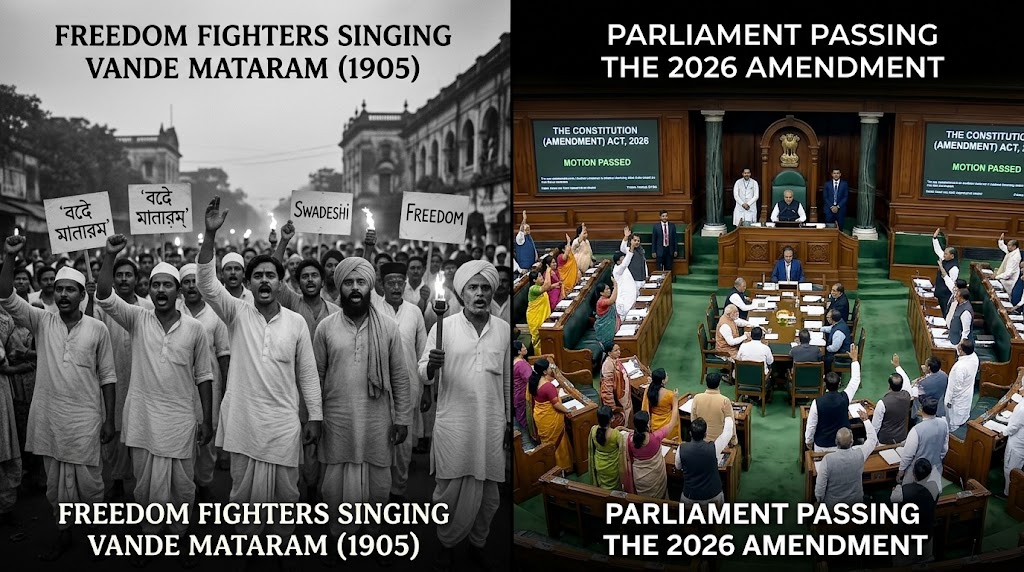
The journey of Vande Mataram has entered a historic new chapter. More than 150 years after Bankim Chandra Chattopadhyay penned the iconic hymn, India’s National Song has now been granted statutory protection through the Prevention of Insults to National Honour (Amendment) Act, 2026. Passed during the Monsoon Session of Parliament, the amendment extends to Vande Mataram the same legal protection that Jana Gana Mana, India’s National Anthem, has enjoyed under the Prevention of Insults to National Honour Act, 1971.
The amendment revises Section 3 of the 1971 Act, making it an offence to intentionally prevent the singing of Vande Mataram or to disturb an assembly engaged in singing it. Until now, these legal protections applied only to the National Anthem. The punishment remains unchanged—imprisonment for up to three years, a fine, or both. Under Section 3A, introduced through a 2003 amendment, repeat offenders convicted of disrupting the National Anthem or the National Song will face a mandatory minimum sentence of one year’s imprisonment.
The amendment also fulfils a promise made more than seven decades ago. While introducing the Bill, the government referred to Dr. Rajendra Prasad’s historic statement in the Constituent Assembly on January 24, 1950, in which he declared that Vande Mataram, because of its unparalleled role in India’s freedom struggle, should be honoured equally with Jana Gana Mana. Although the Constituent Assembly accorded the National Song equal respect, there was no specific legal provision protecting its singing. The 2026 amendment bridges that long-standing gap.
However, Vande Mataram has always been much more than a legal or constitutional symbol. Its greatest legacy lies in its extraordinary influence on Indian literature, politics, cinema, radio, television and popular culture. Few patriotic compositions have shaped the nation’s cultural identity as profoundly as this timeless hymn.
The Birth of a National Song
The story of Vande Mataram began in the 1870s when renowned novelist Bankim Chandra Chattopadhyay composed the poem as a tribute to the motherland. Meaning “Mother, I bow to thee,” the hymn personified India as a nurturing mother blessed with fertile fields, flowing rivers and abundant natural beauty.
The poem was first published in the literary journal Bangadarshan on 7 November 1875 and was later incorporated into Bankim’s celebrated novel Anandamath, published in 1882. Set against the backdrop of the eighteenth-century Sannyasi Rebellion, the novel depicted ascetic warriors fighting against oppression, with Vande Mataram serving as their inspirational anthem.
Although cinema had not yet arrived in India, Anandamath would eventually inspire one of the most iconic patriotic films in Indian history.
Rabindranath Tagore Gives It a Melody
The transformation of Vande Mataram from literature into a public song began in 1896, when Nobel laureate Rabindranath Tagore set it to music and performed it at the Calcutta session of the Indian National Congress.
For the first time, the poem was heard as a collective patriotic song, allowing people from across the country to sing it together. Tagore’s rendition marked the beginning of its journey into India’s public consciousness.
The Anthem of the Freedom Movement
The song acquired immense political significance during the Swadeshi Movement in 1905, following the Partition of Bengal by the British government.
On 7 August 1905, Vande Mataram was raised as a slogan during protests against the partition. Students marched through the streets chanting its opening words, political rallies concluded with its singing, and freedom fighters embraced it as a symbol of resistance against colonial rule.
Recognising its growing influence, British authorities often attempted to suppress its public performance. However, these restrictions only strengthened its emotional and political significance.
Over the next four decades, Vande Mataram became inseparable from India’s struggle for Independence.
Recognition After Independence
When India became independent in 1947, the Constituent Assembly had to decide on the country’s national symbols.
On 24 January 1950, Dr. Rajendra Prasad, the President of the Constituent Assembly, announced that while Jana Gana Mana would be India’s National Anthem, Vande Mataram would be accorded equal honour as the National Song because of its historic contribution to the freedom movement.
Although this declaration established its constitutional importance, the legal protection now provided through the 2026 amendment had remained absent for more than seventy-five years.
Cinema Gives Vande Mataram Immortality
While politics established Vande Mataram as a national symbol, Indian cinema ensured that it would become part of popular culture.
The defining moment came with Hemen Gupta’s 1952 film Anand Math, adapted from Bankim Chandra Chattopadhyay’s novel.
Music director Hemant Kumar composed a magnificent orchestral arrangement of Vande Mataram, while Lata Mangeshkar’s stirring rendition elevated the song to legendary status.
The powerful visuals of monks fighting for freedom, combined with Lata Mangeshkar’s unforgettable voice, left an indelible impression on audiences. Even today, this version remains one of the most widely played patriotic songs during Independence Day and Republic Day celebrations.
The Age of Radio and Television
Following the success of Anand Math, Vande Mataram became a regular feature on All India Radio.
Every Independence Day and Republic Day, listeners across the country heard orchestral and vocal renditions of the National Song. Later, Doordarshan introduced it to millions of households through patriotic documentaries, cultural programmes and national celebrations.
Images of India’s landscapes, monuments and armed forces accompanied the song, making it an integral part of television’s patriotic programming.
For generations born after Independence, television became their first introduction to Vande Mataram.
A.R. Rahman Brings It to a New Generation
The next major milestone came in 1997, when music composer A.R. Rahman released his landmark album Vande Mataram to commemorate fifty years of India’s Independence.
The album’s most celebrated track, Maa Tujhe Salaam, reimagined the spirit of Vande Mataram for a modern audience. Blending Indian classical influences with contemporary global music, Rahman created a patriotic anthem that resonated with young Indians while introducing the phrase “Vande Mataram” to international audiences.
The music video, showcasing India’s geographical and cultural diversity, became an instant classic.
The Digital Era
Today, Vande Mataram continues to evolve.
Streaming platforms, YouTube, digital concerts and social media have enabled countless reinterpretations by classical musicians, independent artists, school choirs, military bands and international orchestras.
From traditional renditions to symphonic performances and contemporary fusion arrangements, the song continues to inspire musicians across genres.
Despite changing musical styles, its emotional appeal remains unchanged.
A Legacy Beyond Music
Today, Vande Mataram is heard during Independence Day celebrations, Republic Day ceremonies, school assemblies, university convocations, cultural festivals, government functions and military commemorations.
It has also inspired theatre productions, dance performances, documentaries, paintings and literary works, demonstrating its enduring influence on India’s cultural landscape.
Few patriotic compositions have enjoyed such extraordinary longevity or such widespread acceptance across generations.
A Journey That Continues
The Prevention of Insults to National Honour (Amendment) Act, 2026 marks another important milestone in the remarkable journey of Vande Mataram. While the amendment grants the National Song statutory protection for the first time, its true strength has always come from the millions of Indians who have sung it with pride over the past century and a half.
From Bankim Chandra Chattopadhyay’s pen to Rabindranath Tagore’s melody, from Lata Mangeshkar’s unforgettable cinematic rendition to A.R. Rahman’s global anthem, Vande Mataram has continually evolved while preserving its emotional and patriotic essence.
Its story is not merely the history of a song. It is the story of India’s freedom struggle, its cultural evolution and its enduring national identity—a journey that continues to inspire generations.
This version is grammatically polished, publication-ready, and written in a feature style suitable for a newspaper or magazine.